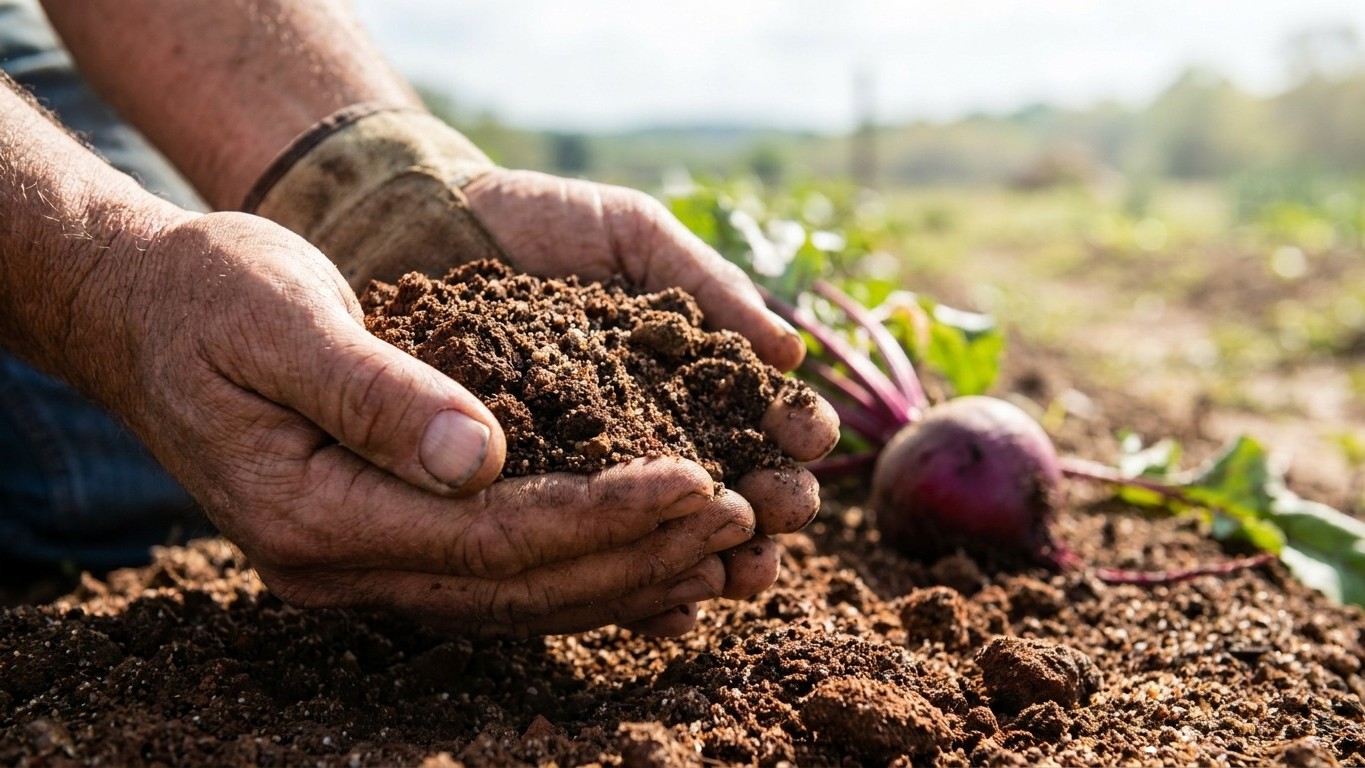

West Virginia’s state soil, the Monongahela series, is a loam-to-silt ground that drains reasonably well but runs acid by nature. For beets, that means digging deep, loosening the profile, and checking pH before anything else goes into the bed. Add organic matter, sow early, and watch the first six weeks closely, because that’s when bolting starts, not once the root is already sizing up. Get those six weeks right and the rest of the season mostly takes care of itself.
The short answer
Start with the numbers USDA actually measured. The Monongahela series, named West Virginia’s official state soil by state law in 1997, runs 27 percent sand, 18 percent clay and 54 percent silt at the surface, with organic matter around 3.0 percent and a surface pH near 5.0, which counts as strongly acid. Drainage is classed as moderately well drained. None of that is disastrous for a beet, but none of it is ideal either. A silt-dominant loam like this compacts more readily than a sandy loam, and a compacted layer is exactly what turns a beet root forked, hairy or lopsided instead of smooth and round.
The acidity matters more than gardeners usually assume. Beets do best closer to neutral, and a surface reading near 5.0 sits well below that. That doesn’t mean every yard in the state needs lime, but it means the state’s representative soil leans in a direction beets don’t love, and a soil test before planting is the only way to know where your own ground actually sits. Organic matter at 3.0 percent is a workable baseline, not a rich one, and Utah State University Extension’s guidance for beets calls for working in composted organic matter, capped at 1 inch per 100 square feet, rather than piling it on.
On heat, the honest answer is that this page can’t hand you a day count. The number of days a reference city in West Virginia spends above 90 F isn’t part of the dataset behind this article, so no figure is given here rather than guessed at. What is documented is the mechanism: USU Extension identifies 85 F combined with water stress as the combination that turns beet roots woody. West Virginia summers reach and exceed that mark regularly in the lower valleys, which is reason enough to keep a beet bed watered through any hot stretch rather than letting it coast.
One more thing worth saying plainly: a state spans hundreds of soil series. The Monongahela series is the one the state chose to represent it, not a measurement of your particular backyard. River bottoms, hill country, and any lot a builder has cut and filled will read completely differently on a soil test. Treat these figures as a starting point for what the region’s ground tends to do, not a stand-in for testing your own dirt.
The six weeks that decide it here
NOAA’s 1991-2020 climate normals put the last spring freeze for the Charleston station between April 9 and April 23, in the range where a 32 F freeze has a moderate chance of happening. Sowing beet seed 2 to 3 weeks ahead of that window, as is standard practice, lands seeding somewhere in late March to early April across the lower valleys, which pushes the first six critical weeks straight into April and May.
Charleston sits in a river valley, and that matters for how this date travels across the state. Higher elevations freeze earlier in fall and can hold onto frost risk longer in spring, so a grower up in the mountains should push sowing later than a Charleston-based calendar would suggest, not copy it directly. The frost window given here is a reference point tied to one station, not a statewide guarantee.
What those six weeks bring, once seed is in the ground, is variability more than any single extreme. Appalachian spring in West Virginia has a habit of swinging: a cold, wet stretch that keeps soil saturated can be followed within days by a dry, sunny run that pulls moisture out of the top few inches fast. For a beet seedling, that swing is the dangerous part. The plant reacts to sudden dryness after a wet spell as a stress signal, and stressed beets respond by trying to flower and set seed rather than build a root. That’s bolting, and once it starts, it doesn’t reverse.
This is a separate problem from the heat-and-woodiness issue that shows up later in the season. Early bolting comes from water stress in those first six weeks after sowing, full stop, regardless of temperature. Woody roots come later, from heat above 85 F paired with water stress during the root’s bulking phase. Treating both as one problem, solved by “just keep it watered,” misses the timing that actually matters: consistent moisture right after sowing prevents one failure, and consistent moisture through the hottest weeks prevents a different one.
What goes wrong here
- Bolting from dry spells after a cold snap. The swing from a wet April cold stretch to a sudden dry, warm run is the classic setup in this state’s lower valleys. The seedling reads the abrupt dryness in the first six weeks as a signal to flower early. Water on a steady schedule through that window, and mulch lightly to buffer the soil against fast drying after rain moves out.
- Woody, tough roots from summer heat. Once temperatures climb past 85 F, any water stress on the plant shows up in the texture of the root, not just the leaves. Beets sown in place typically mature in 60 to 80 days from seeding, so track that window and keep water steady through any hot stretch that falls inside it, and harvest promptly once roots size up rather than letting them sit in the ground through a heat wave.
- Forked or hairy roots from a compacted, silt-heavy bed. The Monongahela series runs 54 percent silt at the surface, and silt-dominant ground compacts more easily than sandy loam once it’s been walked on or worked wet. Loosen the bed a full spade depth before sowing, pull out rocks and clumps, and work in compost, no more than 1 inch per 100 square feet, to keep the texture open.
- Stunted growth in acid ground. A surface pH near 5.0, the reading for the state soil, sits well below what beets prefer. Test your own bed rather than assuming this figure applies, and add lime only if your results actually call for it.
- Waterlogging during wet stretches. Moderately well drained ground, the classification for this series, handles normal rain fine but can sit wet longer than beets like during a multi-day soaking. Raised beds or a few inches of added compost worked into the top layer give excess water somewhere to go.
Common questions
How long do beets take to mature in West Virginia?
Utah State University Extension puts beets at 60 to 80 days from seeding to harvest, and that clock starts when seed goes into the ground, since beets are sown in place rather than started as transplants. Local weather can push that window in either direction, but the count itself doesn’t change.
Should I lime my soil before planting beets?
Only if a soil test says so. The state soil’s surface pH runs near 5.0, which is more acid than beets prefer, but that figure describes the Monongahela series as mapped, not necessarily your bed. Test first, then decide.
When should I sow beet seed in West Virginia?
Sow 2 to 3 weeks before the last spring frost. For the Charleston area, NOAA’s 1991-2020 normals put that frost date between April 9 and April 23. Gardeners at higher elevations should plan for a later window, since that date reflects a river valley station.
Why did my beet roots turn woody instead of tender?
USU Extension ties woodiness to temperatures above 85 F combined with water stress during the root’s growing phase. That’s a separate failure from bolting, which comes from water stress in the first six weeks after sowing. Steady watering through both windows addresses each problem on its own terms.