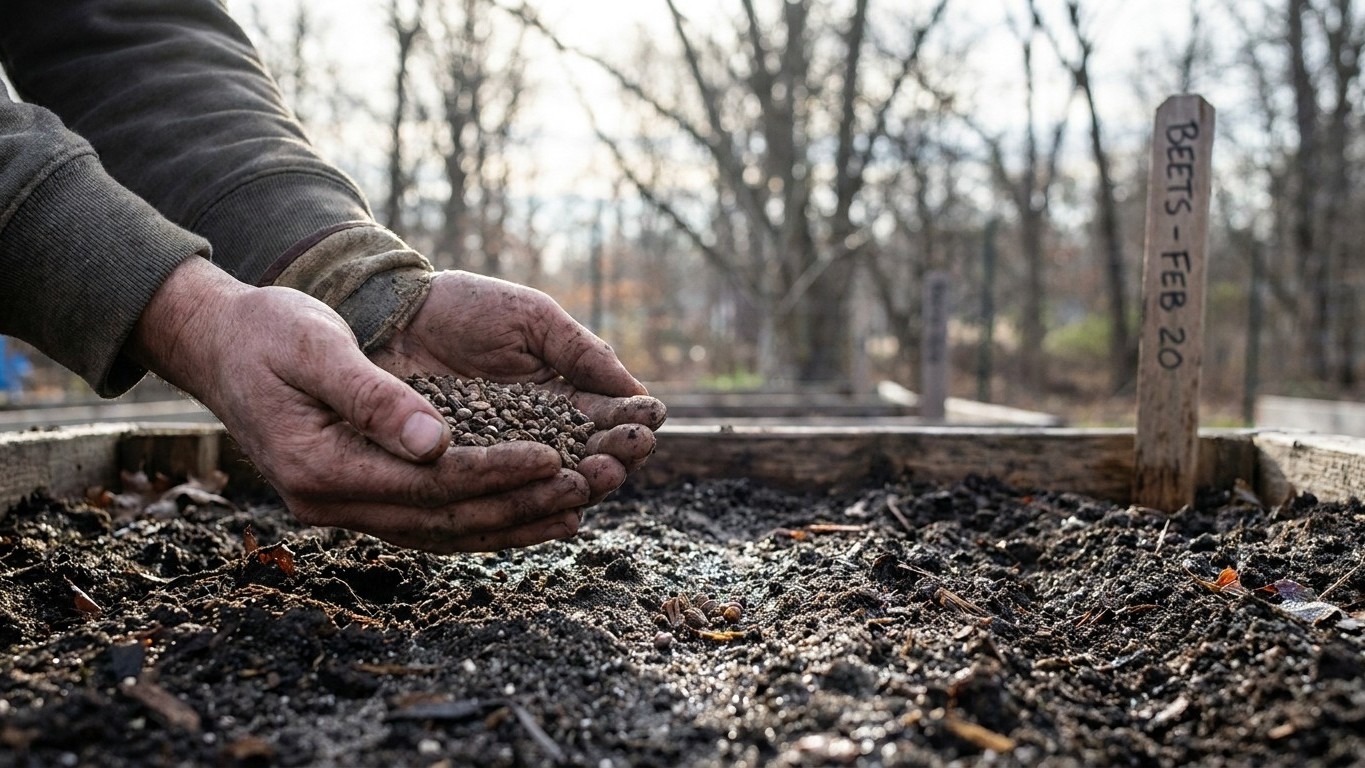

Sow beet seed directly outdoors two to three weeks before the last spring frost. For the NOAA station that anchors Wyoming’s official climate normals, that frost falls somewhere between May 7 and May 18, which puts a typical sowing window in mid-to-late April at lower elevations, and later wherever the ground sits higher or colder pockets linger into early June.
The short answer
Wyoming’s representative soil, the Forkwood series, is an Aridisol, a soil type that forms under low rainfall and tends to run alkaline and carry salts near the surface. Its surface pH sits around 7.2, close to neutral, and the texture comes in as a loam to silt: 42 percent sand, 20 percent clay, 38 percent silt, with organic matter around 1.5 percent and good drainage. That combination is workable for beets, whose main ask is deep, well-drained ground with enough organic matter to hold moisture evenly. The drainage is on the gardener’s side here. The organic matter is not: 1.5 percent is thin, and beets grown in ground this lean will dry out faster between waterings than the same bed built up with the compost most guides recommend, capped at roughly 1 inch per 100 square feet so the soil doesn’t get soft and salt-loaded on top of what an Aridisol already tends to carry.
That’s the mineral picture. The heat picture is where this page has to stop short of guessing. Woodiness in beet roots shows up when temperatures push above 85 degrees Fahrenheit while the soil is also dry, and how often that combination hits depends entirely on where in Wyoming a garden sits. The state runs from roughly 3,100 feet in the east to well over 13,000 feet in the mountains, and no single count of 90-degree days applies across that range. That figure isn’t published for a specific Wyoming location here, and rather than guess at one, the honest move is to say elevation does more work in this state than almost anywhere else: a garden at 6,000 feet is dealing with a cooler, shorter summer than one down in a low valley, and the woodiness risk shifts accordingly.
None of this replaces a look at the actual dirt in a specific yard. Wyoming spans hundreds of mapped soil series, and Forkwood is simply the one USDA designates as representative of the state as a whole. A garden built on river-bottom silt, hill-country clay, or fill dirt from a home build could behave nothing like the numbers above. Treat the Forkwood profile as a reasonable starting assumption, not a stand-in for a soil test pulled from the actual bed.
The six weeks that decide it here
Sowing two to three weeks ahead of the last frost means the first six weeks of a beet’s life land squarely in the part of the calendar NOAA marks as frost-risk season for this state, the stretch running up to May 7 through May 18 depending on the year. That window is also, by the nature of the soil that defines this state, an arid one. An Aridisol doesn’t form under generous, reliable rainfall. It forms where moisture is scarce enough that salts don’t get washed out of the profile, which is exactly what the Forkwood series shows. Translated to a spring seedbed, that means the water beet seedlings need in their first six weeks is far more likely to come from a hose or a drip line than from the sky on any dependable schedule.
This matters because that first six-week stretch is precisely when bolting risk is decided. Beets stressed for water early don’t wilt and recover the way a mature plant might; they read the stress as a signal to skip ahead to flowering, a phenomenon that shows up as an underdeveloped root topped with a seed stalk instead of a beet worth eating. In a state where the base soil type is defined by dryness rather than moisture, that risk sits higher by default than it would in a region with a wetter spring soil profile. The practical response isn’t complicated, but it is non-negotiable: once seed goes into a Wyoming bed in that mid-to-late April window, the soil needs to stay evenly moist through the six weeks that follow, regardless of what the sky happens to do that particular spring.
It’s worth separating this cleanly from what happens later. Bolting from early dryness and woodiness from later heat are two different failures with two different windows, and treating them as the same problem, solved by “just keep it watered,” undersells both. The first six weeks after sowing are about preventing bolting. The stretch of summer that follows, once roots are sizing up and temperatures climb past 85 degrees, is a separate fight, and it’s the one covered next.
What goes wrong here
- Bolting from a dry start. An arid spring on top of an Aridisol base means the first six weeks after sowing are the highest-risk stretch for premature flowering. Water on a fixed schedule through this period rather than waiting for visible wilting, since by the time a beet seedling looks stressed, the bolting signal may already be set.
- Crusting on the silt fraction. With silt making up 38 percent of the Forkwood profile, the surface can bake into a hard crust after a watering followed by sun and wind, which can block tender beet seedlings from pushing through. A light mulch layer or a gentle daily misting right after sowing keeps that crust from forming while seeds are germinating.
- Salt buildup near the surface. Aridisols are known for carrying salts close to the top of the profile, and adding salt-heavy fertilizers on top of that can push levels higher still. A soil test before amending, rather than a routine feeding schedule, avoids compounding a problem the base soil already has.
- Woodiness from a hot, dry midsummer. Once beets are sized and temperatures climb above 85 degrees Fahrenheit, any lapse in watering toughens the root. This is a separate failure from bolting and shows up later in the season; steady moisture through midsummer, not just at sowing, is the only fix.
- Frost showing up out of season. At higher elevations in this state, frost can occur in any month, and the May 7 to May 18 window from the reference station doesn’t apply uniformly across elevation bands. Row cover on hand through late spring, and a willingness to push the sowing date later at elevation, guards against a killing frost the station-level date wouldn’t predict for that specific garden.
Common questions
Do beets need to be started indoors and transplanted in Wyoming?
No. Beets are direct-seeded, and the 60 to 80 days most guides cite to maturity count from the day seed goes into the ground, not from a transplant date. Starting them indoors and moving seedlings out doesn’t shorten that clock and can disturb the taproot in a way that misshapes the beet.
Does elevation actually change when I should sow?
Yes, more in Wyoming than in most states. The frost-free season runs roughly 130 days at 6,000 feet, and frost remains possible in any month at higher elevations. The May 7 to May 18 window applies to the specific NOAA reference station, not to every elevation band in the state, so a garden sitting well above or below that station’s elevation should adjust the sowing date toward its own local frost history rather than the station figure alone.
Should I test my own soil before planting, given the state soil data above?
Yes. The Forkwood series is the soil USDA lists as representative of Wyoming, not a description of any individual garden. The state contains hundreds of mapped soil series, and river bottoms, hillsides, and any yard that’s been graded or filled during construction can differ completely from the Forkwood profile. A soil test on the actual bed is the only way to know its real texture, pH, and salt level.
How do I tell whether I’m dealing with bolting or woodiness?
They show up at different points and look different. Bolting appears early, within the first six weeks after sowing, as a seed stalk rising from an underdeveloped root, and it traces back to water stress during that early window. Woodiness shows up later, once temperatures have pushed past 85 degrees Fahrenheit, and it’s a toughening of an otherwise properly sized root caused by dryness during the hot stretch of summer. One is an early-season failure, the other a midsummer one, and they call for watering attention at two different points in the calendar rather than one blanket fix.