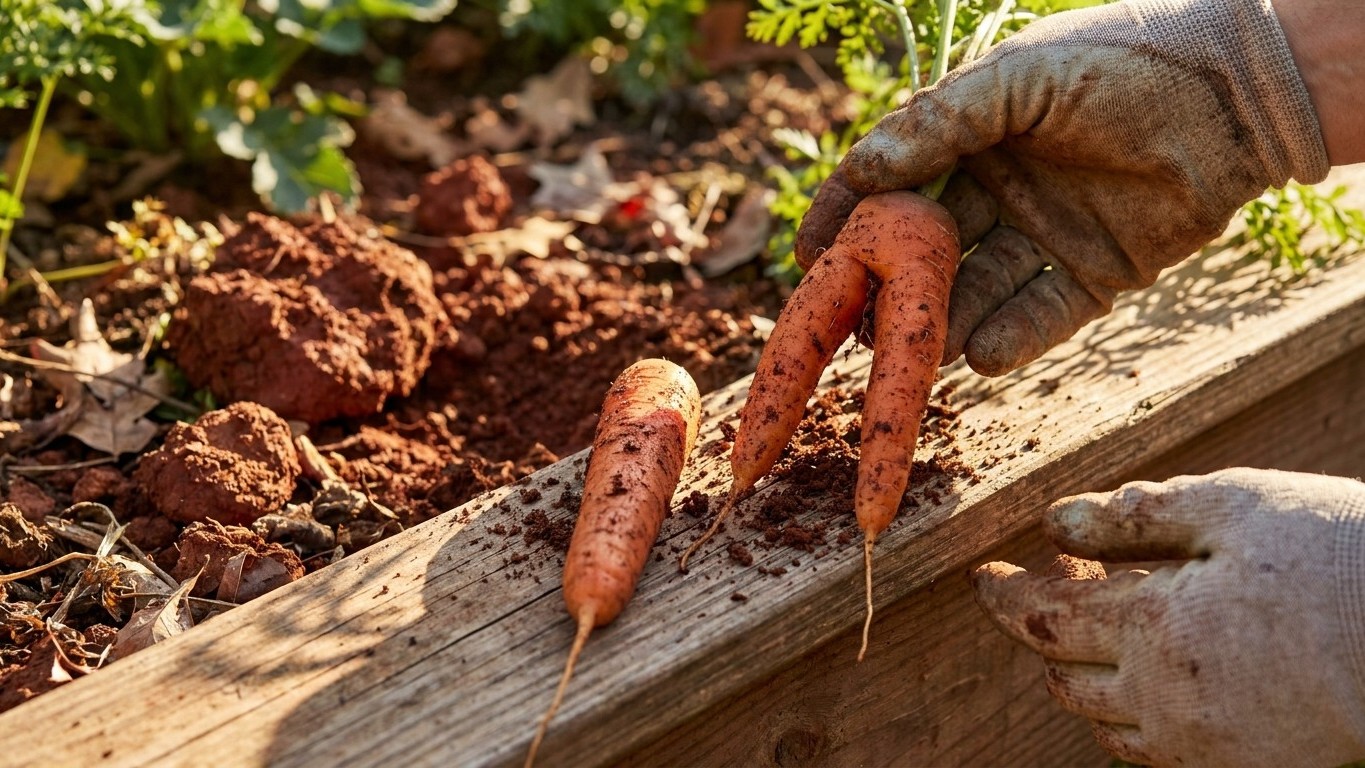

Wyoming’s representative soil, the Forkwood series, runs 42 percent sand, 20 percent clay and 38 percent silt with good drainage and a near-neutral surface pH of 7.2. That’s a loam, not a heavy clay pan, so carrots planted in ground like this generally push down straight rather than splitting into two or three legs. The catch is organic matter: at roughly 1.5 percent, this soil is lean, and lean soil still benefits from compost before you sow.
The short answer
Start with the number that matters most for a root vegetable: texture. The Forkwood series, which USDA NRCS lists as representative of Wyoming, breaks down to 42 percent sand, 20 percent clay and 38 percent silt in its surface layer. That combination lands in loam territory rather than the sticky, compacted clay that stops a carrot root cold and forces it to split around a rock or a hard clod. The series is also classed as well drained, which matters just as much as texture. Carrots hate sitting in soggy ground; wet, airless soil slows root elongation and invites the kind of uneven growth that shows up as forking or stubby, twisted roots.
So the plain answer, for soil that matches this profile: forking is not the default outcome. A well-drained loam with only 20 percent clay gives a taproot enough room to move down without much resistance. What this soil doesn’t hand you for free is fertility. Organic matter sits around 1.5 percent, which is on the thin side. Utah State University Extension notes that carrots want deep, sandy, well-drained soil rich in organic matter, and that heavy or rocky ground makes the root fork, with plenty of compost and double digging as the fix for heavy soil. Here the soil isn’t the heavy culprit, but the low organic matter still calls for the same remedy: work in compost before you sow, not after the roots are already growing.
The surface pH of 7.2 sits close to neutral, which is a comfortable range for most root crops and shouldn’t need correction on its own. Where this soil can still trip up a gardener is stoniness and compaction below the surface. A “well drained, loam” label describes the top horizon; it says nothing about a rocky layer six inches down, or about a yard that got compacted by construction equipment before a house was built. If you hit resistance, rock, or a hardpan while digging, double digging or building a raised bed with loose, deep fill solves the problem regardless of what the county soil map says.
None of this is a verdict on your particular backyard. Wyoming spans hundreds of soil series, from sandy benches to heavy river-bottom clay to fill dirt trucked in around a new subdivision. The Forkwood series is simply the one USDA records as representative of the state as a whole. Treat the numbers above as a starting point for a conversation with your own dirt, not a diagnosis of it.
The test that settles it in your own garden
State averages tell you what to expect in general. Your raised bed or backyard plot is a different story, and the only way to know for certain is to look, feel and time your own ground.
- Dig a hole at least a foot deep. Carrots need room to run before they hit anything solid. If you strike a hard, compacted layer, a dense clay band, or a shelf of rock well before that depth, that’s your forking risk right there, no matter what the regional soil survey says.
- Check for stones and hard clumps as you go. Sift a handful of soil from different depths through your fingers. Pebbles, gravel and stubborn clods force a taproot to split or curve around them. If you’re pulling out a lot of rock, that bed needs sifting or a switch to loose, amended fill.
- Feel the texture between your fingers. Wet a small amount and rub it. Gritty and loose points toward sand; slick, sticky and moldable points toward clay; something in between that holds a shape but crumbles easily is closer to loam, the texture carrots prefer.
- Watch how water moves through it. Dig a hole, fill it with water, let it drain, then fill it again and time the second drain. Water that disappears within a few hours suggests decent drainage. Water that still sits there the next day is a sign of compaction or heavy clay, and that’s a bed better suited to raised construction than to direct digging.
Run through these four checks before you commit a whole row of seed to the ground. It takes less than an afternoon, and it tells you far more about your own carrots’ odds than any state-level soil description ever will.
What goes wrong here
Even where the base soil leans favorable, a handful of predictable problems show up in home gardens working with loam-textured, well-drained ground like Wyoming’s representative series.
- Forking where soil is compacted or filled. The Forkwood series itself is well drained and reasonably loose, but many home plots sit on disturbed, trucked-in, or heavily walked-on ground that behaves nothing like the mapped series. If a taproot meets a hard layer or a buried rock, it splits. The fix is the same one Utah State University Extension gives for heavy soil generally: work compost deep into the bed and double dig, or build a raised bed with loose fill so roots never meet resistance.
- Poor germination during a hot, dry stretch. Carrot seed is small and sits shallow, so it dries out fast once surface soil heats up. In loam with only about 1.5 percent organic matter, there’s less material to hold moisture near the seed. Keep the top inch consistently damp, with light, frequent watering, until seedlings are up and rooted.
- Splitting from uneven watering. A root that grows steadily and then gets a sudden heavy soak (after a dry spell) can crack along its length as it swells too fast. Water on a regular schedule instead of letting the bed dry out completely between soakings, especially once roots are sizing up.
- Stunted or misshapen roots in lean soil. Organic matter around 1.5 percent isn’t rich soil. Roots grown without added compost tend to come out short, forked at the tip, or oddly thin. Mixing compost into the bed before sowing gives the developing root the loose, fertile column it needs to grow long and straight.
Common questions
Does a pH of 7.2 mean I need to add sulfur or lime before planting carrots?
A surface pH of 7.2 is close to neutral and sits within a workable range for carrots without correction. That figure describes the representative Forkwood series though, not necessarily your own bed, so a simple home soil test is the only way to know your actual number before deciding to amend.
How deep should I dig if my soil resembles this Wyoming series?
USDA NRCS doesn’t publish a required digging depth for a home garden bed, only the composition and drainage class of the surface soil. A general rule from Utah State University Extension is that heavy or obstructed soil should be double dug, which typically means loosening well beyond the top few inches so a root has clear room to elongate.
Is low organic matter (1.5 percent) a bigger problem than the clay content?
For this particular soil, likely yes. At 20 percent clay, the texture is loam, not heavy clay, so structural forking risk is modest. But 1.5 percent organic matter is on the lean side, and Utah State University Extension is clear that carrots want soil rich in organic matter. Compost addresses that gap directly.
Are carrots transplanted, or should I sow seed straight into this soil?
Carrots are sown directly in place; they are not transplanted. Any days-to-maturity figure you see for a carrot variety is counted from the seeding date, not from a transplant date, because there isn’t one for this crop.