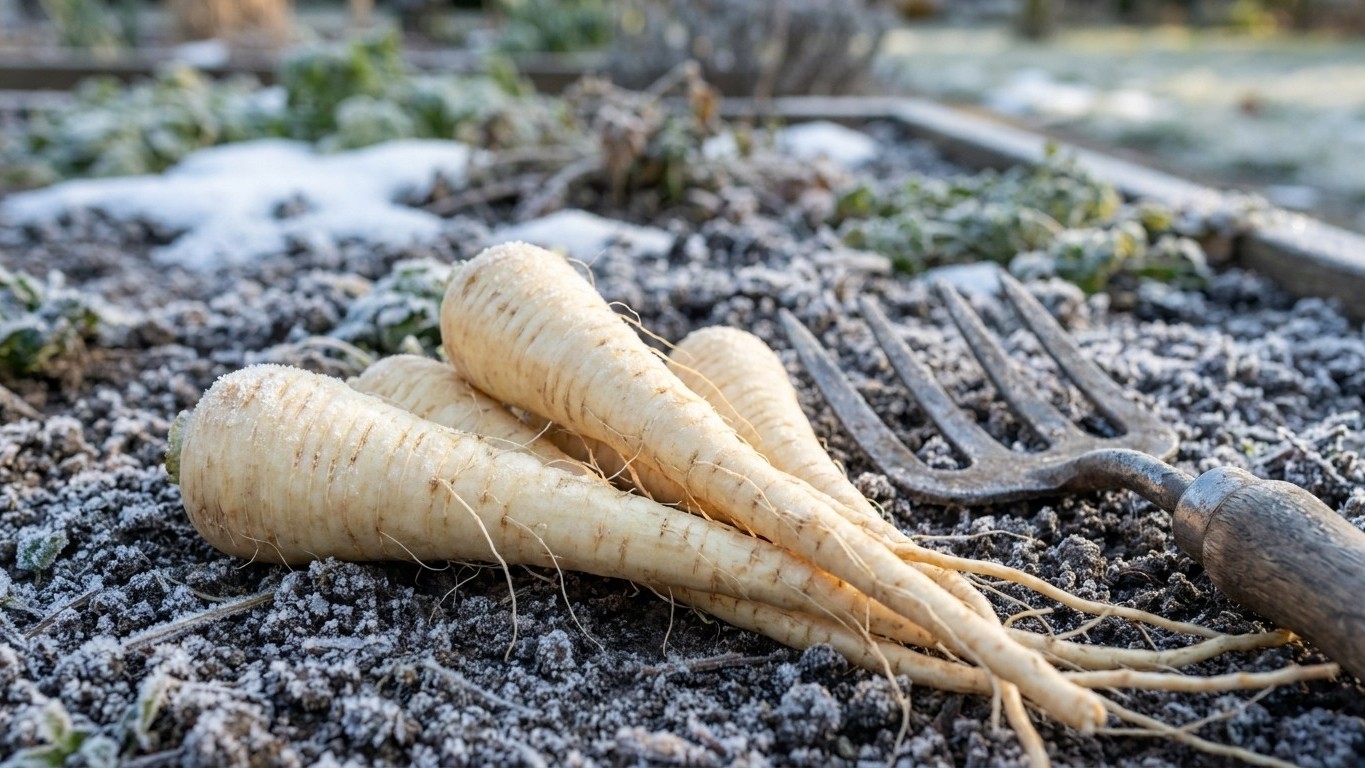

Parsnips need real, sustained cold to taste like anything worth eating. Utah State University Extension is direct about it: the roots taste best only after several weeks of cool, frosty weather have converted their stored starch into sugar. Skip that cold spell and you get a starchy, faintly bitter root instead of the sweet one gardeners rave about, which is exactly the kind of outcome covered in What Goes Wrong With Parsnips.
The short answer
Yes, but the answer has a condition attached. Utah State University Extension states plainly that parsnips taste best when plants have been exposed to several weeks of cool, frosty weather, because that cold is what converts the starch stored in the root into sugar. This isn’t a minor flavor tweak. It’s the difference between a root that tastes like a bland carrot cousin and one that tastes genuinely sweet, almost candy-like when roasted.
The same source adds a detail that changes how a lot of gardeners harvest: roots left in the ground and lifted in early spring are described as “especially tender and sweet.” That means the ideal parsnip isn’t dug in autumn at all. It’s dug after winter has already done its work on it, once the ground softens enough to get a fork or spade in.
None of this happens fast. Parsnips run 100 to 120 days from seeding to harvest, the longest timeline of any root crop grown from seed in a home garden, which is why getting the timing right at Sowing Parsnips matters so much for the whole season. That’s roughly three and a half to four months of the plant sitting in the ground doing very little that’s visible above the soil line, while the taproot slowly thickens below it, a process that starts early with steps like Thinning Parsnips to give each root room to develop. Gardeners used to quicker crops like radishes or lettuce often assume something’s wrong. Nothing is. Parsnips are simply slow by design, and the payoff comes at the very end of the process, when Harvesting Parsnips happens after frost, not before it.
This is also where geography and Parsnip Soil conditions matter more than most seed packets let on. A hardiness zone rating tells you whether a plant survives winter. It says nothing about whether that winter is cold enough, for long enough, to trigger the starch-to-sugar conversion. A region with a mild, frost-light winter can grow a perfectly healthy parsnip plant that never becomes genuinely sweet, because the mechanism depends on frost exposure itself, not on simply surviving the season.
What actually decides it
Cold makes the sugar
The sweetening mechanism is specific: several weeks of cool, frosty weather trigger the conversion of starch stored in the root into sugar. This is a metabolic response to cold stress, not a slow ripening that happens on any calendar schedule, and it explains Why Parsnips Need Frost to Taste of Anything. A parsnip pulled in September, before any real frost, and one pulled in late winter from the same row will taste noticeably different, even though both grew in identical soil. The zone number on a seed packet or extension map tells you about winter survival. It says nothing about whether your particular stretch of cold was long enough or hard enough to do the sugar conversion. That’s a separate question, and it’s the one that actually decides whether growing parsnips in a given spot is worth the four-month commitment.
Two separate reasons a parsnip forks
Forked roots are the most common frustration with this crop, and there are two distinct, unrelated causes behind it. The first is the ground itself. Utah State University Extension notes that parsnips prefer fertile, well-drained, deep, sandy soils rich in organic matter, and that heavy soils need to be amended with plenty of compost and should be double dug to allow good root development. A taproot pushing down through compacted clay or a bed full of rocks will split around the obstruction rather than growing straight, producing the forked, twisted roots gardeners find at harvest.
The second cause has nothing to do with soil texture. Overwatering causes hairy roots to form, and forking may occur as a direct result of too much moisture, independent of how well the bed was prepared. A gardener who double-dug a perfect bed can still end up with forked, hairy roots simply by watering too generously. These are two separate mechanisms producing the same visible problem, and treating them as one issue means fixing the wrong half of it.
How to do it
- Prepare the bed first. Work in plenty of compost, and if the soil is heavy, double dig it to loosen the ground well below where the taproot will develop. Parsnips prefer fertile, well-drained, deep, sandy soils rich in organic matter, and a compacted bed is the single most preventable cause of forked roots.
- Wait for soil temperature, not just the calendar. Sow two to three weeks before the last frost, once the soil has warmed to at least 40 F. Germination is best between 55 and 65 F, so a bed that’s still cold and wet will sit and do nothing.
- Sow in place and expect nothing for weeks. Parsnips are direct-seeded, not transplanted, and germination takes 14 to 21 days. Bare, empty-looking soil for three weeks is normal here, not a failed planting. Resist the urge to dig it up and start over.
- Thin once seedlings are established. Space plants 3 to 6 inches apart within rows, with 12 to 18 inches between rows, so each root has room to develop without crowding its neighbors.
- Water steadily, not heavily. Give the bed 1 to 2 inches of water per week and avoid overwatering, since excess moisture on its own can trigger hairy, forked roots even in well-prepared soil.
- Let the clock run. Plan for 100 to 120 days from seeding before the roots reach harvest size, the longest timeline among common root crops.
- Let frost do its work before harvesting. Hold off pulling roots until they’ve been through several weeks of cool, frosty weather, since that cold exposure is what converts stored starch into sugar.
- Consider leaving some in the ground over winter. Roots lifted in early spring, after sitting through the cold season, are especially tender and sweet.
- Store what you dig. Keep harvested roots at 32 F and 95 percent relative humidity for two to four weeks, or hold them longer, several months, stored in moist sand in a cool cellar.
What goes wrong
- Nothing seems to sprout. Bare soil for two or three weeks looks like a failed planting, but germination genuinely takes 14 to 21 days. Give it the full window before assuming the seed was bad and resowing on top of seedlings that are already on their way up.
- Roots come up forked from tight, heavy ground. This points to soil structure. Amend heavy soil with plenty of compost and double dig the bed before the next planting so the taproot can push straight down instead of splitting around compacted clay or stones.
- Roots come up forked or hairy even in good soil. This is a separate, watering-related problem. Overwatering causes hairy root formation and forking on its own, so scale back to 1 to 2 inches per week rather than assuming the bed needs more amending.
- The harvest tastes flat or starchy instead of sweet. This usually means the roots were pulled before several weeks of cool, frosty weather had a chance to convert the starch into sugar. Waiting longer, or leaving some roots for an early spring lift, solves it.
- Pests and disease pressure show up in the row. Utah State University Extension lists parsnip fly maggots, leaf blights, root rots, and yellows, a leafhopper-borne disease, as the recognized problems affecting this crop. Watching the row through the season and pulling any obviously affected plants promptly limits how far any of these spread.
- A plant left in the ground into a second year turns woody. NC State Extension describes the fleshy sweet taproot from first-year plants as edible, either raw or baked, boiled, pureed, roasted, fried, grilled, or steamed, but that quality belongs specifically to first-year roots. A plant that overwinters and sends up a flower stalk the following season puts its energy into seed production instead, and the root turns woody and unpleasant.
Common questions
Do parsnips need frost to taste good, or will they still be edible without it?
They’ll still be edible without frost exposure, but not sweet. Utah State University Extension specifies that the good flavor depends on several weeks of cool, frosty weather converting stored starch into sugar. Skipping that cold period leaves a starchier, blander root.
How long does it actually take to grow a parsnip from seed to harvest?
Plan on 100 to 120 days from seeding, according to Utah State University Extension, the longest timeline of any common root crop grown from seed at home.
Why is my parsnip bed still bare three weeks after sowing?
That’s expected, not a failure. Germination takes 14 to 21 days, and soil temperature needs to be at least 40 F, with 55 to 65 F being ideal for germination. Cold, wet soil will slow it down further.
Can I eat a parsnip that’s spent an entire second season in the ground?
No, not for the same eating quality. NC State Extension describes the sweet, edible taproot as coming from first-year plants specifically. A second-year plant shifts into flowering and its root turns woody as a result.