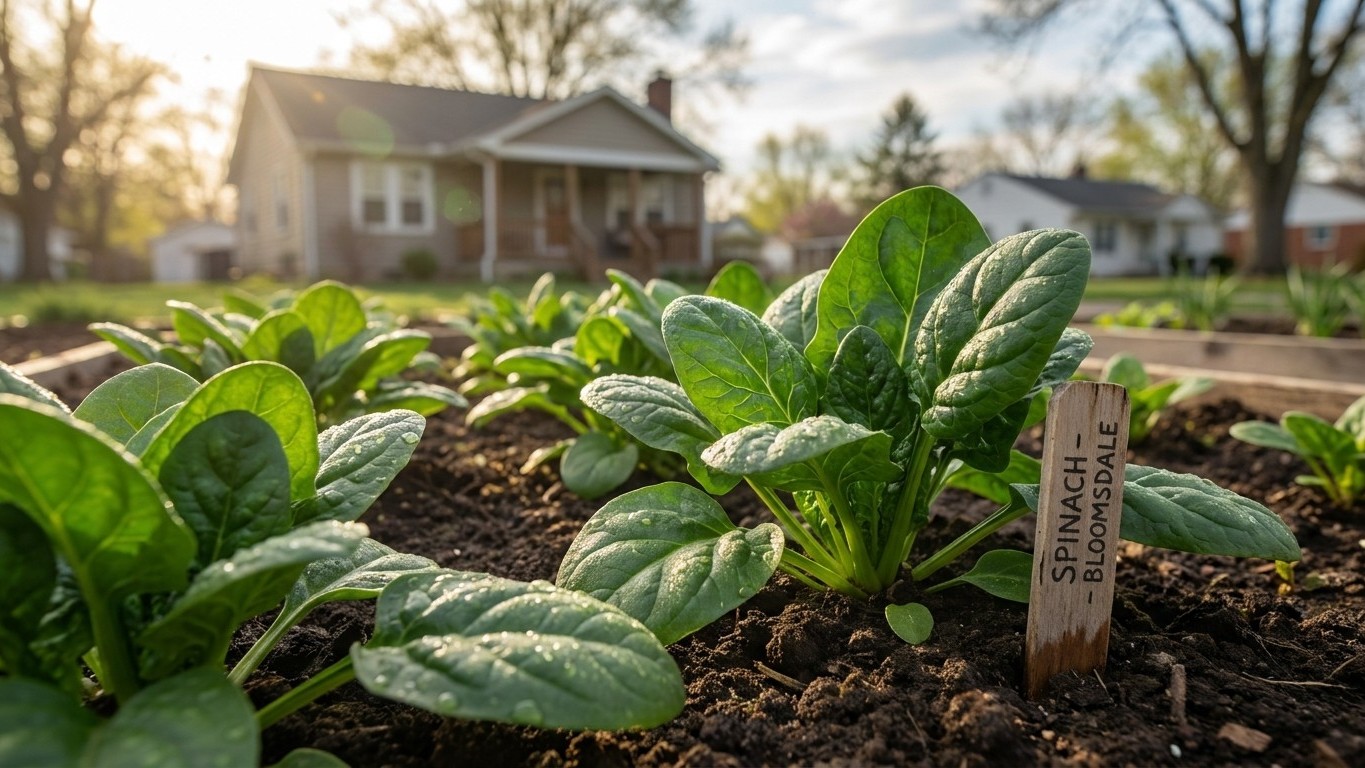

Spinach in Colorado runs on borrowed time twice a year. In spring, the crop is racing a calendar that closes as day length climbs past 14 hours; by early June, most gardeners along the Front Range are watching their spinach throw up seed stalks. In fall, the problem flips: the soil itself won’t let seed germinate until late summer heat breaks. Neither season gives you much slack.
The short answer
On the longest day of the year, Denver gets 14 hours and 50 minutes of daylight. That single number does more to end a spinach crop than any thermometer reading, because spinach flowers, or bolts, once day length stretches long enough to trigger it, no matter how mild the air feels. A cool June doesn’t rescue the plant. Will Spinach Bolt Early in Colorado? The trigger is light, not comfort, and Colorado’s early-summer daylight is already well past the point where spinach starts bolting.
That would be enough on its own, but Colorado piles heat on top of it. The reference station for Denver averages 39.6 days a year at 90 F or hotter, and spinach’s own growth ceiling sits at 75 F, a number that does double duty as both the point where growth quality drops and where leaves turn bitter. So the plant is squeezed from two directions at once: long days pushing it toward flowering, and rising heat pushing it toward poor, bitter growth even before the flower stalks show up.
The honest answer, then, is both. Day length sets the outer limit on how late into early summer you can keep harvesting, and heat decides how good that harvest tastes along the way. Gardeners who treat this as purely a heat problem, and try to out-shade or out-water their way past it, are often surprised when the plant bolts anyway on a day that didn’t even feel that hot. The daylight clock keeps running whether or not you’re watching the thermometer.
This is also why spinach behaves so differently from a crop like onions on the same piece of ground. Long days build an onion bulb. Long days destroy a spinach crop by pushing it into flower. Same variable, opposite effect, and it’s worth keeping straight if you’re managing both crops in the same garden bed.
Practically, this means Colorado gardeners get two narrow harvest windows bracketing the hot middle of the year rather than one long spinach season. Spring gives you a sprint from thaw to early summer. Fall gives you a second sprint once the soil cools enough to let seed germinate at all, a timing question covered in detail in When to Sow Autumn Spinach in Colorado. Neither window is generous, and losing a week to a late cold spell or a slow-to-cool August can eat most of the usable time you had.
How long the spring window really is
Utah State University Extension’s guidance on spinach gives two hard limits to work with here: sow 2 to 3 weeks before the last frost, and expect growth quality to fall apart once temperatures climb past 75 F. Layer those onto Colorado’s own numbers and the spring window comes into focus.
- Denver’s last spring frost, per NOAA climate normals, falls between May 1 and May 11. Counting back 2 to 3 weeks puts a realistic sowing date in mid-to-late April for most Front Range gardens at similar elevation.
- From that sowing date, spinach has roughly six to eight weeks of decent growing conditions before the 75 F ceiling becomes the norm rather than the exception. Denver’s heat load builds fast once late May turns into June, and the average of 39.6 days a year at 90 F or hotter reflects a summer that doesn’t ease into heat, it arrives.
- That leaves a working spring harvest period of roughly six weeks, stretching from late April sowing through early-to-mid June, before both day length and heat push the crop toward bolting and bitterness at the same time.
Six weeks isn’t nothing, but it’s tight enough that a slow germination stretch or a cold snap that delays sowing by even ten days can cut meaningfully into the usable harvest. Gardeners at higher elevation, where the last frost date runs later than the Denver reference station, get an even shorter version of this same window, since the spring start pushes later while the day-length trigger for bolting doesn’t wait for anyone’s local frost date.
None of Utah State’s four named spinach varieties, Bloomsdale, Melody, Teton, and Olympia, come with published days-to-maturity figures from that source, so there’s no way to say with authority which one clears the spring window fastest. What the source does confirm is the ceiling itself: once temperatures push past 75 F, growth quality and flavor both suffer, regardless of variety.
The autumn crop, and when the soil lets you sow
The fall spinach crop in Colorado is governed by a different mechanic than spring’s day-length trigger. Here the obstacle is soil temperature on one end of the season, and an approaching frost on the other, and the two don’t always leave enough room between them.
Soil still too warm
Utah State University Extension notes that spinach seed germination drops once soil temperature climbs above 80 F. That threshold is the real gatekeeper for a fall sowing, not the calendar. Colorado’s late-summer soil, baked by a season that regularly hits 90 F air temperature on nearly 40 days a year, often sits well above that 80 F mark through much of August at shallow planting depth. Sowing into soil that’s still holding heat means poor, patchy germination no matter how carefully the seed is watered in.
The frost that ends the season
Denver’s first fall frost, per NOAA’s 1991-2020 climate normals, arrives between September 30 and October 12. Utah State’s guidance for a fall crop is to plant 50 to 75 days before the date you want to harvest. Counting back from an early-October harvest target puts a workable sowing window between roughly mid-July and mid-August.
That’s where the tension shows up. Mid-July soil in Colorado is still deep in the heat that suppresses germination, which means the earlier end of that 50-to-75-day window is often unusable in practice. The realistic sowing period narrows toward early-to-mid August, once soil temperatures start easing down from their peak, giving a fall crop that’s shorter than the arithmetic alone would suggest and leaves little margin if the season’s heat lingers into late summer.
Checking this against your own county
Denver’s numbers, elevation 5,280 feet on the plains, are a starting point, not a universal answer. Mountain towns run frost-free seasons that can be weeks shorter, with July frosts a real possibility in some high valleys. The Western Slope runs on its own pattern again, shaped by different elevation and different weather systems entirely.
Before locking in a sowing date, check current conditions and local frost expectations with Colorado State University Extension. County-level offices under that same system track local frost data and soil conditions that can shift these windows by a week or more in either direction, which matters a lot when the usable season is only six to eight weeks long to begin with.
Common questions
Can shade cloth stop spinach from bolting in Colorado?
Shade cloth can reduce heat stress and slow the leaf-quality decline that comes with temperatures above 75 F, but it does nothing to change day length. Since bolting is triggered by long days as well as by warmth, shade alone won’t prevent flowering once the daylight trigger is reached.
Is fall spinach more reliable than spring spinach in Colorado?
Neither season offers much margin. Spring is limited by the day-length trigger arriving in early summer; fall is limited by soil that’s often still too warm for good germination through much of the 50-to-75-day planting window counted back from the first frost.
Do Bloomsdale, Melody, Teton, or Olympia bolt at different rates?
Utah State University Extension names these four varieties but does not publish comparative data on bolt timing, days to maturity, or heat tolerance for any of them, so there’s no verified basis for ranking them against each other.
Does higher elevation in Colorado buy more spinach growing time?
It shifts the season rather than lengthening it. Higher-elevation gardens tend to see a later last frost and an earlier first frost than the Denver reference station, which compresses both the spring and fall windows rather than extending either one.