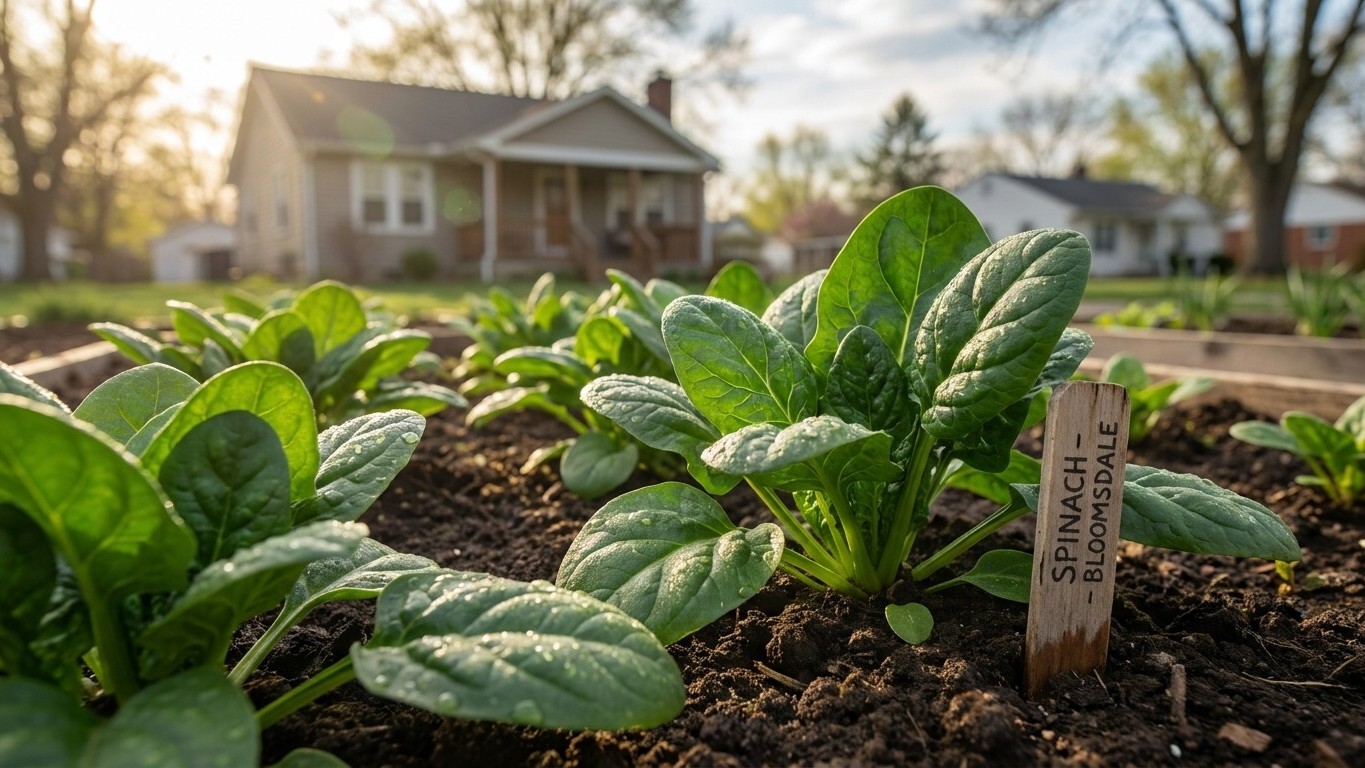

In Kansas, spinach bolts once the calendar pushes past the last week of May into June, when the days climb past 14 hours and daytime highs start clearing 75 F. The trigger isn’t the heat alone. It’s the combination of long daylight and warm soil hitting at the same time, which is exactly what happens here every spring whether the season felt mild or not. This raises the question many local gardeners ask: Will Spinach Bolt Early in Kansas?
The short answer
On the longest day of the year, the reference city for this region sees 14 hours and 36 minutes of daylight. For most garden crops that’s just a fact about summer. For spinach, it’s the mechanism that ends the season. Long daylight hours push the plant into flowering, a process called bolting, regardless of how cool or mild the temperatures happen to be that week. A gardener who gets a cool, cloudy May might assume the spinach earned a reprieve. It didn’t. The clock that matters is the sun’s angle, not the thermometer.
That’s the piece people miss most often, and it’s worth stating plainly: a cool summer does not buy Kansas gardeners extra weeks of spinach. Day length alone is enough to flip the plant into reproductive mode once the calendar crosses a certain point, and Kansas summer days get long enough, long enough that bolting becomes close to unavoidable by late spring.
Heat then finishes the job. Spinach grows best where temperatures stay under 75 F, and this region logs an average of 57.6 days a year at 90 F or higher. Those triple-digit-adjacent days don’t show up until midsummer, but the ramp toward them starts early. By the time day length alone would be pushing the plant toward flowering, the afternoons are also regularly running past that 75 F growth ceiling. The two pressures arrive together, which is why the bolt, once it starts, tends to happen fast. Leaves that were flat and tender one week send up a central stalk the next, and the flavor turns bitter right along with it. That same 75 F threshold is both the growth ceiling and the bitterness line, so there’s no comfortable middle ground where the plant just slows down politely.
So the honest way to frame it for Kansas: the limit is both day length and heat, arriving in sequence. Day length sets the outer boundary on how late into the season a spring planting can hold. Heat closes the gap faster than that boundary alone would suggest, and it also spoils the flavor before the plant physically bolts. Anyone growing here is working against a shrinking window from two directions at once, not one. Once that spring window closes, the better strategy is to look ahead to When to Sow Autumn Spinach in Kansas, since cooling temperatures and shortening days work in the plant’s favor rather than against it.
How long the spring window really is
Working out an actual planting calendar for Kansas means stacking a few known numbers together and being honest about what’s left over. Here’s how that math plays out.
- The reference station’s last spring frost falls between April 4 and April 18. Spinach seed is sown 2 to 3 weeks before that date, since it germinates fine in cool soil. That puts a realistic sowing window somewhere from mid-March to early April, depending on how quickly the ground thaws and dries enough to work.
- From that sowing date, the plant has a run of cool weeks where growth is genuinely good, before spring temperatures start pushing past the 75 F ceiling on a regular basis. In Kansas that transition tends to happen through May, as the state moves from cool fronts to the steadier warmth that eventually produces those 57.6 days a year above 90 F.
- Daylight is climbing the entire time, and by late May it’s well on the way to that 14-hour-36-minute peak. That’s the second trigger arriving on schedule, independent of whatever the thermometer is doing that particular week.
- Put those two pressures together and the usable spring window for good-quality spinach in Kansas runs roughly six to eight weeks: from an early-to-mid-April sowing to a late-May or early-June bolt. Gardeners who sow later, say waiting until after the frost date out of caution, are simply handing back some of that window on the front end, since the back end doesn’t move.
- Succession sowing every week or two through that six-to-eight-week stretch is the practical way to stretch harvests, since a single planting date means a single, fairly abrupt bolt when both triggers land.
The autumn crop, and when the soil lets you sow
Fall is the better season for spinach in most of Kansas, mostly because the two obstacles that end it are easier to see coming than the spring squeeze. There are two separate limits to plan around, and they don’t move together.
Soil still too warm to germinate
Spinach seed germination drops off once soil temperature climbs above 80 F, and Kansas soil holds onto summer heat well past the point the calendar suggests it should. With 57.6 days a year averaging 90 F or hotter, most of them clustered in July and August, the top few inches of garden soil commonly stay above that 80 F germination threshold through much of August even as air temperatures start easing. Sowing too early into that warm ground means poor, patchy germination no matter how good the seed is. The practical fix is to wait until soil has actually cooled, which usually means holding off until late August or into September rather than sowing by the calendar date alone. A simple soil thermometer pushed a couple inches down settles the question faster than guessing from the air temperature on the porch thermometer.
Racing the first frost
The other limit is the first fall frost, which arrives at the reference station somewhere between October 23 and November 2. Utah State University Extension’s guidance for a fall crop is to sow 50 to 75 days before the date you want to harvest, not before the frost date itself. Counting backward from a target harvest in mid-to-late October, that lands the sowing window somewhere in the range of early August through mid-September, depending on which end of that 50-to-75-day range fits your garden and how close to frost you’re comfortable harvesting. Given how warm Kansas soil runs in early August, the later end of that window, sowing once soil temperatures have actually dropped in September, tends to line up better in practice than pushing seed into ground that’s still too hot to germinate reliably.
None of the four spinach varieties Utah State University Extension names for garden use, Bloomsdale, Melody, Teton, and Olympia, come with published days-to-maturity figures from that source, so there’s no shortcut number to plug into this math. The 50-to-75-day sowing rule is the only timing guidance the source provides, and it applies across varieties rather than to one in particular.
Checking this against your own county
Every figure above comes from a single reference weather station, and Kansas is a big enough state that conditions shift meaningfully from one county to the next. Suburban and rural gardens typically see their last spring frost later, and their first fall frost earlier, than an airport station reports, sometimes by one to two weeks, and more at higher elevation. That difference can shrink the spring window described here even further, or push the fall sowing date earlier than the range worked out above.
K-State Research and Extension (ksre.k-state.edu) is the land-grant extension service for the state and the right place to confirm frost dates and soil conditions for a specific county. Local extension offices track microclimate variation that no statewide average can capture, and they’re the ones who can tell you whether your particular garden runs closer to the airport numbers or noticeably off from them.
Common questions
Does shade slow down bolting in Kansas?
Shade can lower soil and leaf temperature somewhat, which helps with the heat side of the equation, but it does nothing about day length. Since long daylight hours trigger flowering on their own, shade alone won’t stop a spring crop from bolting once the calendar catches up.
Is fall spinach less likely to bolt than spring spinach?
Yes, because a fall crop is sown as days are getting shorter rather than longer, removing the day-length trigger almost entirely. The main risk in fall shifts to poor germination in soil that’s still too warm, rather than to bolting.
Can spinach be grown through a Kansas summer?
Not reliably. With average highs pushing well past 75 F for stretches of the season and 57.6 days a year reaching 90 F or above, summer conditions sit outside spinach’s preferred range on both the heat and day-length fronts at once.
What happens to spinach flavor right before it bolts?
Leaves tend to turn bitter as the plant nears the 75 F threshold, since that same number marks both the upper edge of good growth and the point where flavor quality drops. Harvesting a little earlier rather than waiting for peak leaf size usually gets better-tasting spinach.