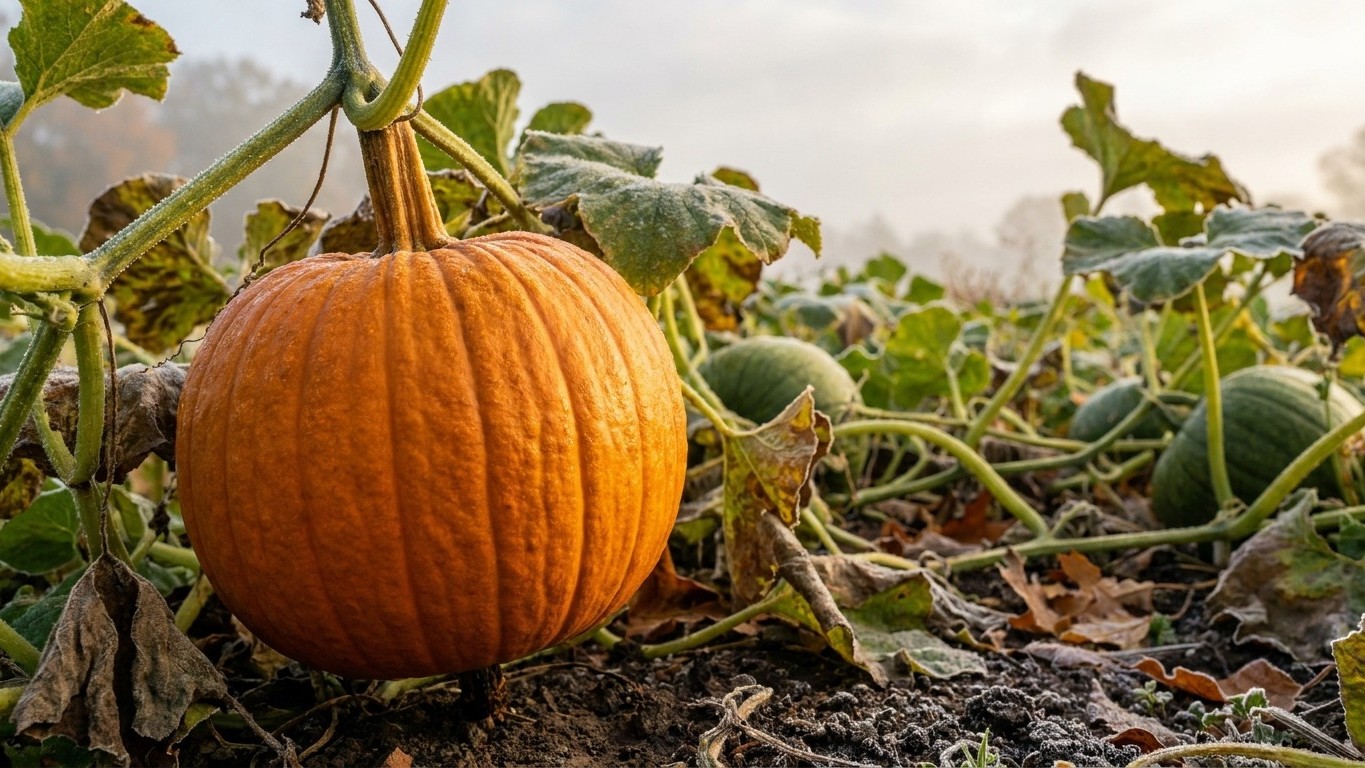

Will Pumpkins Ripen Before Frost in Newfoundland and Labrador? They can, across most of the province, but only if the first flower opens by roughly early September. Work back from the average October 17 fall frost using the 45- to 55-day clock a flower needs to finish a pumpkin, and the safe flowering window narrows to somewhere between August 23 and September 2. Miss that window and you’re pulling green fruit off the vine before frost, not orange ones.
The short answer
Newfoundland and Labrador’s growing season is set by one number: October 17, the average first fall frost recorded at St John’s A, on the Avalon Peninsula. That figure comes from Environment and Climate Change Canada’s 1981-2010 Climate Normals, and it’s the anchor for every pumpkin planted in the province.
Utah State University Extension puts the maturing clock at 45 to 55 days, counted from the day a pumpkin flower opens, not the day seed goes into the ground. Subtract that clock from October 17 and the true flowering deadline appears: September 2 at the short end of the range, August 23 at the long end. A flower opening after early September is racing a season that’s already closing behind it.
That gives growers on the Avalon roughly four and a half months, late May through early September, to move a plant from seed to flower. It sounds generous until you remember what October 17 actually represents. It’s a mean date, the midpoint of three decades of records, so in about half of all years the first hard frost lands later than that, and in the other half it lands earlier. Treat it as a coin flip, not a calendar guarantee, and the sensible target for flowering slides toward the earlier end of the window, closer to August 23 than September 2.
The station behind that number sits on the milder, ocean-buffered Avalon Peninsula. Newfoundland and Labrador is not one climate. Move north toward the Northern Peninsula, or inland through interior Labrador, and frost typically arrives well ahead of the Avalon average, which pulls the flowering deadline earlier too, sometimes into late July for the far north and interior. A grower near St John’s has more room than one near Happy Valley-Goose Bay or along the Northern Peninsula, and that gap matters more than any seed packet’s generic days-to-maturity number.
So the honest answer is yes, pumpkins can ripen here, but the margin is thin and depends heavily on where in the province you’re standing. On the Avalon and similar frost-buffered coastal ground, a plant that flowers by the last week of August has a fair shot at a properly colored, hard-skinned pumpkin before the vine gives out. Push flowering into mid-September, and you’re betting on a frost that, historically, shows up on schedule only about half the time.
When to sow here
For the full breakdown of When to Sow Pumpkins in Newfoundland and Labrador, know that sowing date isn’t set by the frost calendar alone. Two separate thresholds matter, and confusing them is the most common mistake growers make in a short-season province like this one.
- Start with the frost average, but don’t trust it as a fixed line. Last spring frost at St John’s A averages May 30. Because that’s a mean date drawn from thirty years of records, frost lands after May 30 in roughly half of all years. Treat it as the middle of a window, not a date safe to plant on outright.
- Wait for the soil, not just the air. Utah State University Extension is specific that pumpkin seed wants soil at 65 F before it goes into the ground. Soil doesn’t warm at the same pace as air, especially in a province ringed by cold ocean water that keeps spring air temperatures low well into June. In practice, that 65 F soil threshold arrives weeks after the May 30 frost average, not right on top of it. Equating the frost date with planting day is exactly the miscalculation that costs growers here two or three weeks of season they can’t spare.
- Check the ground with a thermometer, not a date on the wall. Push a soil thermometer about four inches down into the bed in mid-afternoon, over several consecutive days, before trusting that 65 F has actually settled in.
- Use row covers to claw back time. Clear plastic or fabric row covers warm soil faster than open ground and typically buy back about two weeks against that natural lag, which can be the difference between a flower opening in late August and one opening in mid-September.
- Count forward from sowing to flowering, then test it against the deadline. Once seed goes into 65 F soil, the plant still needs weeks of growth before it flowers at all. Add that stretch to the 45- to 55-day maturing clock, and check whether the total lands before the flowering deadline worked out above. If it doesn’t, row covers, black plastic mulch, or starting seed indoors under cover stop being optional.
What goes wrong here
- A late flower that never colors up. When the first female flower doesn’t open until mid-September, the fruit behind it can reach full size but stay green or pale, because it never banked the 45 to 55 days of warmth Utah State University Extension says a pumpkin needs after flowering. The remedy is pinching off new flowers once the flowering deadline has passed, so the plant channels what strength it has left into fruit that still stands a chance, instead of starting new ones that have none.
- A fruit caught by frost before it finishes. Frost can blacken vines and skin overnight, even on fruit that was only days from finishing. Once frost is forecast, cut the pumpkin free with several inches of stem attached and move it somewhere it won’t freeze; Utah State University Extension names no specific storage temperature or humidity for this step, only that shelter from freezing is what matters. A partly ripe pumpkin handled this way can firm up some, though it won’t match one that finished properly on the vine.
- A vine that dies back before the skin hardens. Cool, wet stretches common along the coast can knock back foliage weeks before true frost, leaving fruit exposed with soft, thin skin. Cutting the vine a few inches from the fruit and turning the pumpkin so more of its surface faces open sun can speed skin hardening in whatever time remains, though it won’t substitute for a longer season.
- Insects eating into an already tight season. Squash bugs and cucumber beetles both weaken vines early, and a plant fighting pest damage in July has less strength left to push a flower through by the August deadline. For identification and management, see this site’s squash bug guide and cucumber beetle guide rather than treating either pest as an afterthought here.
Checking this against your own county
Every figure in this guide comes from one weather station, St John’s A on the Avalon Peninsula, and one general maturing clock from Utah State University Extension. Neither knows what your particular yard is doing. Frost pools in low ground and river valleys weeks before it touches a hillside a mile away, and the province’s mix of coastline, barrens, and interior forest makes that kind of local variation the rule rather than the exception.
Before committing a season to pumpkins, check current conditions with the Newfoundland and Labrador Department of Fisheries, Forestry and Agriculture, which tracks growing conditions across the province’s different districts, from the Avalon to central Newfoundland to Labrador. A quick check with them can confirm whether the flowering deadline worked out here needs to move earlier for your specific ground.
Common questions
Can pumpkins ripen in Labrador at all?
This guide’s frost figures come from St John’s A on the Avalon Peninsula, not from a Labrador station, and no comparable published date is available here for that region. Labrador’s season runs shorter than the Avalon’s, so the flowering deadline there sits earlier, likely by weeks, and confirming a local date through the provincial agriculture department is the safer move.
What happens if my first flower opens after the deadline?
The fruit behind that flower is unlikely to finish coloring or hardening before frost. It can still be cut before a hard freeze and kept somewhere it won’t freeze, but that’s salvage, not true ripening on the vine.
How do I know when the soil has actually reached 65 F?
Check it directly with a soil thermometer pushed about four inches deep, read in mid-afternoon over several days in a row. Waiting for the calendar or the air temperature alone will mislead you, since soil warms on its own slower schedule.
Is October 17 a safe date to count on for frost?
No. It’s a mean date built from thirty years of records, which means frost arrives after October 17 in roughly half of all years and before it in the other half. Plan for the earlier possibility, not the average.