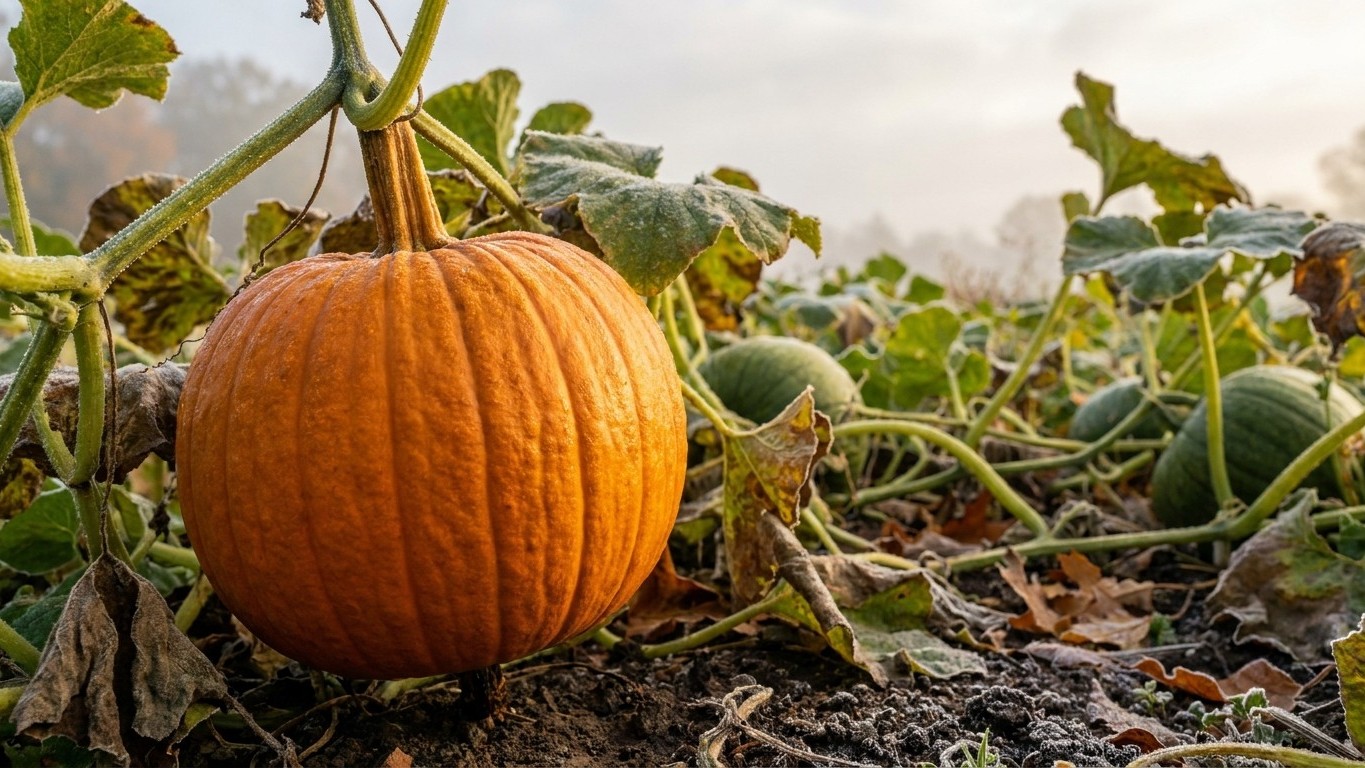

In western Washington, the safe cutoff for a pumpkin flower to open and still turn into a ripe, orange fruit falls somewhere between late September and mid-October. Miss that window and you’re gambling on a green pumpkin at frost. East of the Cascades, the math changes entirely, and that shift is the whole story here.
The short answer
Start with the frost date, because everything else in this calculation works backward from it. NOAA’s 1991-2020 Climate Normals put the first fall frost for western Washington (station USW00024233) between November 13 and November 30. That’s a wide window on its own, nearly three weeks of uncertainty about when the first freeze actually lands in a given year.
Now bring in the second number. Utah State University Extension states that pumpkins need 45 to 55 days after flowering, not after seeding, to reach maturity. That distinction matters more than almost anything else on this page. A vine can sit in the ground for months, but the clock that decides whether you get a ripe pumpkin doesn’t start until the first female flower opens and sets fruit.
Run the subtraction both ways. If frost arrives on the early edge of the window, November 13, and your pumpkin needs the full 55 days, the flower had to open around September 19 or 20. If frost holds off until the late edge, November 30, and the fruit only needs 45 days, a flower opening as late as October 16 still has a shot. That gives you a flowering cutoff window of roughly September 20 to October 16, wide but not limitless.
The honest way to use that window is to aim for the early end of it. Weather doesn’t average itself out for the one pumpkin patch you’re watching this particular year; it either freezes on November 13 or it doesn’t. Treating September 20 as your real deadline, and October 16 as a lucky bonus if the season runs long, keeps you from being the gardener staring at a pale green pumpkin the week before Thanksgiving. For a deeper look at how these dates play out in practice, see Will Pumpkins Ripen Before Frost in Washington?
None of this applies east of the Cascades. That side of the state sits in a high desert climate with a shorter, more compressed growing season and its own frost pattern. The NOAA figures above come from a western Washington station, and stretching them across the whole state would hand an eastern Washington gardener a false sense of how much time they actually have. If you garden east of the mountains, treat this page as a description of the mechanism, not a set of dates you can copy.
When to sow here
Sowing dates get set by soil temperature, not by the frost calendar, and conflating the two is the single most common mistake with pumpkins in this region. For a full breakdown of these sowing dates, see When to Sow Pumpkins in Washington. NOAA’s data puts the last spring frost for western Washington between February 27 and March 18. Utah State University Extension is clear that pumpkin seed needs soil at 65°F to germinate reliably. Those two thresholds are not the same event, and the gap between them is where a lot of springs go sideways for gardeners who plant by the frost date alone.
Western Washington’s soil warms slowly. The region’s marine climate keeps spring cool, damp, and short on direct sun, all of which hold soil temperature down well after the air itself has cleared the frost risk. A soil thermometer pushed a few inches into a garden bed in March, right after the last frost window closes, will often still read well short of 65°F. The lag isn’t a matter of days; it runs into weeks, and it’s the soil, not the calendar, that decides when seed actually germinates instead of rotting in cold, wet ground.
Here’s the practical sequence for getting the timing right:
- Let the last frost window (February 27 to March 18) pass fully before doing anything with pumpkin seed in open ground.
- Check soil temperature directly with a probe thermometer rather than guessing from the air temperature or the calendar date. Wait until it holds at 65°F, not just touches it on a warm afternoon.
- If the season feels tight, use row covers over the planting area. They typically buy about two weeks, effectively pulling your seed-safe date two weeks earlier than bare, uncovered soil would allow.
- Work backward from your flowering cutoff (September 20 to October 16) using the seed-to-flower timeline printed on your specific seed packet, since that figure varies by variety and isn’t part of the maturation window covered here.
That last step matters because the 45-to-55-day figure only covers flowering to harvest. The stretch from seed to first flower is its own variable, and it’s the piece each gardener has to pull from their own seed source rather than from a single regional rule.
What goes wrong here
Most pumpkin failures in this climate trace back to the same root cause: the vine’s internal clock and the calendar’s frost clock arriving at cross purposes. Here’s where that mismatch tends to show up.
- A late flower that never colors up. A female flower opening in late October, after the safer end of the cutoff window, may set fruit that’s still deep green when frost hits, whatever the size. The remedy is prevention rather than rescue: pinch off new flowers appearing after mid-October so the plant channels energy into fruit already set rather than starting new ones that have no realistic path to ripening.
- A fruit caught green by frost. Once frost is forecast and a pumpkin still hasn’t turned, harvest it anyway with the stem attached, per Utah State University Extension’s guidance, and move it somewhere it won’t freeze. A green pumpkin cut early won’t be identical to a vine-ripened one, but a frozen one is a total loss.
- A vine that collapses before the skin hardens. Vines weakened by pests can die back weeks before the fruit is ready, cutting off the plant’s ability to finish hardening the rind. Squash bugs and cucumber beetles are the two most common culprits in this region, and this site covers both in dedicated Washington pages rather than repeating the pest details here: see the guides on squash bugs in Washington and cucumber beetles in Washington for identification and control specific to this state.
- Underestimating how thin the fall margin already is. Because the frost window itself spans November 13 to November 30, a gardener who assumes they’ve got until late November every year is planning around the best-case end of that range instead of the worst-case one. Building in the earlier date as your working assumption removes most of the guesswork.
Checking this against your own county
The frost dates and soil-temperature threshold in this page describe western Washington broadly, using a single NOAA weather station as the reference point. Local conditions still shift things: a valley bottom, a coastal exposure, or an urban heat pocket can each push frost timing earlier or later than the regional average, sometimes by more than a week.
For a reading specific to your county, Washington State University Extension is the named authority to check. Their county offices track local soil and frost conditions more closely than any statewide figure can, and they can tell you whether your particular spot tends to run ahead of or behind the western Washington window used throughout this page.
Common questions
Can I still get a ripe pumpkin if my flower opens in early October?
Possibly. October flowers fall within the wider edge of the calculated window (up to October 16), but they’re relying on a later-than-average frost and a shorter, 45-day maturation. It’s a real chance, not a guaranteed one.
Does the 45-to-55-day figure start when I plant the seed?
No. Utah State University Extension is specific that this window runs from flowering to harvest, not from seeding or transplanting. Seed-to-flower time is a separate span that varies by variety.
How do I know when my soil has actually hit 65°F?
Use a soil thermometer pushed a few inches into the bed rather than judging by air temperature or the frost date. Soil in this region’s climate lags the air by weeks, so checking directly is the only reliable method.
What if frost is coming and my pumpkin is still green?
Harvest it with the stem attached and move it somewhere it won’t freeze, following Utah State University Extension’s guidance. No storage temperature or keeping time for green-harvested fruit is published in that source, so treat “won’t freeze” as the operative standard rather than a specific number.