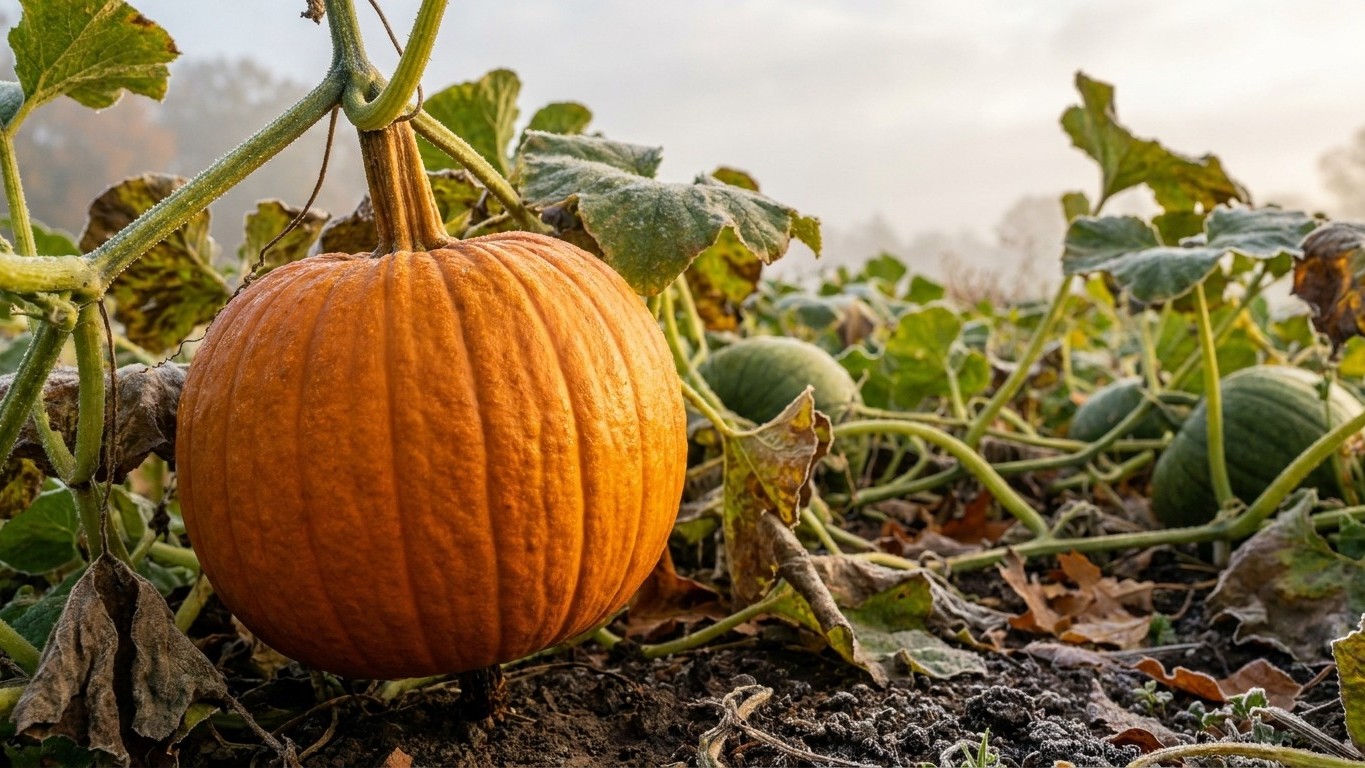

In central Alabama, a pumpkin flower needs to open by roughly the second week of September to have a real shot at turning orange before frost. Wait past early October and you’re gambling on a warm fall to finish the job. The window is tight, but it’s workable if you count backward from bloom instead of forward from planting.
The short answer
Alabama’s first fall frost, based on the 1991-2020 NOAA NCEI climate normals for station USW00003856, typically arrives somewhere between November 2 and November 16. That’s the hard stop. Once that freeze hits, any pumpkin still green on the vine stays green. It won’t ripen on a windowsill the way a tomato might.
Utah State University Extension’s guidance on pumpkin timing gives the number that matters most here: a pumpkin needs 45 to 55 days after the flower opens, not after the seed goes in the ground, to reach a mature, harvestable state. That distinction trips up a lot of gardeners who count from their planting date and assume they’re covered. The clock that actually decides whether you get a ripe pumpkin starts the day a female flower opens on the vine, and it runs for close to two months from there.
Run the subtraction against Alabama’s frost window and you get a target, which is really the same question as Will Pumpkins Ripen Before Frost in Alabama?. Using the earlier end of the frost window (November 2) and the longer end of the maturity window (55 days) as your safety margin, the last flowers that can still finish need to open by around September 8. Using the later frost date (November 16) and the shorter maturity window (45 days), you could push flowering into early October and still make it. In practice, most gardeners split the difference and treat mid-September as the real deadline for a flower that’s going to become a fully colored, hard-skinned pumpkin rather than a frost-killed green one.
That’s a window, not a single date, because Alabama’s fall frost itself lands anywhere across a two-week spread depending on the year and, more importantly, depending on where you actually garden relative to the airport station the climate normals are built from. A garden in a low-lying rural spot or at higher elevation can see frost arrive a week or two before the reference station does. A protected suburban yard near pavement and structures can run later. Either way, the safe move is to aim for flowers opening in the first half of September and treat anything blooming into October as a fruit you’re hoping the weather cooperates on, not one you’re counting on.
When to sow here
Working backward from bloom only helps if the front end of the calendar is right too, and that’s where a lot of Alabama gardeners get tripped up by a false shortcut: assuming the last frost date is also the green light to plant. For a full breakdown of the front end of that calendar, see When to Sow Pumpkins in Alabama.
- Let the last spring frost window pass first. For the reference station, that’s March 19 to April 3. This tells you when the air stops threatening to kill a seedling outright, but it says nothing about whether the ground is actually warm enough for a pumpkin seed to germinate well.
- Wait for the soil, not the air, to hit 65°F. Utah State University Extension specifies 65°F soil as the threshold for sowing pumpkins. Soil warms more slowly than air, holding onto winter cold for weeks after the last frost has come and gone, so this checkpoint typically lands well after the frost date has passed, not on it. Skip this step and plant into cold soil on faith alone, and you’ll often get slow, uneven germination or seeds that simply rot before they sprout.
- Use row covers if you want to move earlier. A row cover traps solar heat against the soil surface, and in practical terms that typically buys about two weeks of head start over bare, uncovered ground reaching the same 65°F mark. That’s the difference between sowing in late March under cover and waiting until mid-April without it.
- Count forward from your actual sowing date, and back from the frost window, to see if they meet in the middle. Sow too late and the flowering clock, plus the 45 to 55 days after that, pushes ripening past the first fall frost window entirely.
What goes wrong here
- A flower opens too late to ever color up. This is the single most common failure tied to Alabama’s season length. A vine that blooms heavily in late September or October is racing a clock it can’t win, since 45 to 55 days from an October flower runs straight into or past the frost window. The remedy is sowing early enough, and warm enough, that peak flowering lands in August, giving you a buffer of extra blooms opening before that mid-September cutoff.
- A nearly-finished fruit gets caught by frost before the skin fully hardens. A pumpkin that’s colored but still soft-skinned isn’t done. Utah State University Extension notes fruit should be harvested with the stem attached, before frost, which means watching the forecast in late October and pulling anything close to ready rather than leaving it on the vine for a few more “just in case” days.
- The vine dies back before the fruit’s shell has hardened. Vines can decline from disease pressure or from pest damage well before the calendar frost date, cutting off the plant’s ability to keep feeding the fruit. If your vines are collapsing early in the season, check whether squash bugs or cucumber beetles are behind it rather than assuming it’s simply age or weather, since both have management steps that can extend a vine’s productive window.
- Storage plans built on guesswork. Once harvested, Utah State University Extension’s guidance only specifies keeping pumpkins somewhere they won’t freeze. No storage temperature, humidity level, or keeping-time figure is published in that source, so treat any specific “store at X degrees for Y weeks” claim you see elsewhere with caution unless it comes from an Alabama-specific extension resource.
Checking this against your own county
Every date and figure above comes from a single reference weather station, and Alabama runs from the Tennessee Valley down to the Gulf Coast, a spread wide enough that frost timing shifts meaningfully across it. Before locking in a sowing date, check current guidance from the Alabama Cooperative Extension System, which tracks frost data and planting recommendations at the county level rather than from one airport station.
A quick call or visit to your county’s extension office can tell you whether your local frost pattern runs earlier or later than the statewide reference, and whether soil warms faster or slower in your specific area based on drainage, sun exposure, and elevation. That’s the kind of detail no statewide figure can capture.
Common questions
Can I still plant pumpkins in July in Alabama?
Only if you’re aiming for a very fast-maturing bloom cycle and accepting real risk. Working back from the September flowering deadline, a July sowing leaves a narrow margin, and any delay in germination or early growth eats into that margin fast. Checking your specific county’s frost data before committing is the safer move.
What if my flowers open in October?
Flowers opening after the first week of October are working against Alabama’s frost window rather than with it. The 45 to 55 day clock from that bloom often runs past even the later end of the frost range (November 16), so fruit from late blooms is at meaningful risk of being caught green.
Does a warm fall change the math?
The frost window itself (November 2 to November 16) reflects a range of possible years, so a warmer-than-typical fall can push the actual frost later within or beyond that band. It’s not something to plan around, but it does explain why some years a late-blooming vine finishes fine while in other years it doesn’t.
Should I count from seeding or from transplanting?
Neither. The 45 to 55 day maturity figure runs from the day a flower actually opens on the vine, not from when the seed went into the ground or when a transplant was set out. Seeding and transplant dates only matter insofar as they determine when flowering begins.