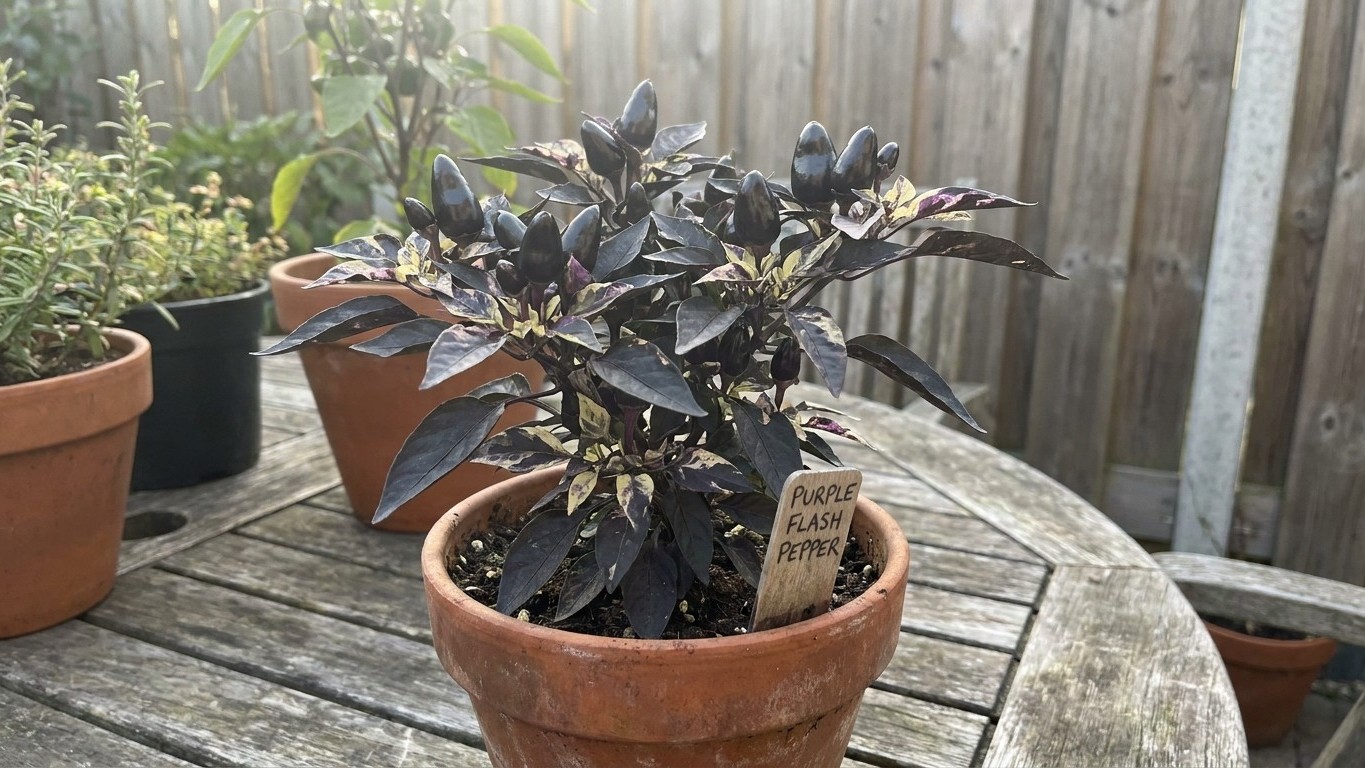

Purple Flash pepper is grown as much for its foliage as for its fruit: near-black leaves splashed with purple and white, topped with tiny, very hot black peppers. NC State Extension is the only university source describing it, and it does not sort this cultivar into any of the usual heat categories. What that means for planting, spice level, and how to use the fruit is worth untangling before you put a plant in the ground.
What Purple Flash Pepper Actually Is
Most pepper variety pages start by naming a type: bell, banana, jalapeno, habanero, cayenne. That’s not possible here. Clemson Cooperative Extension keeps a recommended list that sorts peppers into those categories, but Purple Flash doesn’t appear on it. NC State Extension describes the plant instead, without placing it in any type group. Their description, word for word: “Compact, near-black foliage with purple and white, tiny, very hot black fruits.”
That sentence tells you the plant is small and dense, good for a patio pot or a tight bed, and that the color scheme extends past the leaves into the fruit itself. It does not tell you fruit size, expected yield, or days between transplant and harvest. None of those figures are published for this cultivar. A grower who knows that gap exists is better off than one handed a confident-sounding number that nobody actually measured.
One distinction matters before anything else: some pepper plants sold at nurseries are ornamental only, bred for foliage color and marketed as houseplants or fall décor, with fruit not meant to be eaten. Purple Flash, per NC State’s own description, is an edible cultivar. But the resemblance between decorative and edible peppers is close enough that shoppers mix them up every season. Check the tag, and if a plant is labeled purely ornamental, treat the fruit as decoration, not dinner.
How Hot Is Purple Flash Pepper?
NC State’s description answers this the only honest way it can: the fruits are edible “but spiciness is unpredictable in intensity.” No Scoville number is published for Purple Flash, and inventing one here would suggest a lab measurement that doesn’t exist. For comparison, only two figures in this reference set are actually documented: the Carolina Reaper averages 1.64 million Scoville units, among the hottest peppers grown, and jalapenos run 2,500 to 8,000 Scoville units, a moderate range familiar to anyone who’s diced one for salsa. Purple Flash sits somewhere in hot pepper territory based on its description, but without a measured figure to anchor it, any number would be a guess dressed up as fact.
The “unpredictable” part is worth understanding rather than treating as a shrug. Capsaicin, the compound that produces heat, concentrates under plant stress. A hot, dry summer with inconsistent watering tends to push a plant toward hotter fruit than the same variety grown in a mild, evenly watered season. Soil nutrients play a role too: a nitrogen-heavy feeding regimen tends to produce milder fruit than a leaner one. So two gardeners growing the same Purple Flash plant, in different climates or watering habits, can end up with peppers that taste noticeably different in heat, even with identical genetics.
Practically, that means tasting a small piece before committing a whole pepper to a dish, especially the first harvest of the season. It also means a mild first picking doesn’t guarantee a mild second one. Weather shifts mid-season, and so does the fruit.
Growing Requirements That Set Purple Flash Apart
Compact size, dual-purpose plant
The “compact” descriptor from NC State matters for placement. This isn’t a sprawling plant that needs a wide bed; it fits containers, small raised beds, or tight spacing between other vegetables. The near-black foliage also means it doubles as an ornamental accent in a mixed planting, which is part of why it shows up in decorative garden displays as often as in vegetable rows. That dual identity, edible and eye-catching, is fairly rare among peppers grown mainly for the kitchen.
No published days to maturity
Here’s where the record runs thin again. Days to maturity, the count from transplant to first ripe fruit, isn’t published for Purple Flash. Of all the cultivars in this reference set, only one carries a documented figure, and Purple Flash isn’t it. Guessing based on its type wouldn’t work either, since no type has been assigned to it. The number that will actually apply to your plant is printed on your own seed packet, and that’s the figure worth writing on a calendar, not any average pulled from a different variety.
The one rule every pepper follows
What does hold true across virtually every pepper, regardless of cultivar, is that this is a warm-soil crop. Soil below roughly 60°F stalls root development, and a pepper transplanted into cold ground can sit there for weeks without visible growth while soil-warm neighbors take off. If you’re timing your planting, the soil thermometer matters more than the calendar date. For the specifics of hardening off and moving seedlings outdoors, see our guide to transplanting peppers; for starting from seed indoors on a schedule that gets plants ready before that soil-temperature window opens, see starting pepper seeds.
Taste and How to Use It
Because Purple Flash isn’t sorted into a type by either source, there’s no established flavor profile to lean on, no “sweet like a bell” or “fruity like a habanero” shorthand that applies. NC State’s description stops at “very hot black fruits” and doesn’t add a tasting note. Inventing a flavor description for a specific named cultivar, when the source hasn’t given one, is exactly the kind of detail a careful reader should flag as unsupported.
What can be said comes straight from the description. These are small, very hot fruits, which points toward the same kitchen role as other small hot peppers: used sparingly, minced fine into a dish rather than eaten whole, or dried for later use in small quantities. Given the unpredictable intensity NC State flags, starting with a small amount in any recipe, tasting, then adjusting up, is safer than committing a full pepper to a pot of chili on the first try.
For a plant this visually distinctive, there’s also a case for using a few fruits as a garnish rather than a bulk ingredient, since a couple of the near-black pods scattered over a dish do double duty as color and heat. That’s less a documented culinary tradition than a practical reading of what a compact, ornamental, very-hot pepper plant is suited for.
Common questions
Is Purple Flash pepper the same as an ornamental pepper?
Not quite. Some pepper plants sold purely for their foliage color are not meant to be eaten at all. NC State Extension describes Purple Flash as edible, with fruits that are hot but safe to eat, even though its dark, colorful leaves give it the same decorative look as those non-edible ornamentals. Always check the plant tag to be sure which kind you’re buying.
Can I tell how hot Purple Flash peppers will be before harvest?
No, and that’s due to the plant’s own biology rather than a gap in testing. NC State’s description flags the spiciness as unpredictable, and heat level shifts with growing conditions, drought and heat stress tend to push capsaicin higher. Tasting a small piece from each harvest is more reliable than judging by appearance.
What type of pepper is Purple Flash: bell, jalapeno, or hot pepper?
None of the above, officially. Clemson Cooperative Extension’s recommended list sorts peppers into bell, banana, jalapeno, habanero, cayenne, and other hot pepper categories, but Purple Flash isn’t on that list. NC State Extension describes it independently, without assigning it to a type, so the honest answer is that its category isn’t established by either source.
When should I plant Purple Flash pepper transplants outdoors?
No days-to-maturity figure is published for this cultivar specifically, so rely on the number printed on your seed packet rather than a general average. The constant that does apply is soil temperature: peppers stall in cold ground, so wait until soil consistently reads above roughly 60°F before transplanting, regardless of the calendar date.