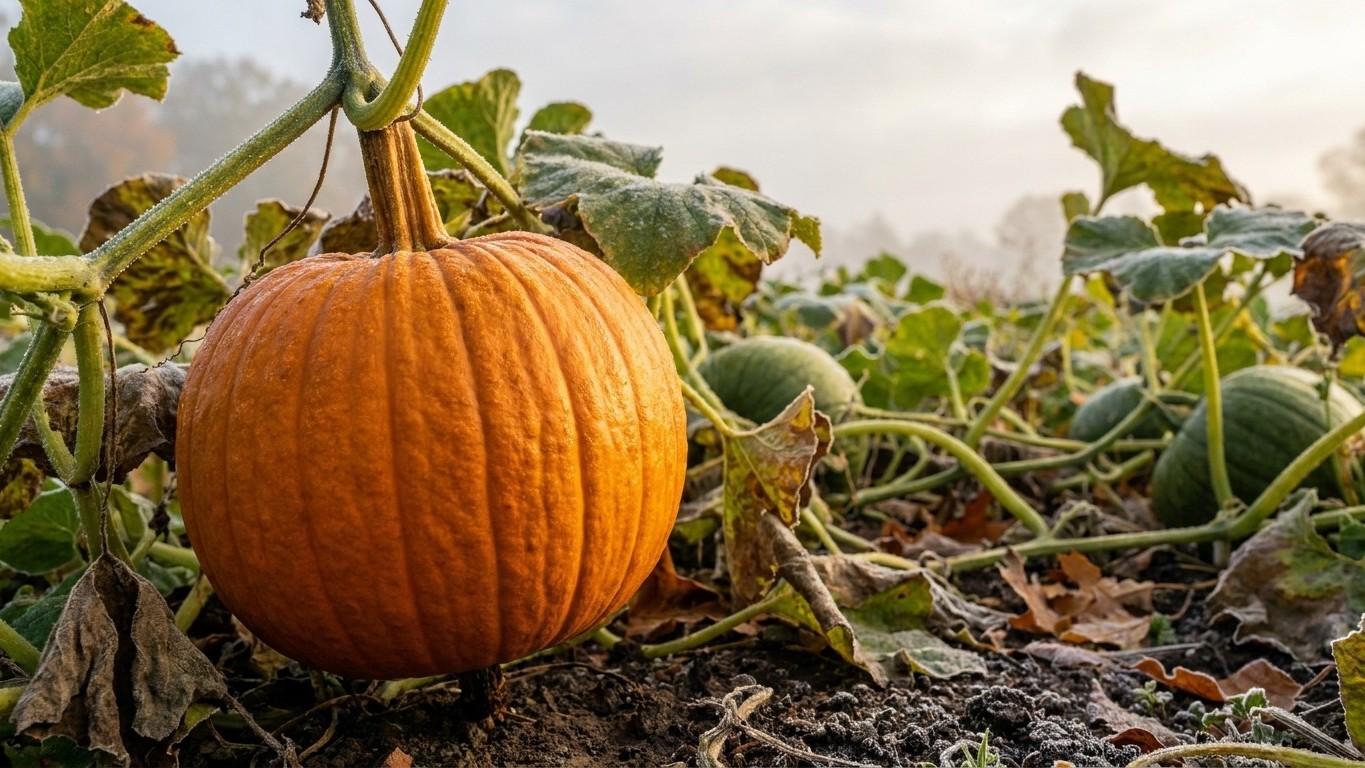

Yes, but the margin is tight. Will Pumpkins Ripen Before Frost in Rhode Island? A Rhode Island pumpkin has to flower by roughly the last days of August through mid-September to reach the 45 to 55 days it needs before the first fall frost arrives, which lands between October 24 and November 3 most seasons. Miss that flowering window and you get a green pumpkin, not an orange one.
The short answer
Start with the wall every Rhode Island pumpkin grower eventually runs into: the first fall frost. NOAA’s climate normals for the region put that date between October 24 and November 3. Everything about a pumpkin’s timeline works backward from that window, because once frost hits, unripe fruit stops developing and starts rotting on the vine.
Pumpkins need 45 to 55 days to mature after they flower, not after the seed goes into the ground. That distinction matters more than almost anything else in this whole calculation. A vine can look enormous by late summer, covered in leaves and blossoms, and still be weeks away from a ripe fruit if those flowers only just opened.
Run the math from both ends of the frost window and both ends of the maturity range, and the latest a flower can safely open in Rhode Island falls somewhere between August 30 and September 19. Using the earliest frost date (October 24) paired with the slower end of maturity (55 days) pushes the cutoff back to August 30. Using the latest frost date (November 3) paired with the faster end (45 days) stretches it out to September 19. That 20-day spread isn’t sloppiness, it’s the honest range you get when two variables (frost timing and maturity speed) both carry their own uncertainty.
What that means for a garden is simple, even if the arithmetic looks fussy on paper: a female flower opening in early September has a real shot at ripening. One that opens in the first week of October almost never will, because even the fast end of the 45-day window runs past the earliest frost date. Growers who track when their first female flowers open (the ones with a small swollen bulb behind the petals, not the male flowers that just supply pollen) can count forward 45 to 55 days and know, with reasonable confidence, whether that particular fruit will finish before the season ends.
None of this accounts for a hard freeze arriving early or a stretch of cool, cloudy weather that slows ripening further. It’s a planning window, not a guarantee. Treat the September 19 edge as optimistic and the August 30 edge as the safer target, and build the rest of the growing calendar backward from there.
When to sow here
Soil temperature, not the calendar, decides when pumpkin seed actually goes in the ground. Rhode Island’s last spring frost falls between April 7 and April 17, but soil takes weeks longer than air to climb into the range pumpkins need. For a full breakdown of ideal planting windows, see When to Sow Pumpkins in Rhode Island. Sowing on the last frost date itself, before the ground has caught up, usually just means rotting seed and a gap where a plant should be.
- Let the last frost window pass first. April 7 to April 17 is the earliest air temperatures are reliably above freezing here, but that date says nothing about the soil underneath. Treat it as the earliest possible starting line, not the actual planting day.
- Track soil temperature directly, not air temperature. A simple soil thermometer pushed a few inches down is the only reliable way to know when the ground has actually warmed, since soil lags air by weeks rather than days.
- Wait for a steady 65°F reading before direct-seeding. That’s the threshold pumpkin seed needs to germinate reliably. Cold, wet soil below that mark tends to rot seed rather than sprout it, even if the air outside feels warm enough for a t-shirt.
- Use row covers to buy about two weeks. A floating row cover over freshly sown ground traps heat and can push effective soil warming forward by roughly two weeks, which matters a lot in a state where the growing season is already squeezed on both ends.
- Count forward from whichever sowing date you land on. Add the weeks a pumpkin plant typically needs to grow from seedling to flowering, then check that projected flowering date against the August 30 to September 19 window from the section above. If the numbers don’t line up, row covers or an earlier soil-warming push are the only levers available.
The arithmetic, in plain terms: last frost clears the way in mid-April at the earliest, soil doesn’t actually hit 65°F until well after that, and row covers can shave roughly two weeks off the wait. Skip any of those steps and the whole downstream flowering-to-frost calculation shifts later, which in a state with this short a window is exactly what you can’t afford.
What goes wrong here
- A late flower that never colors up. This is the single most common failure in Rhode Island pumpkin patches. A flower opens in late September or October, the fruit sets and swells, but frost arrives before the 45 to 55 days are up. The pumpkin stays green or pale orange and soft. Remedy: pinch off any new flowers after the safe cutoff (roughly early September) so the plant redirects energy into fruit that already has a chance, rather than wasting effort on blossoms that can’t finish in time.
- A nearly-ripe fruit caught by an early frost. Some seasons the frost lands on the early edge of the October 24 to November 3 window, or earlier than that at higher elevation or in low-lying frost pockets. A fruit that would have finished with three more days of warmth instead gets nipped. Remedy: watch local forecasts closely once the calendar hits mid-October, and cover exposed fruit with an old sheet or blanket on any night frost is forecast, buying a few extra days.
- A vine that collapses before the rind hardens. Powdery mildew, vine borers, or plain late-season exhaustion can kill the foliage weeks before the fruit is actually ready, leaving pumpkins to ripen (or fail to) on a bare, dying vine. Weakened vines are also more vulnerable to pest pressure late in the season; growers dealing with squash bugs or cucumber beetles should check dedicated guides for Rhode Island rather than guess at treatment. Remedy: keep foliage as healthy as possible through August with adequate water and airflow, since a vine that dies back in early September takes any unripe fruit down with it.
- Fruit harvested too early out of frost anxiety. Some growers, worried about the tight window, pull pumpkins the moment the calendar looks risky, even if the stem hasn’t fully dried and the rind hasn’t hardened. Remedy: harvest with the stem attached and only once the rind resists a fingernail press, cutting it close only when frost is genuinely imminent rather than simply possible.
Checking this against your own county
Every figure above comes from a single NOAA weather station, and Rhode Island’s coastal, inland, and higher-ground pockets don’t all share the same frost calendar. Gardens away from the coast, or tucked into low spots that collect cold air, often see frost arrive earlier in fall and linger later in spring than the airport-based dates used here, sometimes by a week or two.
The University of Rhode Island Cooperative Extension tracks local growing conditions county by county and is the right place to confirm frost timing for a specific address before locking in a sowing date. A phone call or a look at their published resources can settle in minutes what generic state-level dates can only approximate.
Common questions
Can I still plant pumpkins in Rhode Island in June?
It depends on the variety and how much of a gap there is between soil hitting 65°F and the flowering deadline. A June sowing leaves little room for error against the August 30 to September 19 flowering cutoff, so it works best with faster-maturing types and row covers used aggressively early on.
Will a green pumpkin ripen after I pick it?
The maturity clock described here runs on the vine, from flowering to harvest, and no separate ripening period after picking is published in the source guidance used for this page. A pumpkin pulled green because of an incoming frost should be treated as unripe, not as something that will finish coloring in storage.
How long will a Rhode Island pumpkin keep after harvest?
The guidance behind this page doesn’t specify a storage temperature or keeping time, only that pumpkins should be kept somewhere they won’t freeze. Beyond that general rule, no shelf-life figure is available here.
Do all pumpkin varieties need the same 45 to 55 days?
Several named varieties are grown in home gardens across the state, but no days-to-maturity figure specific to any one of them is documented in the source used for this page. Treat 45 to 55 days after flowering as the general range and confirm timing for a specific variety through your seed packet or the county extension office.