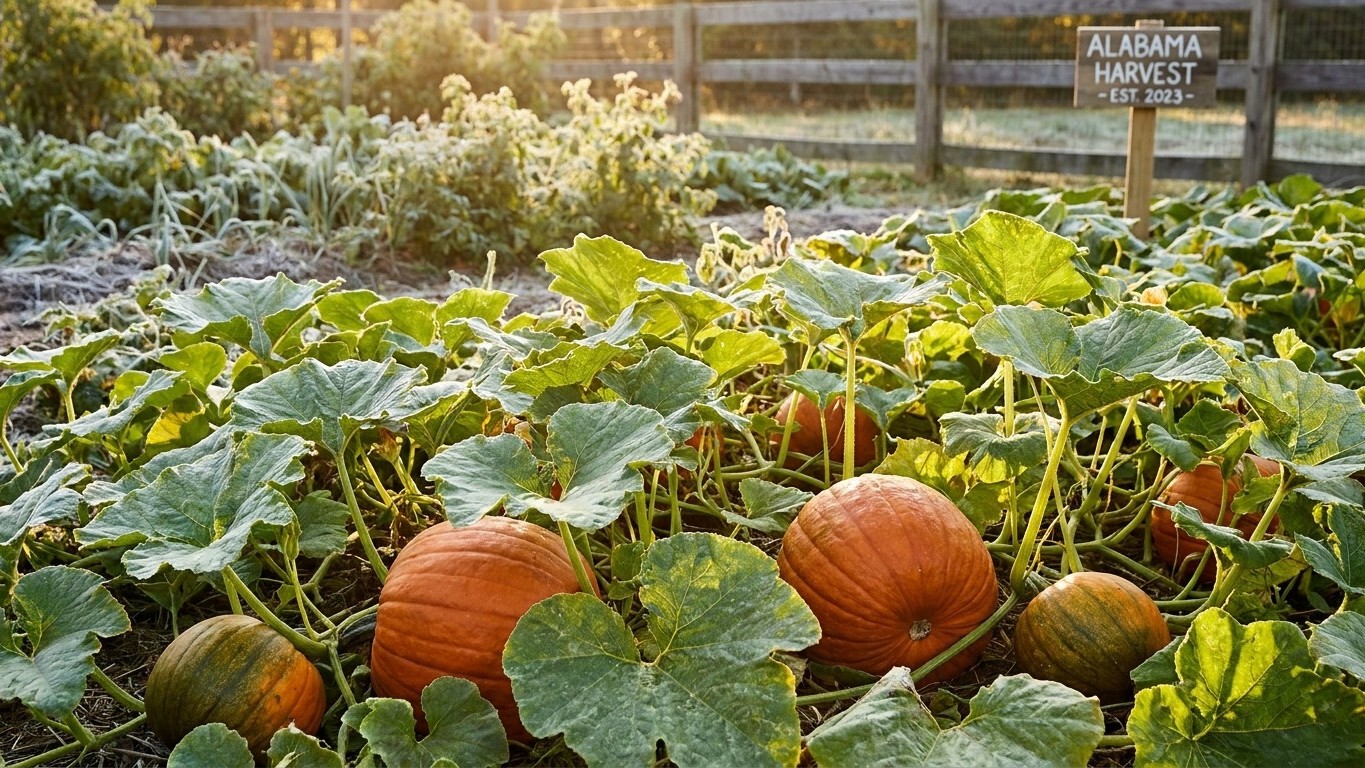

Yes, but only if the flowers open in time. Alabama’s first fall frost typically lands between November 2 and November 16, and a pumpkin needs 45 to 55 days from the day its flower opens to reach full color and a hardened rind. Work that math backward and the safe flowering window runs through roughly early September to early October. Miss it, and the result is green fruit on a vine that’s already been touched by cold. Check your own county’s frost history before betting the patch on the reference dates below.
The short answer
Alabama’s first fall frost, based on NOAA’s 32°F freeze-probability data for station USW00003856, falls somewhere between November 2 and November 16. That’s a single airport station’s record, and it matters because every other date in this calculation flows backward from it.
Counting backward from frost
Utah State University Extension puts pumpkin maturity at 45 to 55 days after the flower opens, not after the seed goes into the ground. That distinction changes the whole conversation. A pumpkin plant can sit in the garden for weeks before it ever sets a female flower, and none of that vegetative time counts toward the ripening clock. Run the subtraction both directions. Take the earliest frost date, November 2, and subtract the longest maturity window, 55 days, and the result lands near September 8. Take the latest frost date, November 16, and subtract the shortest maturity window, 45 days, and the result lands near October 2. That gives a working window: flowers opening anywhere from early September to early October have a real shot at finishing before the vine meets frost. Flowers opening after that window are gambling against the calendar.
The 45- to 55-day figure applies broadly, not variety by variety. Whether the seed in the ground is Jack Be Little, Connecticut Field, Long Island Cheese, New England Pie, Howden, Big Max, Cinderella, Baby Boo, or Sugar Pie, this is the range Utah State University Extension publishes. The source doesn’t break the number down further by cultivar, so the same window applies regardless of which of these names is growing in the bed.
Why the window is a range, not a date
Frost doesn’t arrive on a schedule pinned to a wall calendar; it arrives inside a probability band, and the November 2 to November 16 range reflects that spread at one weather station. Suburban and rural gardens away from that station commonly see frost earlier, sometimes by a week or two, and gardens at higher elevation see it earlier still. That makes the September-to-early-October flowering window described above the generous end of the estimate, not the safe end. The practical move is counting backward from your own county’s typical first frost rather than the airport reading alone, and building in a buffer. A flower opening on the very last safe day leaves no margin if a cold front arrives early, which happens most seasons somewhere in the state.
When to sow here
Sowing date and frost date are two different numbers, and treating them as the same thing is where a lot of Alabama pumpkin patches go wrong. The last spring frost here runs March 19 to April 3, from the same NOAA station data. Soil, though, doesn’t warm at the same pace as air.
Why 65°F soil comes later than the frost date
Pumpkin seed needs soil at 65°F to germinate reliably, and that threshold isn’t reached the moment the last frost passes. The ground holds onto winter cold longer than the air above it, so the ground can still be well short of 65°F even after the frost risk has cleared. That lag is exactly why the last-frost window can’t double as a sowing signal on its own; it only marks the earliest point after which soil warming can begin in earnest.
Steps for timing it right
- Let the frost date pass first. Treat March 19 to April 3 as the earliest boundary, not the sowing date itself, and check your own county’s frost record, since gardens away from the reference station often see frost linger later into spring.
- Check the soil, not the air. Push a soil thermometer a few inches into the bed and wait for a consistent 65°F reading before dropping seed. Air temperature alone will overstate how ready the ground actually is.
- Use row covers to close the gap. A row cover trapping daytime heat over the bed can effectively buy about two weeks, letting the soil beneath it reach 65°F sooner than bare, uncovered ground would manage on its own.
- Work backward from the flowering deadline. Since flowers need to open by roughly early September to early October to finish before frost, and since seed-to-flower time adds more weeks on top of germination, sowing as early as soil conditions safely allow gives the plant the most room to reach that flowering window without being rushed.
- Stagger the planting if the bed allows it. Sowing a second round one to two weeks after the first hedges against a cool spring that delays soil warming, without pushing every flower toward the risky end of the season at once.
What goes wrong here
Alabama’s growing season is long enough for pumpkins most years, but the margin for error is thinner than the frost dates alone suggest. A handful of failures show up more than any others.
Three failures tied to the calendar
- A late flower that never colors. When a female flower opens after the early-October edge of the safe window, the fruit behind it may reach full size but stall out green or pale, since the 45 to 55 day clock runs out before the rind and flesh finish coloring. Track flowering dates through the season and remove flowers that open too late to matter, so the vine’s remaining energy goes into fruit that still has a real chance.
- A fruit caught by frost mid-ripening. Even a fruit tracking well can get overtaken if the first fall frost lands on the early edge of the November 2 to November 16 window, or earlier still in a garden away from the reference station. Watching local forecasts and harvesting early, stem attached, moves a nearly-ripe pumpkin somewhere it can keep finishing rather than leaving it exposed to a freeze.
- A vine that dies back before the skin hardens. Cool nights can kill foliage well before the fruit’s rind has hardened enough for storage, even without a hard frost hitting the fruit itself directly. Cutting the fruit free with its stem intact and curing it in a warm, dry spot lets the rind finish off the vine. The source material is explicit that the only stated requirement afterward is keeping it somewhere it will not freeze; it publishes no storage temperature or keeping-time figure beyond that.
- Vines weakened before the ripening clock even starts. Pest pressure earlier in the season can knock a vine back enough that flowering gets pushed into the risky window in the first place. Alabama’s own squash bug and cucumber beetle pages cover how to keep vines healthy enough to flower on schedule instead of running late.
Common questions
What if my pumpkin flower opens in October?
A flower opening in early October sits right at the edge of the calculated window, and one opening later than that is unlikely to produce a fully colored fruit before frost, based on the 45 to 55 day maturity window measured from flowering. Fruit from a late flower can still be picked green and used, but it won’t finish coloring on the vine.
Does the last spring frost date affect when pumpkins ripen in fall?
Only indirectly, through soil temperature. The last spring frost, March 19 to April 3 at the reference station, sets the earliest point after which soil can begin warming toward the 65°F pumpkins need to germinate. The fall ripening deadline is set separately, by the first fall frost and the 45 to 55 day post-flowering clock.
Can I still harvest a pumpkin that isn’t fully colored when frost is coming?
Cutting the fruit with its stem attached before frost hits and moving it somewhere it won’t freeze is the guidance the source material gives. It does not publish a storage temperature or a keeping-time figure for fruit harvested before full maturity, so treat “won’t freeze” as the only stated benchmark.
Why does my county’s frost date seem different from the November 2 to November 16 window?
That window comes from one NOAA reference station. Suburban and rural gardens, and anywhere at higher elevation, commonly see the first fall frost arrive earlier than the station reading, sometimes by a week or two. Local frost history should carry more weight in your planning than the station figure alone.