
In Calgary and most of Alberta, the safe window for sowing spinach for a fall harvest runs from early July through the last days of that month, counted backward from a target harvest before the season’s first hard frost. Spring sowing happens on a different clock entirely, tied to a frost date in late May. Two separate signals govern these two windows, and neither one is the calendar page most gardeners reach for first.
The short answer
On the longest day of the year, the Calgary area gets 16 hours and 20 minutes of daylight. That number matters more than any thermometer reading, because spinach bolts, meaning it throws up a flower stalk and turns bitter, in response to long days just as much as to warmth. A cool Alberta summer does not buy a spring-sown crop extra weeks the way it might for a plant that only reacts to heat. Sixteen-plus hours of light stacking up toward the June solstice is enough on its own to push spinach toward flowering, no heat wave required.
Day length sets the outer limit
This is the part gardeners moving from a milder region tend to misjudge. They assume that because Alberta summers stay mild, spinach sown in spring will simply keep growing longer than it would somewhere hot. It won’t. The trigger is the length of the day itself, and that clock runs the same in a cool prairie summer as it would in a scorching one. Whatever window a spring crop has, it closes as the solstice approaches, heat or no heat.
Heat is a minor factor here
Where heat usually finishes off spinach elsewhere, it barely enters the picture at this reference station: the average number of days per year reaching 90 degrees Fahrenheit or higher is 0.0. Spinach grows best below 75 degrees, and that ceiling is also the bitterness threshold, the point where flavor turns sharp even if the plant hasn’t bolted yet. In a region that essentially never sees true heat extremes, that 75-degree line gets crossed mostly because of long-day bolting pressure, not because the air itself has turned brutal. So the honest answer is that day length is the dominant limit on the spring crop here, with heat playing only a supporting role, while the fall crop faces a different obstacle altogether: soil that’s still too warm to let seed germinate.
How long the spring window really is
Spinach seed goes into the ground two to three weeks before the average last spring frost, which at the Calgary International Airport station lands on May 21. That date is a mean from the 1981-2010 climate normals, not a guarantee. In one year out of two, the real last frost falls later than May 21, so treat it as the middle of a range rather than a line you can plant right up against.
Counting the weeks step by step
- Start from the average last frost date of May 21, keeping in mind it is a midpoint, not a safe cutoff.
- Count back two to three weeks to find the sowing window, landing somewhere around late April to early May.
- Track the growth ceiling of 75 degrees Fahrenheit, which this station rarely crosses given zero average days at or above 90.
- Watch the calendar approach the June solstice, when daylight reaches 16 hours and 20 minutes and bolting pressure builds regardless of temperature.
- Expect usable harvest quality to fade as day length climbs through late May and June, closing out the spring crop well before high summer.
Add it up and the spring window runs roughly six weeks from a late-April or early-May sowing to a harvest that needs to wrap up before the longest days of June take over. That’s a narrower stretch than the mild spring temperatures might suggest, because the clock that ends it isn’t the thermometer.
The autumn crop, and when the soil lets you sow
Fall spinach flips the spring problem around. Instead of racing daylight, the gardener is waiting for soil to cool down enough for seed to sprout, then racing the season’s first frost to get a harvest in. Utah State University Extension frames the fall planting rule simply: sow 50 to 75 days before the date you want to harvest.
The soil is still too warm to germinate
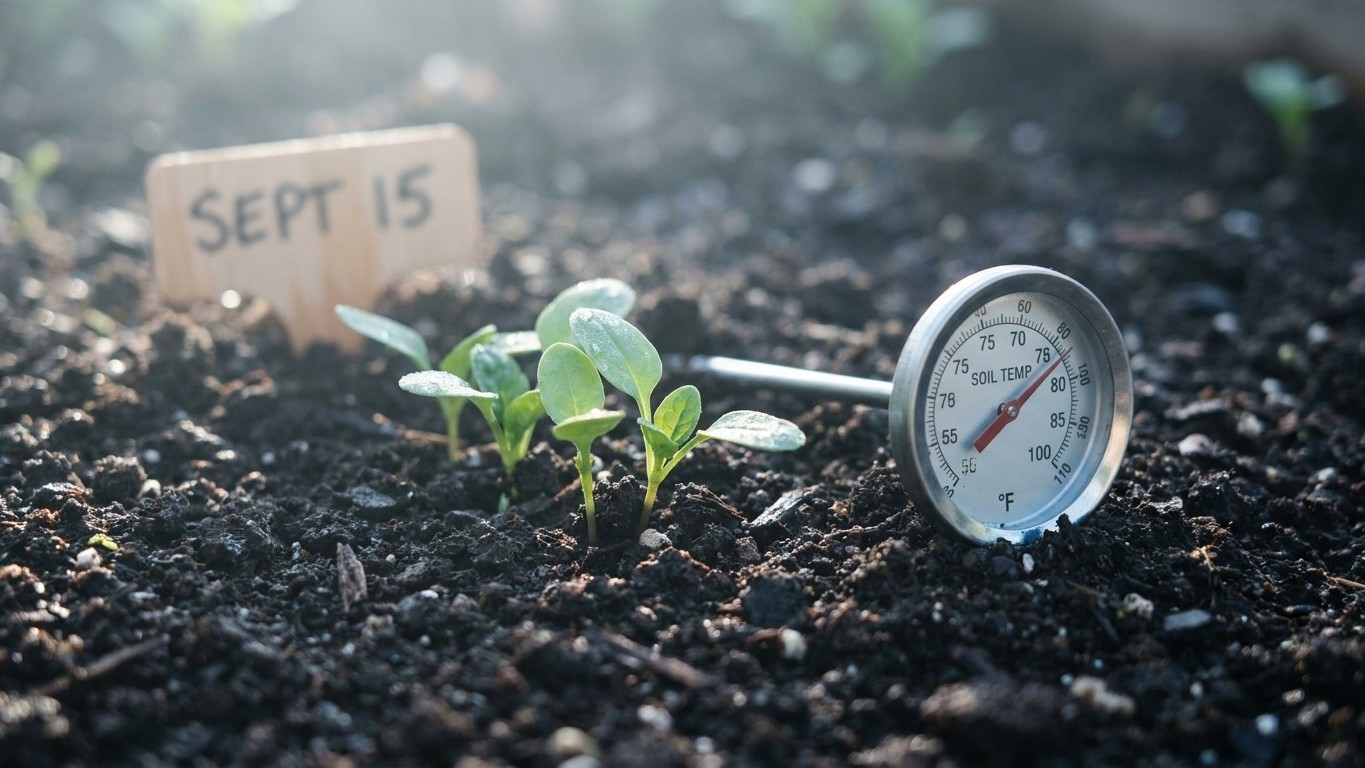
Spinach seed germination drops off once soil temperature climbs above 80 degrees Fahrenheit. Even in a region with no average days above 90, direct summer sun can still heat the top few inches of a garden bed well past that mark through most of July. Since this station rarely delivers extreme air temperatures, the soil-warmth barrier here tends to ease earlier in the season than it would in a hotter climate, but exposed, south-facing beds can still run hot enough in early-to-mid July to slow or stop germination. Waiting until late in the month, watering beds down before sowing, or planting in a bit of afternoon shade all help seed make contact with cooler ground.
The frost that ends the season
The average first fall frost at the Calgary station lands on September 16, again a mean date from the 1981-2010 normals rather than a promise. Half the time, frost arrives later than that. Counting back from a harvest target around that date, 50 to 75 days puts the sowing window between roughly early July and late July. Sow too early and seed sits in soil too warm to sprout well; sow too late and there isn’t enough time left before frost cuts the season short. Splitting the difference, mid-to-late July sowings give fall spinach the best shot at reaching a harvestable size before the season’s average frost date arrives, with the understanding that a later-than-average frost, which happens about half the time, can stretch that window a little further.
The source names four spinach varieties commonly grown for these plantings, Bloomsdale, Melody, Teton, and Olympia, but publishes no days-to-maturity figures or performance data for any of them, so no comparison between them can be made here beyond naming them.
Common questions
Does spinach need long days to grow well?
No. Long days are the opposite of helpful for spinach. Extended daylight, combined with warm temperatures, is what triggers bolting and bitterness. Spinach grows best in shorter, cooler stretches of the calendar, which is exactly why the spring window closes as June’s long days arrive and why the fall window opens once daylight starts shortening again.
Can a light fall frost hurt an autumn spinach crop?
The source used for these dates covers soil temperature and heat limits, not a specific frost-tolerance threshold for spinach in this territory, so no frost-hardiness number is published here to cite. What is documented is that the average first fall frost date is a midpoint, meaning frost commonly arrives later than September 16 in any given year, which in practice gives a fall-sown crop a bit more room to finish than the average date alone suggests.
Which spinach variety should I plant in Alberta?
Bloomsdale, Melody, Teton, and Olympia are named as spinach varieties in the source material, but no data on their maturity speed, bolt resistance, or yield is published there. Choosing between them means relying on seed packet information rather than the climate figures behind this planting guide.
When exactly should I sow spinach for a fall harvest?
Working from an average first frost of September 16 and the 50-to-75-day rule, sowing lands roughly between early July and late July. Soil temperature above 80 degrees can slow germination early in that window, so many gardeners lean toward the back half of July, watering beds to cool the soil before seed goes in.