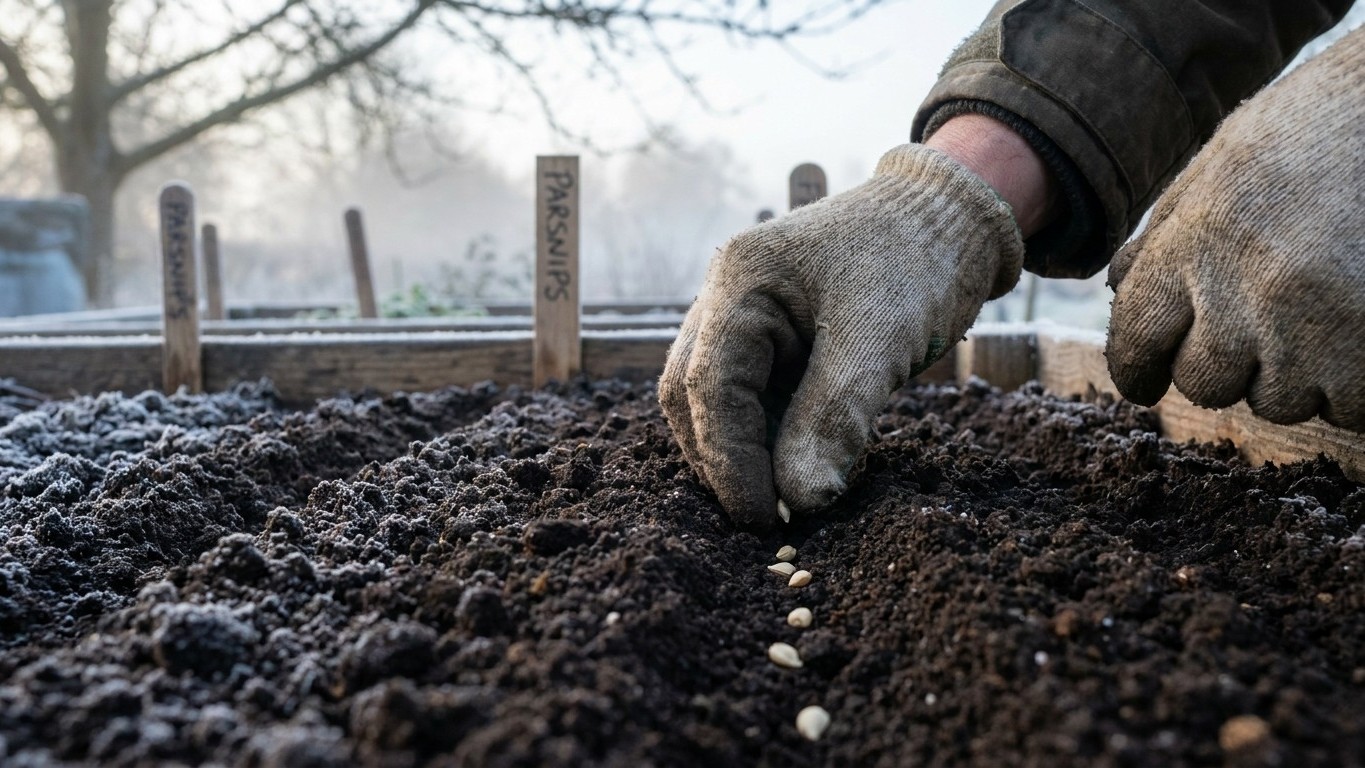

In low-desert Arizona, including Phoenix, parsnips go in the ground in fall, typically October into November, timed so the 100 to 120 day root matures during the mild winter stretch rather than the killing summer heat. The catch: this region rarely delivers the sustained frost that turns a parsnip’s starch to sugar, so the root grows well but often stays mild rather than sweet.
The short answer
Everything about parsnip timing here comes down to one question: does this territory hand you several frosty weeks, or not? For the Phoenix reference station, the mean daily minimum of the coldest month sits at 45.3°F. That’s the average low temperature you can expect night after night in the coldest stretch of the year, and it’s nowhere near freezing. A parsnip patch grown under those conditions will size up fine. It just won’t go through the repeated freeze cycles that convert stored starch into sugar, which is the whole reason gardeners chase this crop in the first place.
Compare that 45.3°F average low against what parsnips actually need. Utah State University Extension describes the sweetening process as something that happens after several weeks of cool, frosty weather. A single light frost won’t do it. A mean low in the mid-40s definitely won’t do it, because the ground and the root itself rarely dip to freezing at all, let alone for a stretch of weeks. In the Phoenix area specifically, records show the temperature reached 32°F in only 6 of 30 recent springs. That’s not “several frosty weeks.” That’s an occasional cold snap that shows up in some years and skips others entirely.
So the honest answer for low-desert Arizona is that you can absolutely grow a parsnip here, but you’re growing it for the vegetable itself, not for the frost-sweetened flavor gardeners in colder states are used to. If sweetness is the goal, this climate works against you no matter when you sow. If you’re fine with a mild, decent parsnip and you’re mainly trying to dodge the summer heat that ends the growing window everywhere else, then fall sowing solves your actual problem.
One more distinction matters here: Arizona is not one climate. The high country around Flagstaff and similar elevations does freeze hard in winter, a genuinely different pattern from the low desert. That region isn’t covered by the Phoenix data used above, so no specific sweetening timeline can be given for it from these figures. Gardeners at elevation should treat their local frost pattern as its own separate question, not an extension of the Phoenix numbers.
Does the season fit?
Parsnips are sown directly in place, never transplanted, and the 100 to 120 day count starts the moment seed goes into the soil, not when the first sprout appears. Working out whether that window fits low-desert Arizona means walking through the calendar step by step.
- Forget the “last frost” rule. The usual advice, sow 2 to 3 weeks before the last spring frost, assumes a real frost date exists. In Phoenix, NOAA lists a 365-day frost-free season in most years, and freezing temperatures only showed up in 6 of 30 recorded springs. There’s no reliable last-frost date to count backward from, so this classic timing rule simply doesn’t apply here.
- Sow by heat, not by frost. The real constraint in the low desert is summer heat, which halts germination and stresses root vegetables for months. That pushes the sensible sowing window to fall, once the worst heat has broken, roughly October into November.
- Add germination time first. Parsnip seed is slow to sprout, taking 14 to 21 days to germinate. Dig too early looking for seedlings and you’ll disturb a bed that’s simply still working. Plan on three weeks of patience before you see any green.
- Then add the 100 to 120 day root-growing period. Starting the clock at an October sowing, 100 to 120 days lands the crop’s maturity somewhere in the January to February range, squarely inside the mildest, coolest stretch of the desert calendar.
- Check that window against the coldest month. That January to February maturity period coincides with the same stretch where the mean daily minimum runs 45.3°F. The timing itself fits comfortably; the temperature during that timing does not deliver the frost exposure the crop wants for sweetening.
So the season fits, arithmetically, without much strain. Fall sowing avoids the heat, gives the seed its full germination window, and lets the 100 to 120 days play out before spring warmth returns. What doesn’t fit is the crop’s separate demand for prolonged cold, which this calendar can satisfy in terms of length but not in terms of intensity.
What goes wrong here
- Forked, twisted roots from heavy or stony ground. Parsnips need deep, loose, sandy soil to send a straight taproot down. Desert soil in much of Arizona runs heavy or compacted, and Utah State University Extension notes that heavy soil has to be double dug before planting or the root will hit resistance and split into forks. This is a separate problem from soil moisture and needs its own fix: loosen and amend the bed to a full spade’s depth before seed goes in, not after.
- Forked roots from overwatering. Even in soil that’s been properly worked, too much water causes the same forking symptom for a different reason, waterlogged ground encourages the root to branch rather than push straight down. Because desert gardeners often overcompensate with irrigation, this is a distinct risk that heavy soil alone doesn’t explain, and it calls for a separate remedy: water deeply but less frequently, letting the bed dry somewhat between soakings.
- A season that runs out at the wrong end. Sow too late in fall and the 100 to 120 day clock pushes maturity into the warming days of spring, right when temperatures start climbing again. Since there’s no frost date to force an early start, the temptation is to delay sowing past the point where the root has time to finish before heat returns. Counting backward from mid-February, using the full 100 to 120 days plus the 14 to 21 day germination lag, sets the real deadline for getting seed in the ground.
- A winter too mild to ever sweeten the crop. Even a well-grown, well-timed parsnip in the low desert runs into the ceiling described above: a 45.3°F mean low in the coldest month simply doesn’t deliver the sustained frost exposure the root needs to convert starch to sugar. There’s no sowing-date fix for this one. It’s a climate limitation, not a technique problem, and it separates low-desert Arizona from the colder states where this crop is traditionally grown.
Common questions
Can parsnips grow at all in Phoenix and the low desert?
Yes. The season length fits, and fall sowing avoids the summer heat that stops most root vegetables cold. What the climate can’t deliver reliably is the frost exposure that sweetens the flavor.
Should I sow parsnips in spring in Arizona’s low desert?
No. There’s no dependable last-frost date to plan around, since Phoenix records a frost-free season in most years. Spring sowing also runs the root’s growth period straight into rising summer heat, which is the opposite of what parsnips need.
Why did my parsnip roots come out forked or split?
Two separate causes produce this in Arizona gardens: heavy or stony soil that resists a straight taproot, and overwatering, which encourages branching even in well-prepared beds. Check which one applies before adjusting your approach, since the fixes are different.
Is Flagstaff or the Arizona high country different from this guidance?
Yes, significantly. That elevation freezes hard in winter, an entirely different pattern from the low desert. No frost or sweetening timeline for that region is covered by the figures used here, so treat it as a separate question tied to its own local frost dates.