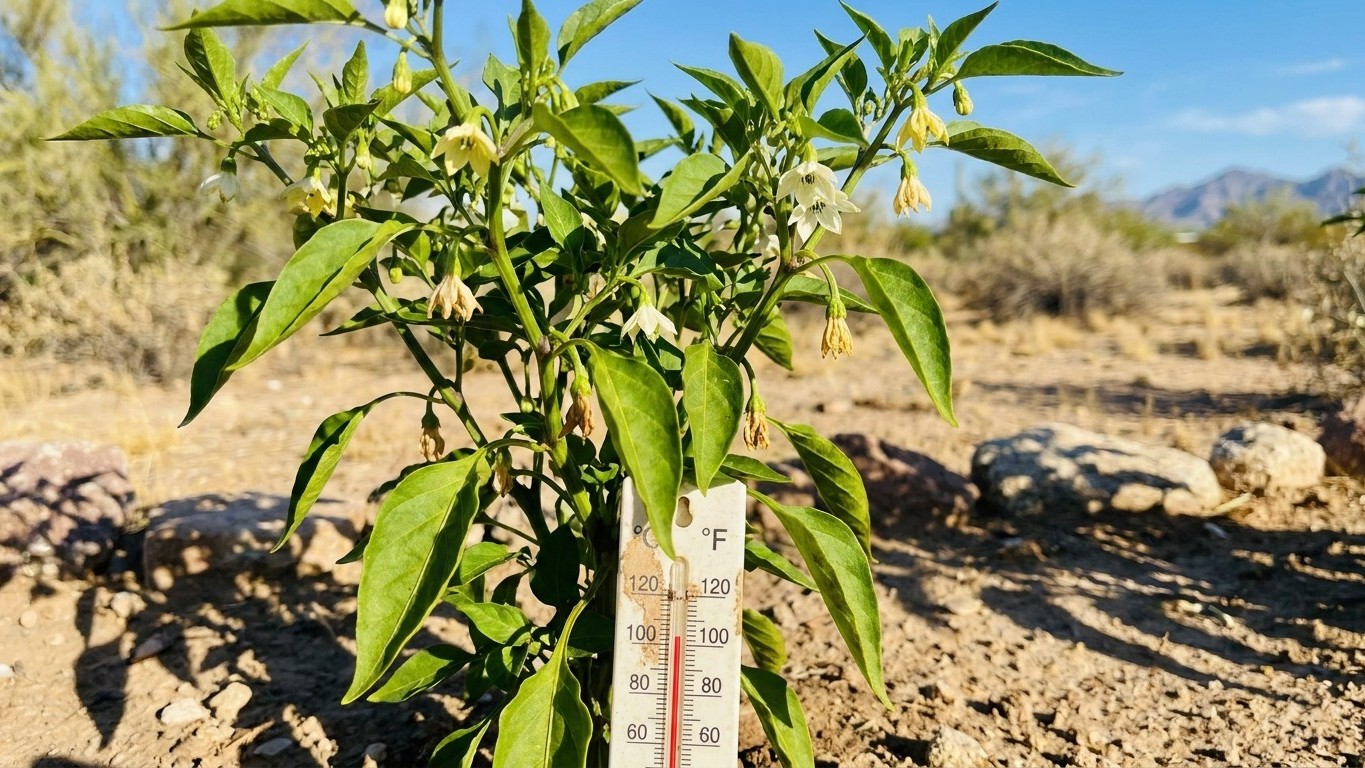

Peppers stall out in Arizona for one main reason: the state’s low desert spends nearly half the year too hot for pollen to work. Phoenix averages 168.9 days annually at or above 90 degrees Fahrenheit, and pepper flowers drop rather than set fruit once heat like that settles in. The other failure point sits at the opposite end of the thermometer, nights under 55 degrees. This site doesn’t track summer night lows for Arizona, so a grower needs to watch a home thermometer for that threshold rather than guess at it.
The short answer
The hot end
Start with the number that actually drives most Arizona pepper failures: 168.9 days a year at or above 90 degrees Fahrenheit, measured at the Phoenix reference station over the 1991-2020 period tracked by NOAA’s Climate Normals. That’s roughly 46 percent of the calendar. Pepper flowers respond to that kind of heat by aborting rather than setting fruit, which is why plants can look healthy, keep blooming, and still hand you almost nothing to pick. It isn’t disease and it isn’t a watering mistake in most cases. It’s the thermometer overriding the plant’s own reproductive timing.
That single figure also explains why the same garden can produce well in April and go silent by July. The heat load doesn’t arrive all at once, it builds toward a stretch of consecutive days that push past the fruit-set ceiling, and once that stretch settles in, it tends to hold for weeks.
The cool end
Fruit set fails at the other extreme too, when nights drop below 55 degrees. Utah State University Extension lists that cool-end threshold right alongside the hot one, and it matters in Arizona more than the state’s reputation for heat would suggest. Early spring and late fall, the same weeks when daytime highs are finally comfortable, can still carry night lows cold enough to stop the same blossoms that survived the summer.
This site doesn’t carry summer night minimum data for Arizona, so there’s no local figure to hand over here. The practical move is to keep a simple outdoor thermometer running through those transition weeks and note when overnight readings dip near 55, rather than assuming a date on a calendar will tell you. Elevation changes fast across the state, and a reading in one part of a county can look nothing like a reading twenty minutes up the road.
When to start seed here
The arithmetic behind pepper starts is straightforward once you know which end of the season is actually setting the deadline. In most of the country that deadline is the last frost. In Arizona’s low desert, it usually isn’t.
- Drop the frost calendar for the low desert. At the Phoenix reference station, a 32-degree reading showed up in only 6 of 30 spring seasons, and NOAA lists the frost-free season there at 365 days. Frost simply isn’t the limiting factor most years. If you garden in Flagstaff or elsewhere in Arizona’s high country, none of this applies. Those areas do freeze hard, and you’ll need your own local frost dates rather than anything tied to the low desert.
- Track soil temperature instead of the frost date. Transplant pepper starts once the soil holds steady at 60 degrees Fahrenheit. A soil thermometer pushed a few inches down, checked over several mornings, tells you more than any average date ever will.
- Count back 8 to 10 weeks from that soil-temperature date. That’s your indoor sowing date. If your soil typically firms up at 60 degrees in early spring, back up 8 to 10 weeks from that point on your own calendar to know when seed needs to go into trays under lights.
- Check the heat clock before you commit. With Phoenix averaging 168.9 days a year at 90 degrees or hotter, work out roughly when your own area starts running that hot on a regular basis. Transplants that go out too small or too late end up trying to flower right as that heat window opens, and the blossoms simply won’t hold.
- Consider a second window in fall. Once the long run of 90-plus days finally breaks, some low-desert gardeners get another stretch of fruit set before overnight lows drop toward that 55-degree cutoff. Watch your own nights closely here, since that’s the variable this site doesn’t track for you.
What goes wrong here
Three failure points
- Blossom drop. Triggered from either direction: a run of days above 90 degrees, or a night that drops below 55. Since summer night lows aren’t published here for Arizona, keep a thermometer on the patio through the shoulder seasons and log what you actually see. If highs are holding above 90 for several days straight, or nights are dipping near 55, expect flowers to fall rather than set. The remedy is timing, not fertilizer: concentrate on getting fruit set done in the narrow window between those two extremes rather than fighting either one directly.
- Sunscald. Direct sun in Arizona is intense enough to damage exposed fruit, especially on plants that have been pruned hard or that never filled in a full canopy. Fruit sitting unshaded on the south or west side of a plant can develop pale, papery patches that soften and rot. The fix is coverage: let the plant keep its leaves, and add shade cloth over the hottest stretch of the day if the canopy alone isn’t doing the job.
- Blossom-end rot. This shows up as a dark, sunken patch on the bottom of the fruit, and in most home gardens it traces back to uneven watering rather than a true calcium shortage in the soil. Desert heat dries containers and raised beds fast, and a plant that goes from soaked to bone-dry and back again can’t move calcium into new fruit reliably. A steady irrigation schedule and a layer of mulch to slow moisture swings solve this far more often than adding calcium products does.
Common questions
Does Arizona ever get frost that would kill pepper transplants?
In the low desert around Phoenix, rarely. NOAA’s 1991-2020 data lists a 365-day frost-free season there, and the reference station only recorded a 32-degree reading in 6 of the 30 spring seasons in that record. A cold snap can still bring a freeze between late December and mid-January in an occasional year, but for most gardens in that part of the state, frost isn’t the factor that decides when to transplant. Higher elevations in Arizona are a different climate and do freeze hard, so that guidance doesn’t carry over.
How many days a year are too hot for pepper fruit set in Arizona?
At the Phoenix reference station, the average is 168.9 days a year at or above 90 degrees Fahrenheit, based on NOAA’s 1991-2020 Climate Normals. Pepper flowers tend to abort rather than set fruit once heat like that holds for multiple days in a row.
What temperature stops peppers from setting fruit on the cool end?
Utah State University Extension puts that threshold at nights below 55 degrees Fahrenheit. This site doesn’t carry summer night minimum figures for Arizona locations, so there’s no published local number to lean on here. Watching a home thermometer through spring and fall transitions is the reliable way to catch it.
How far ahead should pepper seeds be started for an Arizona garden?
Start seed indoors 8 to 10 weeks before transplanting, and transplant once soil temperature holds at 60 degrees Fahrenheit, per Utah State University Extension guidance. In the low desert, that soil-temperature marker matters far more than the frost date, since frost is close to a non-issue there most years.