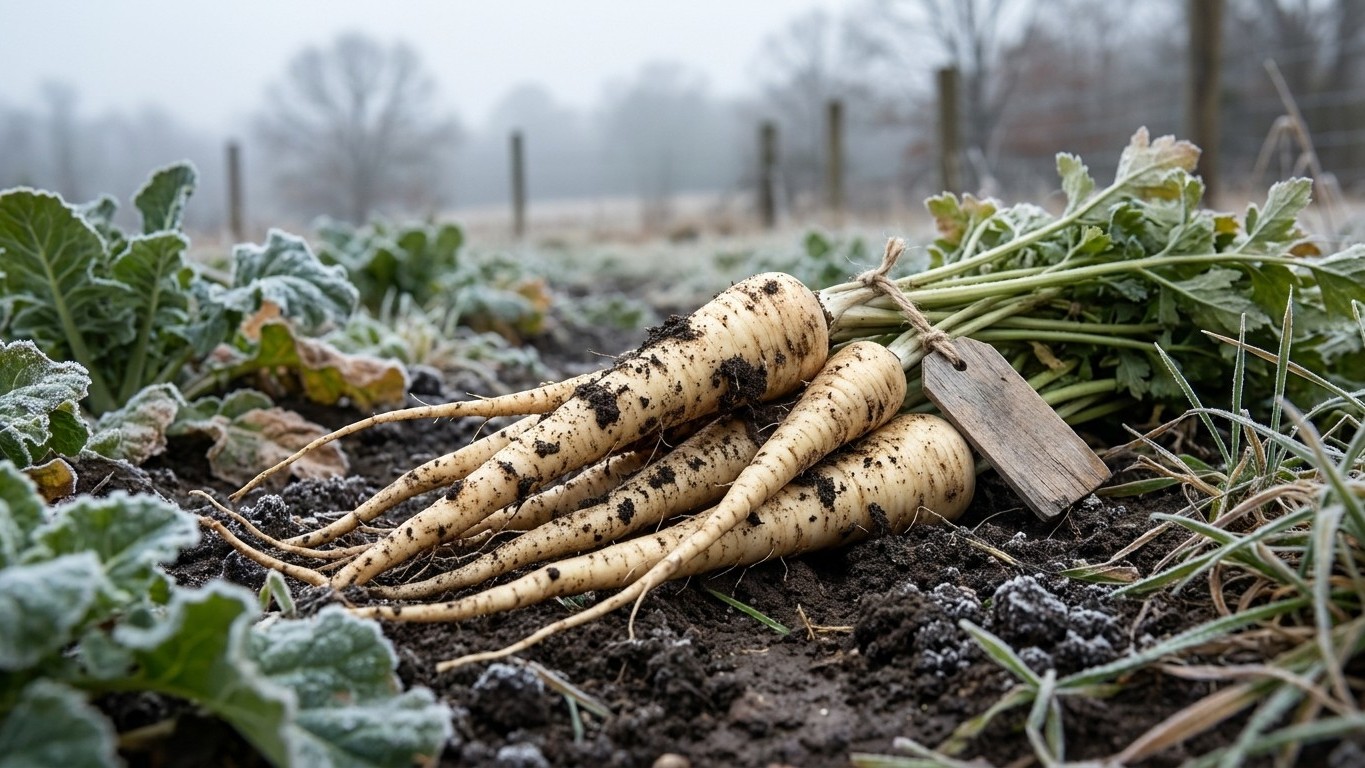

Most of California will grow a fine parsnip. It just won’t taste the way the old garden wisdom promises. The reference station in Los Angeles shows an average minimum of 49.1°F in the coldest month, and NOAA’s 30-year record counts zero freezing days there in a typical year. That’s not a hardiness question, it’s a chemistry one. Sweetening happens when frost hits the root, and along the coast and through the south, frost simply doesn’t show up.
The short answer
Here’s the question that actually settles this: does the ground here see several weeks of real cold? Not a mild dip, not one chilly night, several consecutive weeks of cold air sitting on the soil. At the Los Angeles reference station, the answer is no. The coldest month averages a minimum of 49.1°F, a temperature that never dips into frost territory on an average year. NOAA’s daily record backs that up further: over three decades, that station logged zero days at or below 32°F, and the frost-free season is listed at a full 365 days.
That number matters more than any hardiness zone rating ever could. A hardiness zone tells you whether a perennial plant will survive winter. It says nothing about whether a root vegetable sitting in the ground will convert its stored starch into sugar. Parsnips do that conversion only when exposed to sustained cold, and a mean minimum of 49.1°F in the coldest month never gets close to the threshold where that reaction kicks in. Grow a parsnip in coastal or southern California and you’ll harvest a perfectly edible, perfectly starchy root. It will not develop the sweetness gardeners in colder climates rave about.
This is also where the state gets misunderstood by anyone reading a single climate stat and assuming it applies everywhere. California is enormous, and its interior behaves nothing like its coast. Northern California, the Central Valley, and the Sierra foothills and higher elevations do experience real winter freezes, some of them hard and prolonged. A grower in those regions is working with an entirely different climate than someone gardening a few miles from the Pacific in Los Angeles or San Diego. The reference station data here describes the coastal and southern pattern specifically, not the state as a whole.
So the honest answer splits in two. Along the frost-free coast and through the southern lowlands, parsnips will grow but won’t sweeten, because the frost exposure that triggers the starch-to-sugar shift never arrives in an average year. Move inland and north, toward the Central Valley or up into the Sierra, and the calculus changes entirely, because those areas do get the cold spells parsnips need. The plant is the same everywhere. The climate underneath it is not.
Does the season fit?
Parsnips are sown directly into the ground where they’ll mature, not started indoors and transplanted, and the standard timing is a sowing 2 to 3 weeks before the last frost, followed by 100 to 120 days until the roots are ready. In a frost-free zone, that anchor point simply doesn’t exist, so the arithmetic has to run a little differently.
- There is no last spring frost date to count backward from here. NOAA’s 30-year record for the reference station shows no computable freeze normal at all, so gardeners in this climate anchor sowing to soil temperature and the cooler part of the calendar instead of a frost line.
- Once seed goes into the ground, germination takes 14 to 21 days. This is slow enough that an impatient gardener often assumes the seed failed and re-sows, disturbing a bed that was actually working fine.
- From that germination point, the root needs 100 to 120 days of growing before it reaches harvestable size, an interval that has nothing to do with frost and everything to do with steady root development in loose, deep soil.
- Add the germination window and the maturity window together, and a full cycle runs roughly 114 to 141 days from seed to harvestable root, well over three months.
- Set that figure against a 365-day frost-free season, and the calendar has plenty of room. Length of season is not the limiting factor in coastal and southern California the way it is in short-summer climates.
- What the calendar can’t provide, no matter when you sow, is the several weeks of frost exposure the crop needs afterward to sweeten. The season fits comfortably in terms of days. It never fits the sweetening requirement, because that requirement is about temperature, not time.
The practical upshot: in this climate, timing your sowing is about avoiding the hottest stretch of the year rather than racing a frost date. Get the seed in early enough that the root finishes its growth before peak summer heat, and you’ll have plenty of season to work with. Just don’t expect the calendar math to deliver the flavor that gardeners in colder states get almost automatically.
What goes wrong here
- Forked or split roots in heavy or stony native ground. Parsnips push a single taproot straight down, and anything solid in its path, compacted clay, rocks, hardpan, splits that root into two or three legs. Utah State University Extension recommends deep sandy soil, and where the native ground is heavy, double digging the bed before sowing so the root has clear, loose soil to grow through.
- Forked roots from overwatering. This is a separate cause from heavy soil, not the same problem in disguise. Too much water, applied too often, encourages the root to branch rather than drive straight down, even in soil that’s otherwise loose and workable. The fix is a steady, moderate watering schedule rather than frequent heavy soaking.
- A season that runs out before the root finishes, not from cold but from heat. In coastal and southern California, the constraint isn’t a short window before frost, it’s the arrival of summer heat before the 100 to 120 days are up. Sowing too late in spring means the root is still developing when temperatures climb, which stresses growth and stunts the taproot. Sowing early enough to finish before the hottest stretch avoids this.
- A winter too mild to ever sweeten the crop. This one has no fix within the garden itself. The coldest month here averages a 49.1°F minimum, and frost simply doesn’t occur in an average year along the coast and through the south. A grower who wants the classic sweet, frost-touched parsnip has to look to a genuinely colder microclimate, higher elevation, or the interior and northern parts of the state where real winter freezes happen, rather than trying to force sweetness out of a mild coastal winter.
Common questions
Can parsnips grow in Los Angeles or coastal California?
Yes. The soil stays workable year-round and the frost-free season runs a full 365 days on average, so length of growing season is not a barrier. The roots will grow to full size given loose, deep soil and steady watering.
Will parsnips sweeten without frost?
No. Sweetening happens when stored starch converts to sugar under cold exposure, and that conversion requires several weeks of frosty weather. Where the coldest month averages a 49.1°F minimum and freezing days don’t occur, that conversion simply doesn’t happen, no matter how long the root sits in the ground.
What’s the best time to sow parsnips in California’s frost-free zones?
Since there’s no last-frost date to count from, sow early enough that the 100 to 120 day maturity window, plus the 14 to 21 days germination takes, finishes before the peak of summer heat rather than trying to dodge a freeze that doesn’t happen here.
Do parsnips grow better in Northern California or the Sierra?
Those regions experience real winter freezes, unlike the coastal and southern reference station data cited here. Where sustained cold actually occurs, the crop has the frost exposure it needs to sweeten, something the frost-free coast and south cannot provide regardless of soil quality or timing.