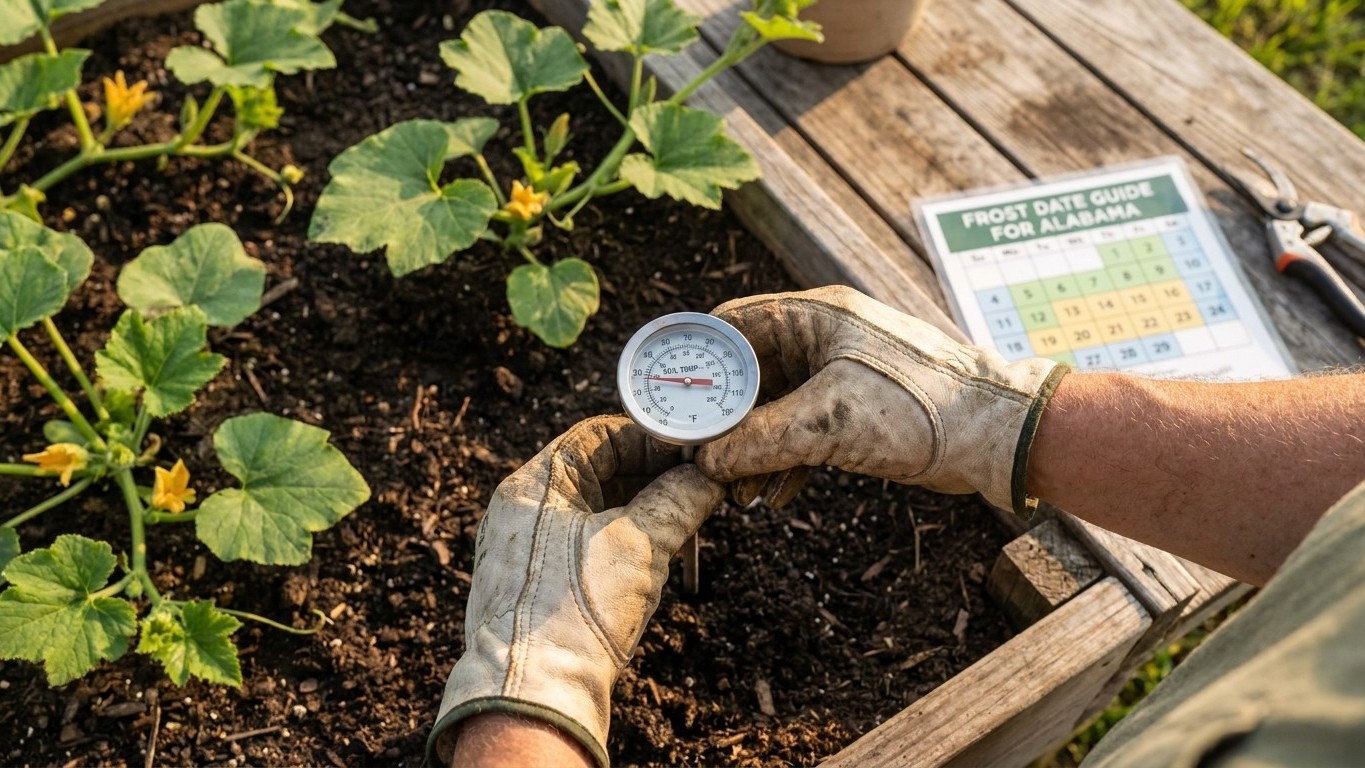

Delaware gardeners sow pumpkin seeds once the soil holds at 65°F, which usually lands somewhere between mid-May and mid-June depending on the spring and how quickly a given yard warms up. That target isn’t random. It’s built backward from the state’s first fall frost, expected between October 26 and November 7, and from the 45 to 55 days a pumpkin needs after its flower opens to finish ripening on the vine.
The short answer
Delaware’s first fall frost typically shows up between October 26 and November 7, based on NOAA’s 1991-2020 Climate Normals for the state’s reference weather station. That’s the hard stop for the growing season. Work backward from it by the 45 to 55 days a pumpkin needs after its flower opens, and you get a flowering deadline: the latest a pumpkin flower can open here and still turn into a fully colored, ripe fruit falls somewhere between September 1 and September 23.
Notice what that math is actually measuring. It’s not counting from the day you drop a seed in the ground. It’s counting from the day a flower opens on the vine, the moment pollination sets the fruit in motion. A vine can be sown early, grow lush, and still miss its window if the first flower doesn’t open until October. The flowering date, not the sowing date, is the number that decides whether a pumpkin colors up or stays green on the vine when frost hits.
There’s a caution worth carrying into every calculation on this page. Those frost dates come from an airport weather station, and airport stations tend to run warmer than the yards, fields, and low-lying gardens most people actually plant in. A suburban lot with a shaded north side, or a rural garden tucked into a valley, often sees its first fall frost arrive one to two weeks earlier than the October 26 to November 7 window suggests, and sometimes more if there’s elevation involved. Treat that window as the state’s reference figure, not a guarantee for your specific plot, and check what your own county has recorded in past seasons if you can.
Whatever variety fills the patch this year, whether it’s a classic Connecticut Field, a miniature Jack Be Little, a Baby Bear, a Cinderella, a Long Island Cheese, a Howden, a Big Max, a Small Sugar, or an ambitious Atlantic Giant, the clock runs the same way for all of them: from flower to frost, not from seed to frost. Variety choice changes vine size and fruit shape. It doesn’t change the arithmetic tying flowering date to frost date.
When to sow here
- Let the last spring frost pass first. Delaware’s reference station shows that landing between April 3 and April 14, but that date only tells you when the air stops freezing, not when the ground is ready for pumpkin seed.
- Check soil, not air. Pumpkin seed needs the soil itself sitting at 65°F, and soil warms far more slowly than the air above it. That means the actual sowing window typically doesn’t open until well into May here, and in a slow, cool spring it can slide into early June, weeks after that last frost has already come and gone.
- Use a soil thermometer instead of a calendar. Push it two to four inches down in the planting bed, check it at the same time on a few consecutive days, and wait for a steady 65°F reading rather than guessing from how warm the afternoon feels.
- Warm the ground faster if the calendar is tight. Floating row covers or dark mulch laid over the bed ahead of planting can buy roughly two weeks, pulling that 65°F threshold earlier than bare soil would reach it on its own.
- Keep the September flowering deadline in the back of your mind while you sow. Because vines need real time to establish before their first flowers open, most Delaware gardeners aiming for that September 1 to September 23 window don’t push sowing much past mid-June, even with row covers helping the soil along.
- Sow seeds about an inch deep in raised hills spaced several feet apart, thin to two or three strong seedlings per hill once they’re up, and harvest with the stem attached before frost, following Utah State University Extension’s harvest guidance.
What goes wrong here
- A late flower never colors. Sow too late, often anytime in July, and the first flowers may not open until well past the September 1 to September 23 deadline. The fruit sets but never gets its full 45 to 55 days before frost cuts the vine down, leaving a green, undersized pumpkin instead of an orange one. The remedy is calendar discipline: count backward from Delaware’s frost window every season rather than by feel, and if a planting is clearly behind, plan on using those fruit for cooking rather than counting on them to color for display.
- A fruit gets caught by frost even after flowering on time. A vine can flower right on schedule and still lose the race if the first fall frost lands on the early edge of the October 26 to November 7 window, or earlier still in a low-lying or rural yard. The remedy is to watch local frost forecasts closely as October approaches rather than relying solely on the reference date, and to harvest at the first real frost warning, cutting the stem cleanly even if the pumpkin hasn’t fully cured on the vine.
- The vine dies back before the skin hardens. Foliage lost early to pests or disease stops feeding the fruit, and a pumpkin left without healthy leaves around it often ends up with a soft, thin rind that won’t store well. Squash bugs and cucumber beetles are common culprits behind that early foliage collapse; see this site’s Delaware pages on squash bugs and cucumber beetles for how to spot and manage them. The remedy is simply keeping the vine’s leaves intact as long into fall as possible, since that foliage is what hardens the rind before frost.
Common questions
Can I still plant pumpkins in July in Delaware?
It’s tight. A July sowing pushes flowering close to or past the September 1 to September 23 deadline calculated from this state’s frost window, leaving little or no cushion for the 45 to 55 days a fruit needs afterward. It can still work in a mild fall, especially in a warmer suburban yard, but a rural garden where frost tends to arrive earlier than the reference date carries real risk of an unripe crop.
Does soil temperature or air temperature decide when to sow pumpkins?
Soil temperature is the number that matters. A 65°F soil reading, taken a few inches down, is the sowing signal, and it lags behind the air by weeks. A warm, sunny stretch of April days doesn’t mean the ground underneath is ready; only a thermometer in the dirt tells you that.
How do I know when a pumpkin flower has “opened” for the clock to start?
The clock starts when the female flower is pollinated and the small fruit behind it begins to swell, not simply when the vine starts blooming. Once that fruit is visibly setting, count forward 45 to 55 days to estimate when it should be ripe and ready to cut.
What’s the safest storage temperature after harvest?
Utah State University Extension doesn’t publish an exact storage temperature, humidity level, or keeping time for pumpkins. The guidance is simply to store them somewhere they won’t freeze. Plan for a dry, cool, frost-free spot rather than a specific degree reading.