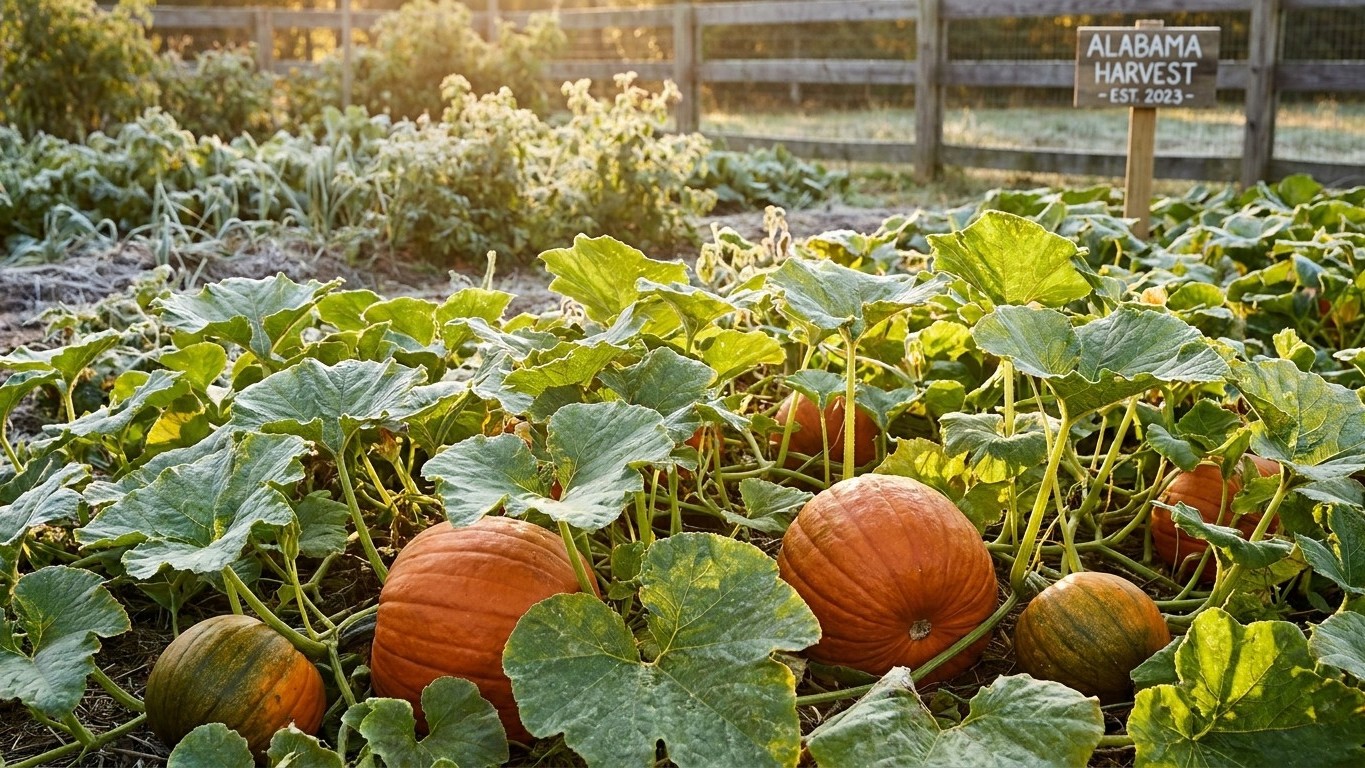

Maine’s first fall frost typically lands between October 9 and October 21, and a pumpkin needs 45 to 55 days after its flower opens, not after the seed goes in the ground, to finish coloring and harden its rind. Cross those two windows and the honest answer is: it depends on when your vines actually bloom. On the coast, timely flowering usually clears the deadline with room to spare. Inland and in northern Maine, where frost arrives earlier, that margin shrinks fast.
The short answer
Maine’s growing season ends with freezing air, not with a date circled on a calendar, and NOAA’s 1991-2020 climate normals put the state’s first fall frost anywhere from October 9 to October 21. That range is the anchor for every pumpkin calculation here. From there, the math runs backward.
A pumpkin flower needs 45 to 55 days from the moment it opens, according to Utah State University Extension’s guide to pumpkins in the garden, to turn a green softball into a ripe, hard-shelled pumpkin. Only female flowers count toward that clock, the ones with a small swelling at the base that becomes the fruit; male flowers open earlier and don’t need tracking. Subtract the maturation window from Maine’s frost dates and you get the latest point a female flower can open and still finish the job.
Take the earliest, most cautious frost date, October 9, and subtract the longest maturation stretch, 55 days, and you land around August 15. Take the latest frost date, October 21, and subtract the shortest maturation window, 45 days, and you land closer to September 6. Somewhere between those two dates, roughly mid-August to the first week of September, sits the real deadline for a flower to open if you want color and a hardened rind rather than a green fruit killed on the vine.
That’s a wide window, and it should be. Fall frost timing shifts year to year, and so does the day any given vine sets its first female flower. The safer bet, especially inland and north where frost tends to land at the early end of that range, is to aim for the earlier deadline, flowers open by mid-August, rather than banking on the extra weeks the coast sometimes gets.
This is also why the sowing date alone tells you almost nothing. A pumpkin seeded right on schedule but slow to flower, because of cool soil, transplant stress, or a stretch of cloudy weather, can still miss its own deadline even though the calendar suggested plenty of season was left. Track the date the first female flower opens against Maine’s frost window. That’s the number that decides whether you get a jack-o’-lantern or a green shell on a dead vine.
When to sow here
Maine’s last spring frost falls between April 22 and May 1, but that date tells you when it’s safe to stop worrying about freezing air, not when it’s safe to put pumpkin seeds in the ground. Pumpkins germinate reliably once soil temperature holds at 65 F, and soil warms far more slowly than air, especially in the heavy, poorly-drained ground common across much of Maine. The gap between a frost-free morning and 65 F soil, measured a few inches down, routinely runs several weeks, not days, since soil holds cold longer than the air above it.
- Let the last spring frost window, April 22 to May 1, pass completely before you plan a planting date. A late frost can still kill emerged seedlings even after the soil itself has started to warm.
- Check soil temperature directly with a soil thermometer at planting depth, about 1 to 2 inches, rather than treating the frost date as a stand-in. Morning readings taken over several consecutive days give a truer picture than a single afternoon check.
- Expect that 65 F soil in Maine typically doesn’t arrive until well into late May or even early June, since soil lags several weeks behind the air even after frost risk has passed.
- If the calendar is tight, use black plastic mulch or row covers to speed up soil warming. Growers who use them often report gaining about two weeks on the natural date, which matters once you’re counting backward from a fall frost deadline.
- Once soil reads a steady 65 F, sow directly, then count forward from the expected flowering date, not the sowing date, to check the crop against the flowering deadlines described above.
What goes wrong here
Maine’s frost math doesn’t leave much slack, and most pumpkin failures in this state trace back to one of the following.
- A late-opening flower that never colors up. Cool, wet springs delay sowing, and slow soil warming delays flowering right behind it. If the first female flower opens after the safe window, roughly mid-August to early September depending on local frost timing, the fruit runs out of the 45 to 55 days it needs. Remedy: track when flowers actually open rather than trusting the calendar, and if you’re past the safe window, treat it as a season for smaller ornamental types rather than a full-size jack-o’-lantern.
- A fruit caught mid-ripening by the first freeze. A pumpkin that’s close but not fully hardened when frost hits often shows blotchy color and a soft rind that won’t hold up. Remedy: harvest before a hard freeze even if a fruit hasn’t fully finished. Cut with the stem attached and move it somewhere it will not freeze; that’s the step Utah State University Extension actually documents, without giving a specific storage temperature or keeping time.
- A vine that dies back before the rind hardens. Disease pressure or pest damage can kill foliage weeks before the fruit is ready, cutting off the leaf area the plant needs to keep feeding sugar into the shell. Squash bugs and cucumber beetles are common causes of early vine collapse in Maine gardens; both pests have dedicated pages on this site covering identification and control, worth checking before the vine gets weak.
- Sowing timed to the frost date instead of soil temperature. Planting the moment the last spring frost window closes, before soil has actually reached 65 F, often leaves seeds rotting or germinating unevenly, pushing the whole flowering timeline later than planned. Remedy: confirm soil temperature with a thermometer before sowing rather than trusting the frost date alone.
Common questions
What if my pumpkin flowers in September?
A flower opening in early September, on the late edge of the safe window, is cutting it close against Maine’s October 9 to October 21 frost range. It can still work if frost lands toward the later end of that range, but there’s little room left for a cold stretch to slow ripening beforehand. Watch the fruit closely and be ready to harvest at the first frost warning even if the rind hasn’t fully hardened.
Can a green pumpkin ripen indoors after picking?
Utah State University Extension’s guidance covers keeping harvested pumpkins somewhere they will not freeze, but it doesn’t publish a storage temperature, humidity level, or a specific number of days for indoor ripening. If you pick a pumpkin before it’s fully colored, moving it somewhere frost-free is the documented step; how much more color it develops off the vine isn’t something this source puts a number on.
Does frost kill pumpkin vines immediately?
The frost dates in Maine’s climate normals mark the point where freezing temperatures become likely enough to plan around, not a guaranteed kill date for every vine in every yard. Microclimates, low spots, and coastal versus inland exposure all shift the actual night a given garden sees its first freeze, which is exactly why October 9 to October 21 is given as a window rather than a single day.
Is coastal Maine safer for pumpkins than inland areas?
Generally, yes. Coastal areas like Portland sit at the milder end of Maine’s frost timing, meaning the first fall frost tends to land later and the last spring frost tends to end earlier, widening the growing season on both ends. Inland and northern Maine see the opposite pattern, frost arriving earlier in fall and lingering later in spring, which tightens the flowering deadline calculated above and leaves less room for a slow-starting vine to catch up.