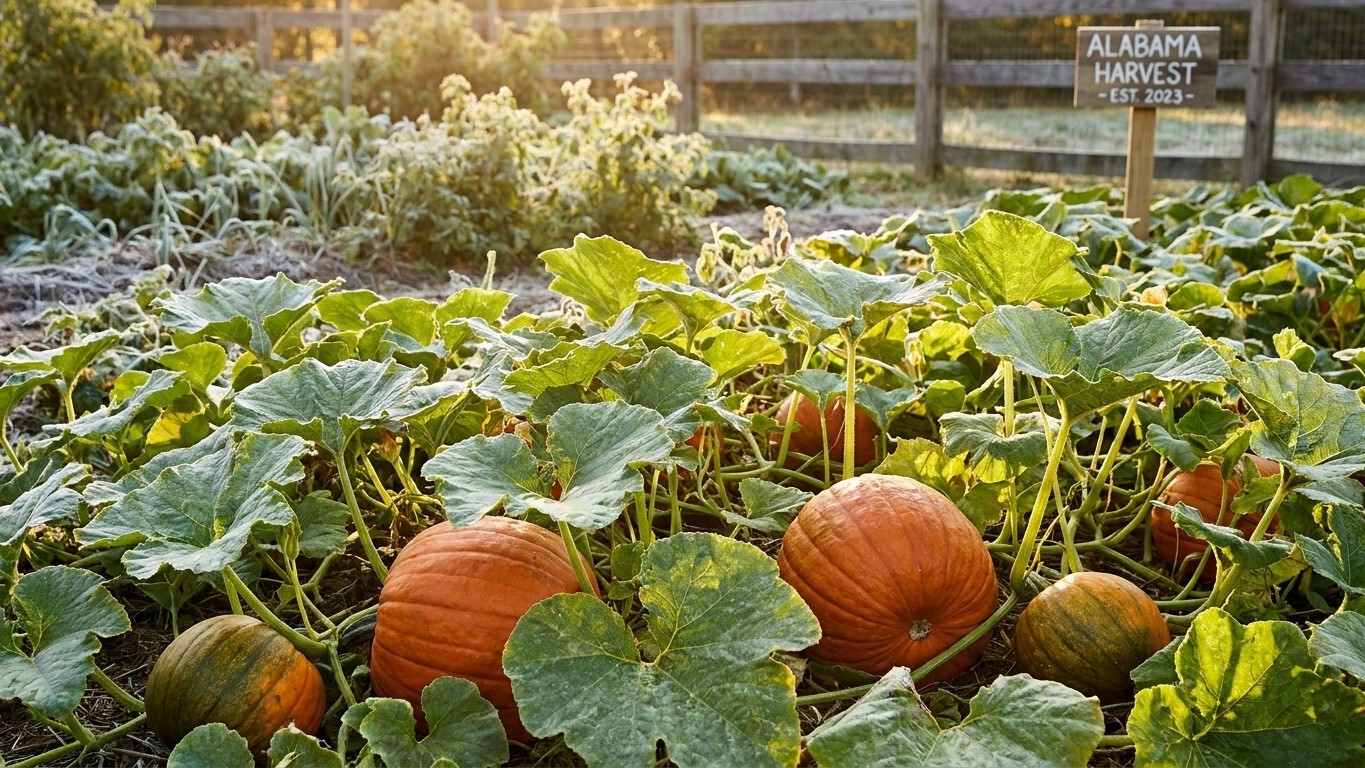

In North Carolina’s Piedmont, most pumpkins do have enough time to ripen before frost, but only if their flowers open by late summer. First fall frost here typically lands between October 30 and November 8, and a pumpkin needs 45 to 55 days from the day a female flower opens to reach full color and a hardened rind. Miss that flowering window, and the vine runs out of season before the fruit finishes turning orange.
The short answer
Start from the frost date and count backward, because that is the only direction that tells you anything useful. The earliest end of the Piedmont’s frost window falls on October 30. Subtract the longest maturation time in the range, 55 days, and you land on roughly September 5. The latest end of the frost window falls on November 8. Subtract the shortest maturation time, 45 days, and you land on roughly September 25.
Put those two calculations together and you get the real answer to whether a pumpkin will ripen here: a flower needs to open sometime between early September and late September to have a realistic shot at finishing before frost. Open before September 5 and the fruit is almost certainly safe, since even a slow-to-ripen pumpkin in an early-frost year has enough runway. Open after September 25 and the fruit is gambling against a late frost year and a fast-ripening variety both working in its favor at once. Neither is something a gardener controls.
This is why the flowering date matters more than the seeding date, and why so many pumpkin failures in this state trace back to a single late bloom rather than bad soil or poor watering. A vine can look healthy, covered in leaves and setting new flowers into October, and still produce nothing but green fruit. The plant does not know the calendar is against it. It keeps flowering because that is what pumpkin vines do until a hard freeze stops them, not because those late flowers have any chance of becoming a jack-o’-lantern.
The window also shifts depending on where in North Carolina you garden. The frost dates above reflect Piedmont conditions. Growers in the Blue Ridge Mountains to the west see frost arrive weeks earlier in fall, which pulls the safe flowering window back correspondingly. Growers on the coastal plain to the east typically get a longer stretch before frost, which gives late-blooming vines a little more room to work with. Anyone gardening outside the immediate Piedmont should treat the September 5 to September 25 range as a starting point, not a fixed rule, and adjust toward the local first-frost pattern in their part of the state.
None of this changes the underlying math: 45 to 55 days from flower to harvest, no exceptions, and no shortcuts for a fruit that opens too late.
When to sow here
Sowing date and frost date are not the same decision, and treating them as one is where a lot of the confusion around pumpkin timing starts. Pumpkins are sown when the soil reaches 65°F, not when the air stops freezing. Soil warms far more slowly than air, holding onto cold long after the last frost has passed, so a gardener who plants the day after the last frost date is very likely planting into soil that is still too cold for reliable germination.
- Let the last spring frost window pass first. In the Piedmont, that window runs from March 23 to April 5, and planting before it closes risks losing seedlings to a late cold snap.
- Wait longer than that for the soil itself. Because soil temperature lags behind air temperature, 65°F soil typically shows up well after the last-frost window has closed, not right on top of it. There is no published soil-temperature calendar for this specific date, so the safest approach is to check soil temperature directly with a thermometer rather than guessing from the frost date alone.
- Use a soil thermometer at a 2 to 4 inch depth in the morning, before the sun has warmed the surface layer, to get an accurate reading rather than one skewed by afternoon heat.
- Consider row covers if the soil is close to 65°F but not quite there. Row covers trap solar heat and can buy roughly two weeks on the calendar, letting a gardener sow earlier than bare, uncovered soil would allow.
- Work backward from the safe flowering window identified above, roughly September 5 to September 25, and make sure whatever sowing date is chosen leaves the vine enough time to establish, vine out, and set flowers before that window closes.
The two-week cushion from row covers matters more in this state than it might elsewhere, because the gap between the spring frost window and the safe flowering window is not enormous. A late, cold spring that delays sowing by even a couple of weeks can push flowering right up against the risky end of the September range. Row covers do not change the 65°F requirement, but they let a gardener hit that soil temperature sooner, which is the only lever available on this end of the season.
What goes wrong here
- A late flower that never colors. When a vine keeps setting new blooms into late September or October, those flowers rarely have time to reach the 45 to 55 day mark before frost. The remedy is to stop the vine from wasting energy on them: pinch off new flowers and immature fruit once the safe window has closed, so the plant redirects its resources into the pumpkins that already set earlier and still have a chance to finish.
- A fruit caught by frost while still soft. A pumpkin that has grown to full size but hasn’t fully hardened its rind can still be lost to a sudden freeze. Watch the forecast as the frost window approaches and harvest early rather than risk it, cutting the fruit with several inches of stem attached, since a pumpkin without its stem tends to rot faster in storage.
- A vine that dies back before the skin hardens. Foliage loss from disease, heat stress, or an early light frost on the leaves (without yet killing the fruit) can strip a pumpkin of the leaf cover it needs to keep ripening. Once the vine has collapsed, growth on the fruit itself stalls. The remedy is to harvest at that point rather than wait, moving the pumpkin somewhere it will not freeze to finish curing off the vine.
- Insect pressure shortening the productive season. Vine-damaging pests can weaken plants earlier in the season, leaving less time for flowers to set and mature before the fall frost window arrives. For identification and management specific to this region, see this site’s North Carolina pages on squash bugs and cucumber beetles.
Common questions
Can a green pumpkin ripen after picking?
A pumpkin picked before it has hardened its rind will not continue ripening the way a tomato does off the vine. If frost is imminent and a fruit is close but not fully colored, harvesting it and keeping it somewhere it will not freeze is the only option, but a fruit that is still mostly green when picked is unlikely to finish properly.
Does the 45 to 55 day window start at seeding or at flowering?
It starts at flowering, not at seeding or transplanting. This is the detail that trips up the timing calculation most often. A vine can take weeks to grow from seed to its first bloom, and none of that time counts against the 45 to 55 day maturation clock.
How should ripe pumpkins be stored after harvest?
The only guidance available here is to keep harvested pumpkins somewhere they will not freeze. No specific storage temperature, humidity level, or keeping time is published for this crop, so beyond avoiding freezing conditions, exact storage figures should not be assumed.
Do all pumpkin varieties follow the same 45 to 55 day timeline?
The 45 to 55 day range applies broadly, but individual varieties differ in how they behave in the garden. Names like Connecticut Field, Jack-o’-Lantern types, and various miniature or giant cultivars each have their own characteristics, though no specific day count, size, or color data is available here to compare them directly. Choosing a variety known to perform well in the Piedmont’s growing conditions is worth discussing with a local extension office before sowing.