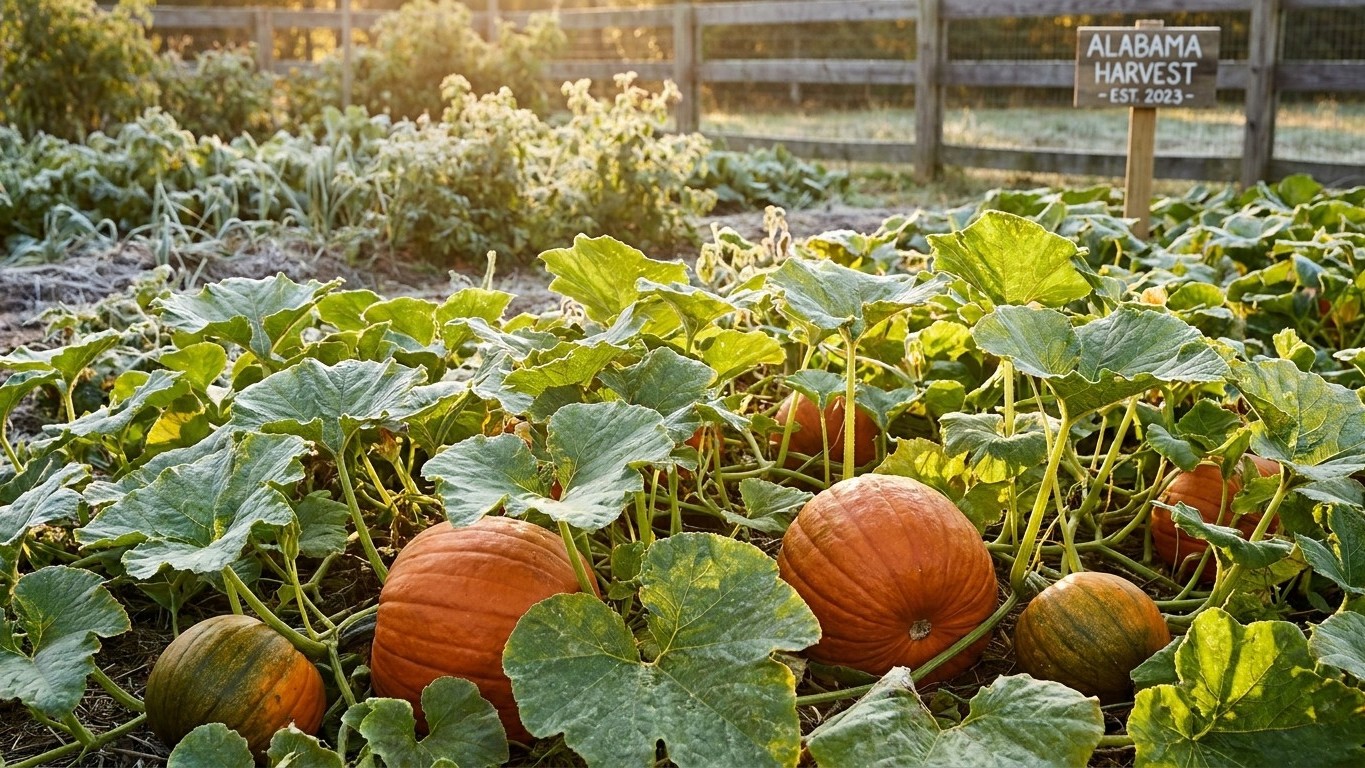

Most years, yes: pumpkins planted with Tennessee’s growing season in mind finish coloring before the first hard freeze arrives between October 28 and November 8. But that depends on when the vine actually flowered, not when it went into the ground. A pumpkin needs 45 to 55 days from bloom to full color, and if that bloom opens too late in September, the fruit runs out of warm days before it turns from green to orange.
The short answer
The frost date itself isn’t the number that matters most here. What matters is the flower, because that’s the point where Tennessee’s growing season starts running out for a given fruit. Utah State University Extension puts pumpkin maturity at 45 to 55 days measured from the day a female flower opens, not from the day the seed went into the ground. That distinction changes how a Tennessee grower should read a calendar.
Run the math against the state’s frost window. NOAA’s 1991-2020 climate normals put the first fall freeze at station USW00013897 somewhere between October 28 and November 8, an eleven-day spread that reflects how much a single season can swing. Subtract the fast end of the maturity clock, 45 days, from the early end of that frost window, October 28, and the count lands on September 13. Subtract the slow end, 55 days, from the late end of the frost window, November 8, and the count lands closer to September 24.
That gives a flowering cutoff somewhere between September 13 and September 24 for most of the state. A pumpkin flower that opens before that window closes has a real shot at finishing. One that opens after it is racing a freeze it’s more likely to lose.
This is also why a single frost date isn’t a useful target on its own. The eleven-day spread between October 28 and November 8 reflects real year-to-year variability, not rounding. Treating the earlier end of that spread as the deadline, rather than the later end, is the more conservative read for a grower who doesn’t want to gamble on a late freeze to save an unfinished crop.
The margin shrinks the moment you move east. East Tennessee and the Cumberland Plateau run cooler and later than the Nashville area in spring, which pushes the whole planting calendar back and leaves less slack at the other end of the season. A grower in Knoxville or up on the plateau should treat the early end of the flowering window, closer to September 13, as the safer target rather than the late end.
None of this accounts for a cool, wet stretch in September that slows a vine without an outright freeze. The 45 to 55 day figure is a range for a reason: soil moisture, sunlight, and how many fruits a single vine is trying to finish at once all push the actual number toward one end or the other.
When to sow here
Working backward from a September flowering date means starting further back still, at the sowing date, and that’s where a lot of Tennessee gardens lose time without anyone noticing. The trap is treating the last spring frost as the starting gun. It isn’t.
- Mark the last frost window first. NOAA’s climate normals for station USW00013897 put it between March 31 and April 12. That’s when the air stops freezing, not when the ground underneath a garden bed is ready for pumpkin seed.
- Wait for the soil, not the air. Utah State University Extension is specific on this point: pumpkin seed goes in once soil temperature reaches 65 F. Soil lags air temperature by weeks, because it holds both cold and heat far longer than the atmosphere above it. A sunny, 70-degree afternoon in early April doesn’t mean the top few inches of soil are anywhere near 65 F yet.
- Check with a thermometer instead of a calendar. The only reliable way to know soil has crossed 65 F is to measure it directly, a few inches down, over several mornings in a row. Guessing from air temperature or from the date alone tends to run early and can cost a week or two of stalled or failed germination.
- Use row cover to close the gap. A floating row cover traps ground heat and can move up the point at which soil underneath it reaches 65 F by roughly two weeks compared with bare soil nearby. In a cool spring, that’s the difference between sowing in late April and sowing in mid-May.
- Count forward from the sowing date, then check it against the flowering window. Once seed is in warm soil, a vine still needs weeks of growth before it produces its first female flower. If a realistic sowing date pushes flowering past the September cutoff described above, the fix isn’t to sow later and hope for a mild fall. It’s to start earlier under cover.
What goes wrong here
Tennessee’s season length produces a specific, repeatable set of failures, and all three trace back to the same gap between when a vine flowers and when frost actually lands.
- A late flower that never colors. A female flower that opens after the mid-to-late September cutoff is starting a 45 to 55 day clock it doesn’t have time to finish. The fruit sets, swells, and then sits green as days shorten and nights cool. The remedy is upstream: sow early enough, using row cover if needed, that flowering happens well inside the window rather than at its ragged edge, and pinch off any new flowers that open too late in the season to have a realistic finish date.
- A fruit caught by frost before it’s done. Because the first freeze can arrive anywhere in the October 28 to November 8 window, a pumpkin tracking to finish right at the edge of that window is betting on the later date. Watching the forecast in late October and covering vines overnight during a cold snap can buy a fruit the last few days of color it needs. If frost is unavoidable, harvest with the stem attached rather than leaving an unripe fruit exposed on a dying vine.
- A vine that dies back before the skin hardens. Powdery mildew, borers, and plain end-of-season exhaustion can kill foliage weeks before a killing frost does, and a pumpkin left without leaves stops hardening its rind even if it already has color. Once a vine is clearly failing, cutting the fruit and moving it somewhere it won’t freeze lets the rind finish curing off the plant instead of on a dead vine exposed to the next hard freeze. Pest pressure that speeds this kind of decline is worth catching early; the site’s pages on squash bugs and cucumber beetles in Tennessee cover the specifics of identifying and managing each one.
Common questions
Can I still plant pumpkins in Tennessee if it’s already August?
Count backward from the September flowering cutoff described above. If a variety needs several weeks of vine growth before its first female flower opens, an August sowing is cutting it close across most of the state and closer still on the Cumberland Plateau. It isn’t automatically too late, but it leaves little room for a slow, cool stretch of weather to eat into that margin.
Does East Tennessee need a different schedule than Nashville?
Yes. East Tennessee and the Cumberland Plateau run cooler and later in spring than the Nashville area, which delays both the point where soil reaches 65 F and the safe flowering window that follows. Growers in those regions should lean toward the earlier end of every date range mentioned here rather than the later end.
How can I tell a pumpkin is actually ripe versus just orange?
Full color is the visible cue, but a hardened rind matters just as much. Press a thumbnail against the skin; a ripe pumpkin resists the mark, while an unripe one dents easily. Harvest with the stem attached, which is the guidance Utah State University Extension gives for handling fruit ahead of frost.
Will a green pumpkin ripen after I pick it and bring it inside?
That specific question isn’t answered in the available guidance. Utah State University Extension’s direction stops at harvesting before frost and storing fruit somewhere it won’t freeze, without specifying a storage temperature, a humidity level, or how long a partially colored pumpkin might continue to change once it’s off the vine.