
Utah’s first fall frost falls somewhere between October 18 and October 29, and a pumpkin needs 45 to 55 days after its flower opens (not from the day the seed went in) to finish coloring and hardening its rind. Working that backward, the last flowers of the season need to open sometime between late August and mid-September, and seed generally goes into the ground once soil hits 65 F, which lands weeks after the last spring frost, not on the same date.
The short answer
Utah’s first fall frost lands between October 18 and October 29, depending on where along the Wasatch Front or into the mountains a garden sits (NOAA NCEI 1991-2020 Climate Normals, station USW00024127). That window is the finish line for a pumpkin crop. What a lot of gardeners miss is that the 45 to 55 days a pumpkin needs to mature run from the day its flower opens, not from the day the seed was sown or the seedling went into the bed, per Utah State University Extension’s guidance on pumpkins. Seed packets that promise “days to maturity” are usually talking about a different clock; for pumpkins specifically, flowering is the starting gun.
Run the frost window and the maturation range backward together and the real deadline shows up. If frost arrives on the early side, October 18, and a particular fruit needs the full 55 days to finish, its flower had to open by August 24. If frost holds off until October 29 and that fruit only needs 45 days, a flower opening as late as September 14 still has time to color up and harden before the cold hits. Stack those two ranges and you get the honest answer: the last flowers of the season need to open somewhere between August 24 and September 14, depending on which end of the frost band shows up in a given year and how quickly that fruit finishes.
That three-week spread isn’t vague hedging. It’s two real uncertainties layered on top of each other, an eleven-day frost band and a ten-day maturation range, and pretending either one collapses to a single day would be dishonest. Salt Lake’s valley floor sits on the milder end of that frost band. Most of the rest of Utah, sitting higher and colder, tends to see frost earlier, which pushes the safe flowering cutoff toward the August 24 side. Southern Utah runs warmer and can lean toward the later date instead.
None of that replaces watching the actual vines. A flower that opened in early September, with green fruit still sizing up as October arrives, is worth checking daily once the frost window gets close, because a calendar only ever gives a range here, never a guarantee.
When to sow here
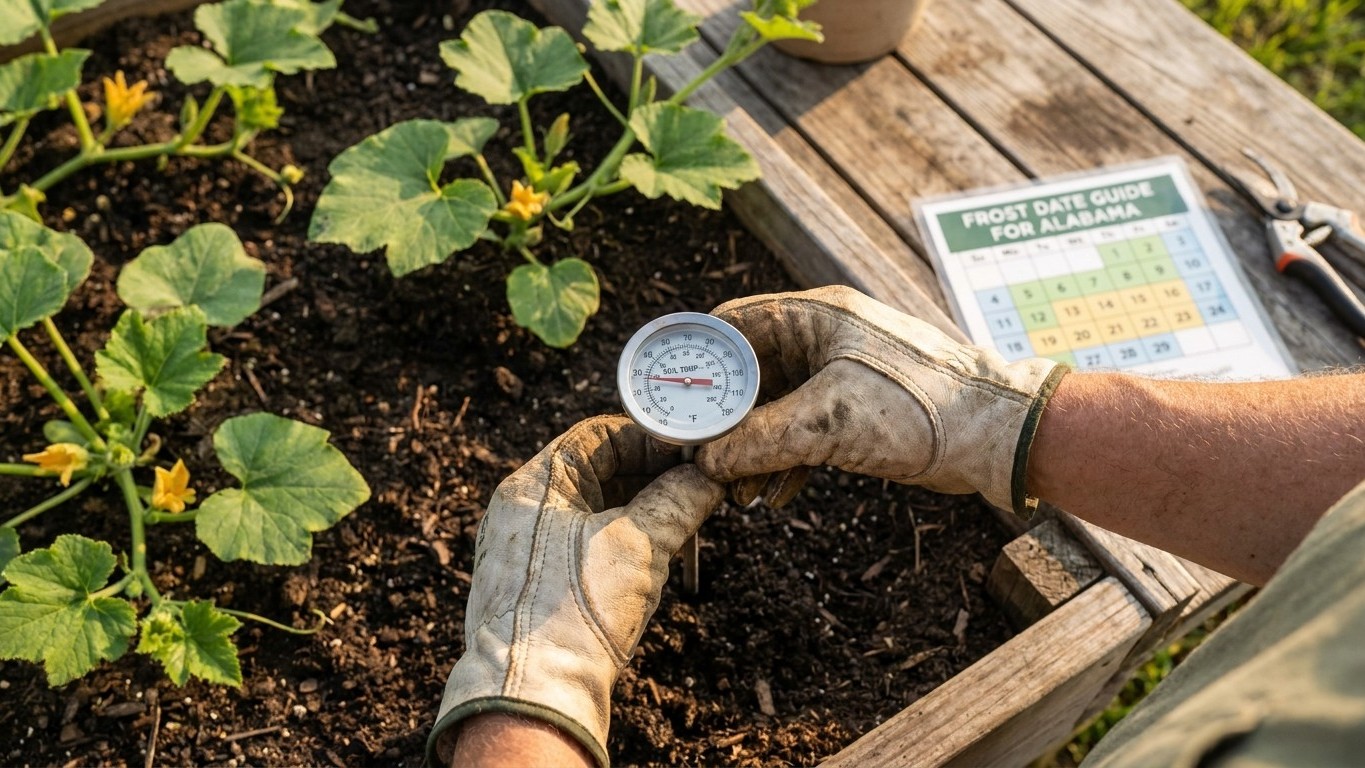
Utah’s last spring frost falls between April 12 and April 29, and it’s tempting to treat that date as the green light for pumpkin seed. It isn’t. Utah State University Extension is clear that pumpkins go into the ground once soil temperature reaches 65 F, and soil warms far slower than air. A frost-free morning in late April can sit above ground while the dirt six inches down is still holding in the 50s. That lag routinely pushes the actual sowing date weeks past the frost window, not days past it.
- Let the last spring frost window, April 12 to April 29, run its full course before doing anything with seed. That date only describes air temperature and freeze risk, not soil readiness.
- Start checking soil temperature directly, ideally at planting depth, rather than relying on the calendar. Air and soil temperatures move on different schedules in spring, and the gap between them is exactly why a frost-free week doesn’t mean plantable dirt.
- Wait for a soil reading of 65 F before direct-seeding pumpkins, per Utah State University Extension. In much of Utah that reading arrives well after the frost window has closed, since soil needs sustained warmth, not just the absence of freezing air.
- If waiting that long feels late against the fall frost math above, lay row covers over the bed ahead of time. Covers trap heat and warm the soil faster, buying roughly two weeks, which means seed can go in about two weeks earlier than bare, uncovered soil would naturally hit 65 F.
That two-week cushion from row covers matters more in Utah than the frost date alone suggests. Because the safe flowering cutoff runs from late August to mid-September, and because pumpkins still need 45 to 55 days after that flower opens, every week gained at the sowing end is a week of insurance against a fruit that flowers too late to finish.
What goes wrong here
- A late flower that never colors. When sowing gets pushed into June, either from waiting on cool soil or replanting after a failed first try, flowering can slide past the safe cutoff. A fruit that sets after mid-September, needing the full 55 days, is racing a frost window that opens as early as October 18. The fix is sowing as soon as soil legitimately hits 65 F, using row covers to move that date up rather than waiting on the calendar alone.
- A fruit caught by frost before it finishes. Utah’s frost window is a probability band, not a fixed date, and a fruit that’s still green when the first hard cold arrives won’t finish ripening off the vine the way a tomato might. Utah State University Extension recommends harvesting with the stem attached and moving fruit indoors before frost hits, storing pumpkins somewhere they will not freeze rather than leaving them exposed once the forecast turns.
- A vine that dies back before the skin hardens. Powdery mildew, drought stress, or an early cutback of foliage can kill the vine before the rind has had its full 45 to 55 days to toughen up. A pumpkin cut loose too early bruises easily and stores poorly. Letting the foliage stand as long as possible after flowering, and watching for the stem itself to start drying and the rind to resist a fingernail scratch, gives a better read on true readiness than counting days alone.
Common questions
Can I still sow pumpkins in Utah in July?
It depends entirely on the frost math above. A July sowing needs a fast-flowering plant and a fall frost on the late side of the October 18 to October 29 window to have any real shot at a colored, hardened fruit. It’s tight, not impossible, but there’s no cushion left for a slow season.
What if my soil still hasn’t hit 65 F by late May?
That’s normal in much of Utah, since soil lags air by weeks, not days. Row covers are the tool Utah State University Extension effectively supports for closing that gap, warming the bed enough to sow roughly two weeks ahead of where bare soil would naturally land.
How long do harvested pumpkins keep in storage?
Utah State University Extension’s pumpkin guidance doesn’t publish a storage temperature, humidity target, or keeping time. Its only stated instruction is to store fruit somewhere it will not freeze, which is a narrower recommendation than a full storage protocol.
Do different pumpkin varieties shift the sowing date?
Utah State University Extension’s guide names several varieties suited to home gardens without attaching a days-to-maturity or size figure to any specific one. Without that per-variety data published, the safest approach is to apply the same 45-to-55-day-after-flowering rule to whatever variety is planted, and adjust sowing time using the frost math above rather than assuming one variety runs meaningfully faster than another.
For the two insect pressures that most often cost Utah pumpkin growers a season, see the site’s dedicated pages on squash bugs in Utah and cucumber beetles in Utah.