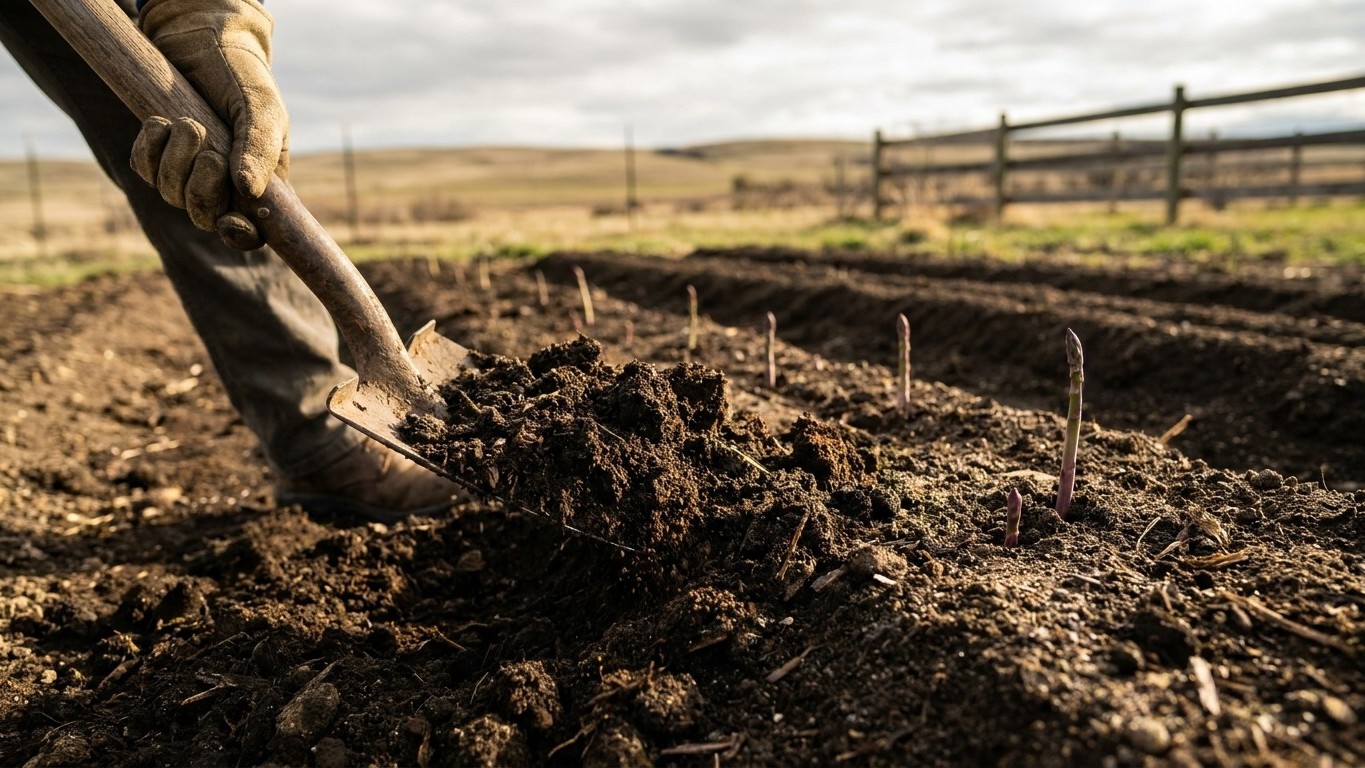

Ten to Fifteen Years in One bed, one requirement that matters more than any other: the ground has to drain. Alabama’s official state soil is naturally well drained and sandy, which is good news for a crop that punishes wet feet more than any other vegetable in the garden. But a state soil is a average, not your yard, and the fix for a soggy spot is simple enough that it shouldn’t stop anyone from planting.
The short answer
Asparagus is a long-haul crop. Crowns go into the ground once, and if the site is right, that same row of spears keeps producing for 10 to 15 years before it needs to be replanted somewhere else. Will Alabama Soil Hold an Asparagus Bed for Fifteen Years? is the question worth answering before planting, and knowing When to Plant Asparagus Crowns in Alabama matters just as much as the site itself. Utah State University Extension, the authority behind most of the growing guidance here, is blunt about the one thing that matters: most soils will do, provided they are well drained. Everything else, fertility, texture, organic matter, can be worked with over time. Standing water in a bed that’s supposed to last a decade and a half cannot.
Alabama’s answer to that question starts with the Bama series, named the state soil under Alabama law in 1997. According to USDA NRCS Soil Survey Geographic Database records, the surface horizon of Bama runs sandy, about 67 percent sand, 14 percent clay, 19 percent silt, with organic matter around 0.8 percent and a surface pH near 5.3. NRCS classifies it as well drained. For an asparagus bed, that texture is close to ideal: sand lets excess water move through instead of pooling around the crowns.
That said, the Bama series describes a representative soil mapped across the state, not the dirt in any one backyard. River bottoms run heavier and wetter. Hill country can be shallow over rock. Anything a builder has graded, filled, or compacted for a foundation behaves nothing like an undisturbed agricultural soil series. The only way to know what’s actually under a planned asparagus row is to dig a hole, fill it with water, and watch how fast it disappears. If it’s still standing after an hour, the fix is a raised bed or a mounded row, not a different crop.
The clock on this crop is also worth setting expectations for early. There’s no harvest at all in year one or two. Year three brings a first cutting of about four weeks, year four stretches to roughly six weeks, and from year five on, harvest can run about eight weeks. The rule for when to stop each season isn’t a date on a calendar. It’s a look at the spears: once most of them come up thinner than a pencil, cutting stops for the year so the plant can rebuild its roots.
On variety, the published guidance from Utah State University Extension names four options by sex only: Jersey Giant and Jersey Knight are all-male hybrids, while UC 157 F1 and Purple Passion are male-and-female types. No flavor comparison, yield figure, or regional preference is published alongside those names, so picking among them comes down to availability rather than a documented reason to favor one over another.
Will the summer here water it for you?
An asparagus bed has a watering rhythm that changes as it ages. In the first two years, while the crowns are still establishing, the target is 1 to 2 inches of water every other week. After that establishment period, the interval stretches out and the bed only needs watering about every three weeks. The question for anyone planting in Alabama is how much of that the sky covers on its own, using the 1991-2020 climate normals recorded at NOAA NCEI station USW00003856.
- June averages 4.06 inches. Spread evenly, that’s close to the 1-2 inch every-other-week target for a young bed, and it’s the closest the summer comes to matching the crop’s needs without help.
- July climbs to 4.49 inches, the wettest of the three summer months, but Southern rain in July tends to arrive as short, heavy thunderstorms rather than steady soaking rain, which matters more on sandy soil than on clay.
- August drops to 3.55 inches, the driest month of the three and the one where a young bed is most likely to fall short of its every-other-week target without a hose.
- The three-month summer total is about 12.1 inches, against an annual normal of 54.3 inches, meaning most of the region’s rain falls outside the growing season when the bed needs it least.
- Sandy soil drains fast in both directions. The same texture that keeps asparagus crowns from sitting in water also lets a thunderstorm’s rain pass through the root zone and disappear within a day, so a wet-sounding month on paper can still leave the bed dry by the following week.
- The practical takeaway: a first-year or second-year bed on Alabama’s typical sandy ground should be checked with a finger in the soil at least weekly through summer, with a hose ready to close the gap, especially through August.
None of these are forecasts. They’re what the reference station has recorded as normal over three decades, and a rain gauge on the actual planting site is what settles the question for any given year.
When to put the crowns in
Crowns go into the ground in early spring, timed to land after the risk of a hard freeze has mostly passed. For the reference station used throughout these figures, NOAA NCEI’s 1991-2020 climate normals put the window for the last spring freeze at 32°F somewhere around March 19 to April 3. That’s a mean derived from three decades of data, not a guarantee for any single year, and it comes from an airport weather station rather than any one backyard. Suburban and rural sites tend to run cooler than an airport station, often by a week or two, and elevation pushes that later still.
Planting itself follows a specific method. Crowns are set into furrows about 8 inches deep, spread out with their roots fanned downward. The furrow isn’t filled in all at once. Instead, soil gets pulled back in gradually, about 2 inches every other month across the year, so the crown is only fully buried by the time the growing season is well underway. This staged backfilling gives the emerging shoots room to push upward without being smothered early on.
Seed is the other route into an asparagus bed, and it’s the slower one. Starting from seed means an extra season of growth indoors or in a nursery bed before the young plants are large enough to transplant as crowns, pushing the eventual first harvest out further than starting with purchased crowns already a year old. For a bed meant to sit in the same spot for a decade and a half, most home gardeners lean toward crowns simply to shave a year off the wait, though seed remains a viable, just slower, alternative.
Either way, the planting date should flex around the local frost pattern rather than a fixed spot on the calendar. A gardener working from the March 19 to April 3 window should treat it as a rough center point, watching local conditions and their own county’s frost history rather than planting on a fixed day regardless of what the weather is actually doing that particular spring.
Checking this against your own county
Everything above comes from statewide soil series data and one reference weather station, useful for setting expectations but not a substitute for local knowledge. The Alabama Cooperative Extension System is the named authority to check next. County extension offices can run an actual soil test on the planned bed site, confirm local frost timing that may run later or earlier than the reference station, and flag any soil quirks specific to that part of the state that a statewide series average can’t capture.
That local check matters more for asparagus than for most vegetables, precisely because the commitment is measured in years rather than a single growing season.
Common questions
How long before I get my first asparagus harvest in Alabama?
No cutting happens in year one or two regardless of location. The first harvest comes in year three and runs about four weeks, followed by roughly six weeks in year four and about eight weeks from year five onward.
Does Alabama’s soil need amending before planting asparagus?
The state’s representative soil, the Bama series, is sandy and well drained, which suits asparagus without heavy intervention. Organic matter runs low at about 0.8 percent, so working in compost at planting time helps fertility, but the published guidance’s core requirement is drainage, not a specific pH or nutrient target.
Which asparagus variety grows best in Alabama?
Published guidance from Utah State University Extension names four varieties, Jersey Giant and Jersey Knight as all-male types, UC 157 F1 and Purple Passion as male-and-female types, but doesn’t rank them by flavor, yield, or regional fit. No documented reason favors one over another for Alabama specifically.
What if my yard has heavy clay instead of sandy soil?
A clay site that holds standing water after a heavy rain isn’t a good match for a 10-to-15-year asparagus bed as-is. Building a raised or mounded bed lifts the crowns above the wet zone and solves the drainage problem without needing to relocate the entire garden.