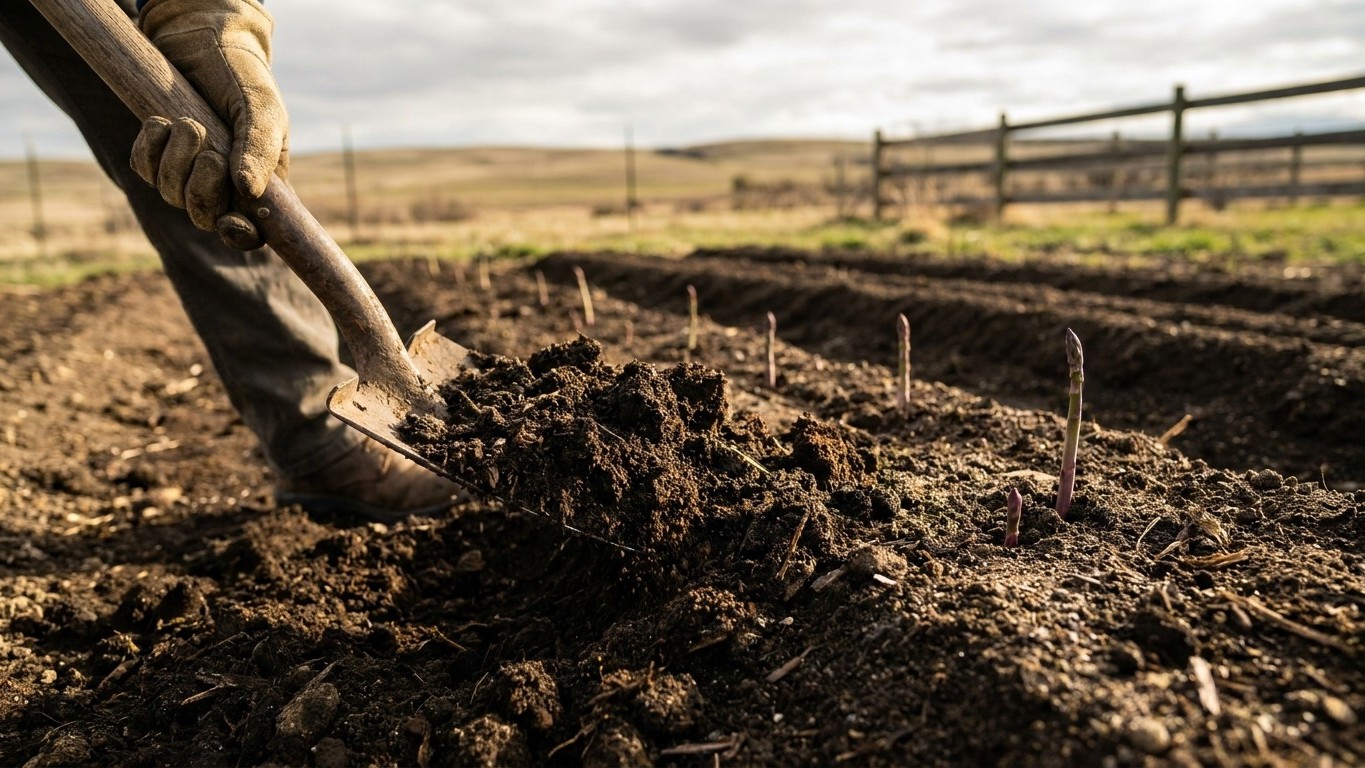

The Stuttgart series, Arkansas’s official state soil, is described by USDA as “somewhat poorly drained.” That single word matters more here than almost anywhere else in a home garden, because asparagus is planted once and then left alone for 10 to 15 years, raising the real question of whether Will Arkansas Soil Hold an Asparagus Bed for Fifteen Years? Get the drainage wrong at planting and there’s no fixing it in year six.
The short answer
Asparagus crowns go into the ground in furrows about 8 inches deep, and When to Plant Asparagus Crowns in Arkansas matters just as much as how they’re planted. The plant doesn’t give up a single spear for harvest until year three, and once it starts producing it keeps going for 10 to 15 years, according to Utah State University Extension. That’s the whole arrangement: three years of patience, then a decade or more of payoff, from one bed, in one spot. The extension guidance is blunt about what that spot needs: most soils will do, provided they are well drained. No exceptions carved out for clay, no workaround offered for standing water.
That’s where the Stuttgart series becomes relevant, and where it becomes a caution rather than a diagnosis. USDA NRCS records the surface horizon of this series as loam to silt, roughly 30 percent sand, 16 percent clay, and 54 percent silt, with organic matter around 1.8 percent and a surface pH near 5.6. Structurally it’s a moderately fertile forest soil. Drainage-wise it’s rated somewhat poorly drained, which in plain terms means water sits longer in this ground than asparagus roots want to tolerate.
None of that tells a gardener what their own dirt does. The Stuttgart series is the soil chosen to represent Arkansas on paper, not a survey of every backyard in it. A river-bottom garden, a hillside plot, or a lot a builder graded and filled years ago can behave nothing like the mapped series. So the real question isn’t “is Arkansas’s soil good for asparagus” but “does my patch of it drain within a few hours after a hard rain, or does water linger.”
If the answer is that water lingers, the fix is not to skip asparagus. It’s to change the bed, not the crop. Raised beds, or furrows mounded into low berms rather than dug flat, lift the crowns above the slow-draining layer and let excess water move off rather than pool around the roots. Working extra organic matter into a heavy bed also opens up structure over time, though on a soil already sitting at roughly 1.8 percent organic matter, that’s a multi-season project, not a one-time fix. What the source stays silent on is pH: it names good drainage as the requirement and says nothing about how acid or alkaline the ground should be, so there’s no published number to chase here, and inventing one would be worse than leaving the gap.
Will the summer here water it for you?
The establishment period is where asparagus is thirstiest. For the first two years, the bed wants 1 to 2 inches of water every other week. After that, once the roots are established, the demand drops to about the same amount but only every three weeks. Arkansas summers deliver roughly 10.0 inches of rain across June, July, and August combined, with June at 3.55 inches, July at 3.33 inches, and August, the driest of the three, at 3.16 inches, based on NOAA’s 1991-2020 climate normals for the reference station used here.
- Year one and two, June through August: at 1 to 2 inches every other week, a young bed asks for somewhere between roughly 6 and 12 inches of water across the three summer months. Natural rainfall of about 10.0 inches sits inside that range, but only as a seasonal average, not as a guarantee any given month lines up.
- The August gap: August is the driest month at 3.16 inches and typically the hottest, which means it’s the month most likely to fall short of what a two-year-old bed needs, even in a summer that averages out fine on paper.
- Established beds, year three onward: watering every three weeks instead of every two weeks lowers total demand, and at that point normal summer rain is more likely to cover the requirement without help, particularly in a wetter June or July.
- The soil complicates the math: the Stuttgart series’ silt-heavy surface, and any comparably fine-textured soil, can shed a hard summer thunderstorm as runoff rather than letting it soak in, so a season that adds up to 10.0 inches on the gauge doesn’t necessarily put 10.0 inches into the root zone.
- The practical move: keep a rain gauge on the bed itself, especially through August, and plan to supplement by hand or drip line whenever two weeks pass without at least an inch landing and staying.
When to put the crowns in
Crowns go in during early spring, while the plant is still dormant and before the ground has fully warmed. For this territory, NOAA’s 1991-2020 normals put the mean window for the last 32F freeze around March 12 to March 28, based on the 30 to 70 percent freeze-probability band at the reference station used here. That’s an average across three decades, not a promise for any single spring, so “around” is doing real work in that date range.
There’s a second, tighter number worth knowing if the concern is tender green growth rather than the dormant crown itself. At the 36F light-frost threshold, the window narrows: NWS Little Rock gives April 3 as the last light-frost date and October 31 as the first in fall. Dormant crowns buried 8 inches deep don’t need that protection, but any spears that push up early into a cold snap do, so gardeners planting on the earlier end of the March window are betting on the crown staying dormant a little longer, while those who wait toward late March are trading a shorter growing head start for less risk to any early green shoots.
Seed is the other route in, as an alternative to buying crowns outright. Utah State University Extension’s guidance centers on the crown method, furrows around 8 inches deep, but starting from seed is a recognized alternative for gardeners who want to grow their own stock rather than purchase crowns; seed-grown plants simply need extra time to reach a size worth transplanting before they’re handled the same way a purchased crown would be.
On variety, the published record is thin and it’s worth saying so rather than pretending otherwise. Utah State University Extension names four: Jersey Giant and Jersey Knight, both all-male varieties, and UC 157 F1 and Purple Passion, both male and female. That’s the extent of what’s documented there, sex type only. No flavor comparison, no yield figures, no stated reason to prefer one over another appear in that source, and no nursery is named here either. Anyone choosing between them is choosing on criteria the extension guidance simply doesn’t cover.
Checking this against your own county
Everything above is built on statewide soil averages and a single reference weather station, useful for spotting the pattern but not a substitute for what’s actually happening in one county’s ground and microclimate. Frost dates shift with elevation and river proximity, and soil drainage can change from one side of a road to the other.
The University of Arkansas Division of Agriculture’s Cooperative Extension Service, at uaex.uada.edu, is the named resource for exactly this kind of local check. County extension offices there can point to soil testing services and local planting calendars that reflect conditions closer to a specific address than any statewide normal can. Before digging furrows for a bed meant to last a decade or more, a call there is worth the time it takes.
Common questions
Can asparagus grow in clay-heavy soil in Arkansas?
It can struggle if water sits rather than draining through. The state’s representative soil, the Stuttgart series, is rated somewhat poorly drained, so a bed built as a raised mound or true raised bed reduces the risk compared with planting flat into heavy ground.
How long until asparagus can be harvested after planting?
Not until year three, according to Utah State University Extension. There’s no partial harvest allowed in the first two years; the plant needs that time to establish its root system before spears are cut.
Does an established asparagus bed need much water?
Less than a new one. Established beds want roughly 1 to 2 inches every three weeks, compared with the same amount every other week during the first two years, and Arkansas’s average summer rainfall of about 10.0 inches over June through August often gets close to covering that lighter, later demand.
Should crowns go in as early as possible in spring?
Planting near the start of the frost window, around March 12 in this territory’s normals, gives the plant more of the growing season, but any spears that emerge before the last light frost, given as April 3 for this area, face a higher risk of frost damage than the dormant crown itself does.