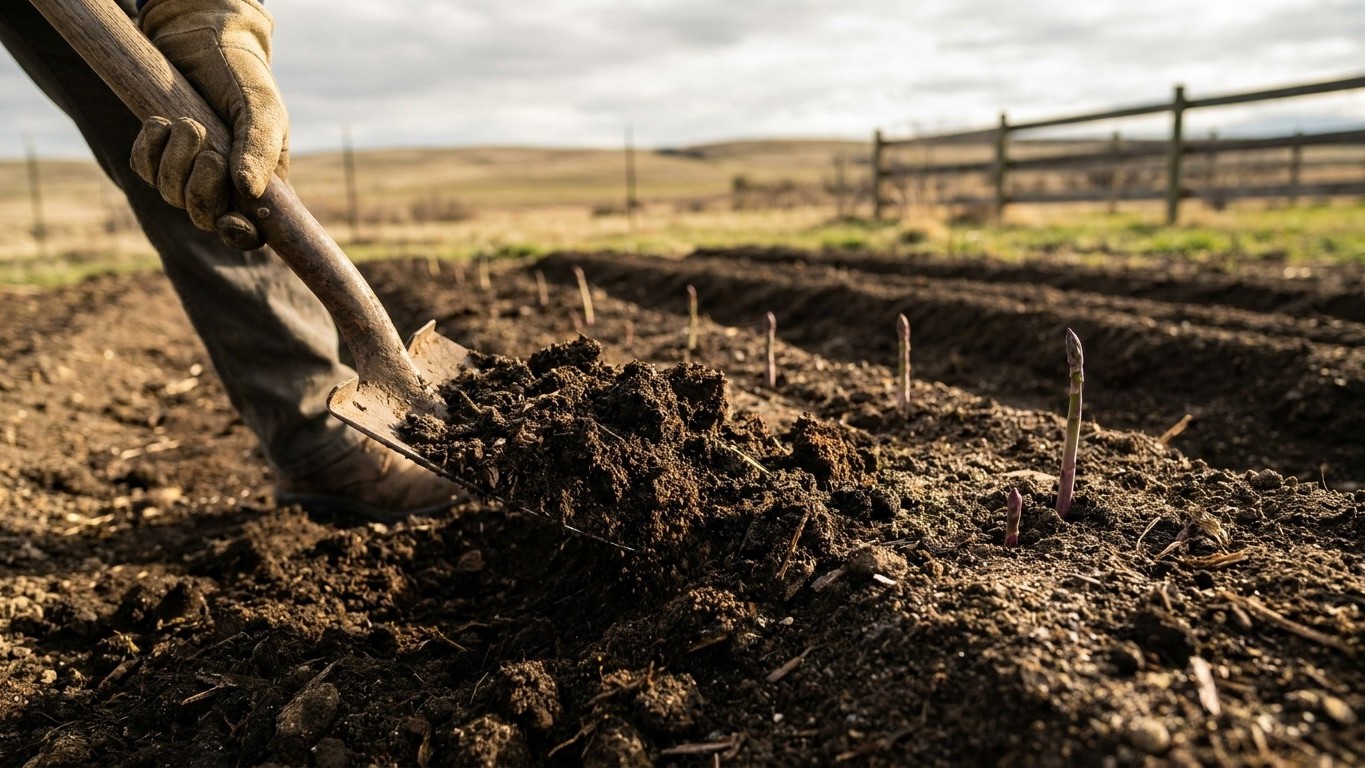

Asparagus asks for one thing above all else: a bed that drains, because once those crowns go in the ground they’re staying put for a decade or more. In Florida, that single requirement runs straight into the state’s own signature soil, and the fix isn’t complicated but it isn’t optional either.
The short answer
Start with the ground itself. Florida’s official state soil is the Myakka series, a Spodosol found across much of the peninsula and the panhandle. It’s almost pure sand, about 97 percent, with a surface pH running around 5.1, strongly acid, and organic matter near 2 percent in that topsoil layer. On paper, sand sounds like exactly what a drainage-hungry crop wants. The Myakka series isn’t. USDA’s own survey data classifies it as poorly drained, the result of a hardened layer beneath the surface that holds water where you’d expect it to run straight through.
That matters more here than it would with almost any other crop on this site. A tomato plant that sits in soggy ground for a season is a problem you fix next spring by moving the bed six feet. An asparagus crown is a fifteen-year commitment, which raises the real question: Will Florida Soil Hold an Asparagus Bed for Fifteen Years? Utah State University Extension puts the productive life of a well-sited bed at 10 to 15 years, with no harvest at all in the first two seasons. Getting When to Plant Asparagus Crowns in Florida right matters just as much as the soil itself, since choosing wrong ground now doesn’t show up as a bad crop, it shows up as a slow, waterlogged failure you’re stuck watching for a decade.
So the plain answer for a garden sitting on ground that behaves like the state soil: don’t plant asparagus straight into it. Raised beds or heavily amended, mounded rows solve the drainage problem without asking the plant to fight standing water for its entire life. Work in coarse sand or aged organic matter to lift the root zone above the water table, or build a bed frame 10 to 12 inches high and fill it with a well-draining mix. Either approach turns a poorly drained starting point into something asparagus can live with for the long haul.
None of this means every yard in Florida is doomed. The state soil describes what the survey found as representative across mapped Myakka components, not what sits under any one particular garden. A property on a slope, a lot with imported fill, or ground near a river terrace can drain completely differently from the textbook description. That’s exactly why the next step, before a single crown goes in the ground, is a shovel test: dig a hole a foot deep, fill it with water, and watch how long it takes to disappear. If it’s gone within a few hours, the ground is doing its job. If water is still sitting there the next morning, build up rather than plant down.
Will the summer here water it for you?
Established asparagus wants water on a schedule: roughly 1 to 2 inches every other week for the first two years while the crowns are settling in, then a lighter routine of the same amount every three weeks once the plant is mature. That’s the target. What a north Florida summer actually delivers is a different number, and the gap between the two is what a gardener ends up making up with a hose.
- June: normal rainfall runs about 7.6 inches for the month, which sounds generous against a 1-to-2-inch biweekly target, but Florida rain rarely falls evenly. It tends to arrive as afternoon thunderstorms that dump a lot of water fast and let much of it run off a sandy surface before it soaks in.
- July: the driest of the three summer months at 6.77 inches, this is the stretch where a young bed is most likely to run short even though the season “average” looks wet on paper.
- August: back up slightly to about 6.88 inches, keeping the three-month summer total around 21.2 inches, roughly 53.4 inches for the full year.
- The sand factor: because the dominant regional soil is nearly all sand, whatever rain does soak in tends to pass through the root zone quickly rather than sitting there for the plant to draw on gradually. A wet-sounding month can still leave a bed dry three days later.
- The bottom line for a new bed: during the first two establishment years, don’t assume a rainy-looking week covers the requirement. Check the soil by hand, and if the top few inches are dry, add water even after a storm has passed through.
Total rainfall on a normals map is a regional average pulled from one reference station, not a reading from any specific backyard. A rain gauge staked next to the actual bed, checked weekly through the growing season, tells a gardener far more than any climate table can.
When to put the crowns in
Crowns go into 8-inch furrows in early spring, and for the northern part of the state that window sits around the last frost date, which runs from roughly February 16 to March 7 at the reference weather station covering that region. That’s a probability band from three decades of records, not a guarantee, so treat it as a planning target rather than a calendar lock. Planting into furrows that are then backfilled gradually, adding about two inches of soil every other month across the first year rather than filling the trench all at once, gives the developing crown room to push upward as the plant establishes.
That frost window applies specifically to the northern reaches of the peninsula and the panhandle, where a real winter still shows up most years. Central and south Florida run essentially frost-free, and the whole planting calendar flips there: the growing season runs through the cooler months, and summer becomes the hard season to manage rather than the friendly one. A gardener working from this frost date in Orlando or Miami is working from the wrong data entirely.
Seed is the other route in, though it asks for more patience than most home growers want to spend. Growing asparagus from seed means raising a season of seedlings before those young plants are ever large enough to go into the permanent bed, effectively adding an extra year onto the three-year wait before the first harvest. Crowns, which are simply one-year-old dormant roots, skip that seedling stage and are the route most home gardens use.
On variety, the available guidance from Utah State University Extension names four options without ranking them on flavor or yield: Jersey Giant and Jersey Knight are all-male hybrids, while UC 157 F1 and Purple Passion are male-and-female types. The distinction that’s actually published is reproductive, not culinary, all-male varieties don’t spend energy producing seed and tend to put more of that energy into spear production. Beyond sex type, no source here makes a case for choosing one over another, and no nursery is recommended.
Checking this against your own county
Everything above describes a region, not a specific yard. Soil drainage, frost timing, and even rainfall totals can shift meaningfully from one county to the next, and sometimes from one side of a property to the other. The most reliable next step is a call or visit to UF/IFAS Extension, Florida’s land-grant university extension service, which maintains county offices staffed with agents who know the local soil series, the realistic frost dates for that specific area, and which asparagus varieties other gardeners nearby have actually had luck with. A soil test through that same office will also give an actual pH and drainage reading for the bed in question, replacing the state-level averages here with numbers that belong to that one patch of ground.
Common questions
Can asparagus grow anywhere in Florida?
The frost dates and planting window described here apply to north Florida. Central and south Florida are essentially frost-free, and the growing calendar there runs differently, with the cooler months serving as the main season rather than spring alone.
How long until the first harvest?
No harvest happens in year one or year two. Utah State University Extension is clear that picking begins in year three, and even then it starts light before building over the following seasons.
Does the soil need to be acidic?
That’s not published in the source guidance used here, and the state soil’s pH figure describes a mapped survey average, not a recommendation for growing asparagus. A local soil test is the only way to get an actual number for a specific bed.
What if my yard doesn’t drain well?
Build up rather than plant down. A raised bed or a mounded, amended row lifts the root zone above a high water table, which matters far more with a crop that stays in one spot for a decade or more than it would with anything replanted each season.