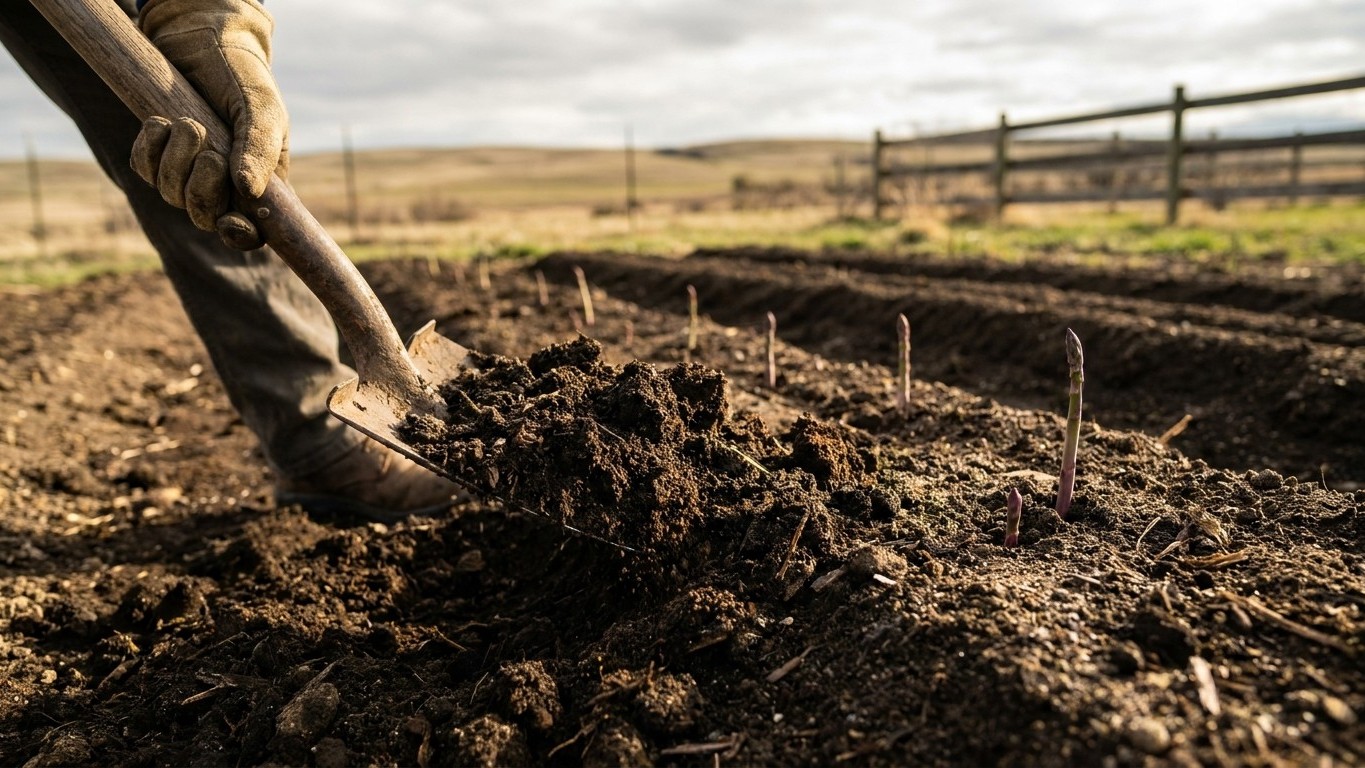

Yes, Iowa can host a productive asparagus bed for a decade and a half, and the state’s own soil profile helps explain why. The real question at planting time isn’t climate. It’s drainage, and how a single decision now outlasts more than a decade of seasons that follow. Get the bed right at the start, and there’s little to do after that but wait, water, and eventually cut spears for weeks at a stretch each spring.
The short answer
Asparagus is one of the few vegetables where a gardener picks a spot and lives with it for ten to fifteen years, according to Utah State University Extension. Once the crowns go down, the bed isn’t going anywhere until well into the next decade, so Will Iowa Soil Hold an Asparagus Bed for Fifteen Years? comes down to whether the ground drains, a question covered separately in this guide on When to Plant Asparagus Crowns in Iowa.
Iowa’s representative soil, the Tama series recorded by USDA NRCS as the state’s benchmark, is a Mollisol, the deep, dark prairie soil that built the Corn Belt. Sampled across 246 mapped components, the surface horizon runs about 4 percent sand, 26 percent clay and 70 percent silt, with organic matter near 3.5 percent and a surface pH close to 6.5. Despite that heavy clay-and-silt mix, USDA lists the Tama series as well drained. That’s the figure that matters most for asparagus, because the Utah State University Extension guidance on the crop is direct: most soils will grow it, provided the water actually moves through.
That’s a reassuring baseline for anyone gardening on ground close to the Tama profile. It is not a guarantee for any one backyard. The Tama series is a representative value for the state, not a soil test for a particular lot, and Iowa holds hundreds of other mapped soil series besides it. Ground near a river bottom, a spot scraped or filled during construction, or a low corner of the yard that collects runoff can behave nothing like the state’s benchmark soil, even a few miles from where the Tama series is mapped. A gardener working a spot that regularly puddles after rain, or where water still stands hours after a heavy downpour, isn’t looking at a good asparagus bed no matter what the wider county soil survey says. The fix there isn’t fighting the native ground for fifteen years: raised beds or mounded rows, built up above the surrounding grade, let excess water drain away from the crowns instead of pooling around them.
Once the site checks out, the schedule that follows is fixed and unglamorous. No spears get cut the first year or the second, Utah State University Extension is clear on that point. Harvest opens in year three, and even then it’s rationed: about four weeks of cutting that first harvest year, stretching to roughly six weeks the year after, and eight weeks once the bed is fully established. The stopping point each season isn’t a date on a calendar; it’s a look at the spears themselves. Once most of what’s coming up is thinner than a pencil, cutting stops for the year so the plant can rebuild its root reserves for next spring.
Will the summer here water it for you?
An asparagus bed has a simple watering rule for its first two years: 1 to 2 inches of water every other week, per Utah State University Extension. After that establishment period, the schedule relaxes to roughly the same 1 to 2 inches every three weeks. The question for anyone gardening near the Tama series soil is whether an Iowa summer delivers that much on its own, or whether a hose has to make up the difference.
NOAA’s 1991-2020 climate normals for the reference station used across this series put summer rainfall at about 13.2 inches across June, July and August combined, with July running driest at 3.82 inches. June averages 5.26 inches and August 4.17 inches. Laid against the bed’s needs, here’s how the season actually breaks down:
- June: at 5.26 inches average, June typically clears the roughly 2 to 4 inches a young bed needs across the month’s two watering cycles, with a bit to spare, though that depends on the rain arriving in usable doses rather than one runoff-heavy storm.
- July: the driest month of the three, at 3.82 inches, sits right at the edge of what a two-year-old bed needs and can fall short in a below-normal year. This is the month most likely to call for a gardener to fill the gap with a hose or drip line.
- August: 4.17 inches keeps pace with the lower end of a young bed’s needs, and comfortably covers an established bed on its every-three-week rhythm.
- Established beds, year three onward: with watering needs cut roughly in half, a normal Iowa summer covers most of what the bed asks for, leaving supplemental watering mostly for dry stretches rather than a fixed weekly routine.
None of this replaces watching the actual ground. These are 1991-2020 normals for one reference station, not a forecast and not a reading from any particular yard. Rain that falls as a single summer thunderstorm tends to run off a clay-heavy surface rather than soak down to the root zone, and days that push into the 90s speed up how fast that moisture disappears again. A rain gauge staked next to the bed, checked every week or two through the growing season, tells a gardener more than any regional average. It’s the only way to know whether July actually needs the hose or not.
When to put the crowns in
Crowns go into the ground in early spring, timed to when the soil has warmed and the risk of a hard freeze has mostly passed. For the reference station tracked in NOAA’s 1991-2020 climate normals, the last spring freeze at 32°F falls somewhere around April 12 to April 24, a band, not a single day, since a mean frost date is an average built from thirty years of variation, not a promise about any one spring. Iowa State University Extension has noted that county-level records covering 1950-2021 tend to run about four days later in spring than this airport-station figure, so a gardener working from county data rather than the airport reading should plan on waiting a few extra days before it’s safe to dig.
Planting itself follows a specific method, per Utah State University Extension: crowns go down in furrows about 8 inches deep. That furrow doesn’t get filled in all at once. Soil is drawn back in gradually over the course of the year, about 2 inches every other month, rather than burying the crowns under a full 8 inches on planting day. That slow backfill lets emerging shoots keep reaching daylight as the furrow fills, instead of getting smothered under too much soil too soon.
Seed is the other route into a bed, and it works, though it asks for more patience than crowns do, since a plant grown from seed needs extra time to reach the size a two-year-old crown already has on the day it goes into the ground. For a gardener weighing varieties before committing fifteen years to one spot, Utah State University Extension names four by their sex alone rather than by flavor or yield: Jersey Giant and Jersey Knight are all-male varieties, while UC 157 F1 and Purple Passion are male-and-female types. Nothing in that guidance ranks one above another on taste or productivity, so the choice mostly comes down to what’s actually available locally.
Checking this against your own county
Every figure here, the soil profile, the rainfall normals, the frost dates, describes a region, not a specific lot. The Tama series is what USDA lists as representative of Iowa as a whole; the actual dirt under a particular yard might be sandier, wetter, or shallower to bedrock than that profile suggests, and the only way to know for certain is a soil test pulled from that exact spot.
Frost dates carry the same caveat. The April window given here comes from one reference weather station, and Iowa State University Extension’s own county-level analysis already shows spring dates running a few days later in some places. A gardener a county or two away, at a different elevation or closer to a river valley, may see meaningfully different numbers.
Iowa State University Extension keeps county-specific soil, frost, and planting guidance, and it’s built to answer exactly what a state-level normal can’t: the numbers for one particular piece of ground. Before committing a bed to Fifteen Years in One Spot, a call or visit there is worth more than any regional average.
Common questions
How long does an asparagus bed really last in Iowa?
Ten to fifteen years, according to Utah State University Extension, once the crowns are established in a well-drained spot. There’s no published figure narrowing that range further for any particular region.
Can I harvest asparagus the first year I plant it?
No. Utah State University Extension is specific that no spears come out in year one or year two. Harvest starts in year three, and even then only for about four weeks.
What if my soil doesn’t drain well?
Don’t fight it for fifteen years. A raised bed or mounded row built above the surrounding grade lets water move away from the crowns instead of sitting around them, which matters more for this crop than for most others in the garden.
Do I need to worry about soil pH for asparagus in Iowa?
The state’s representative soil, the Tama series, runs a surface pH near 6.5, but the Utah State University Extension guidance on asparagus doesn’t specify a pH requirement for the crop. A soil test from the actual planting site is the only way to know what’s really there.