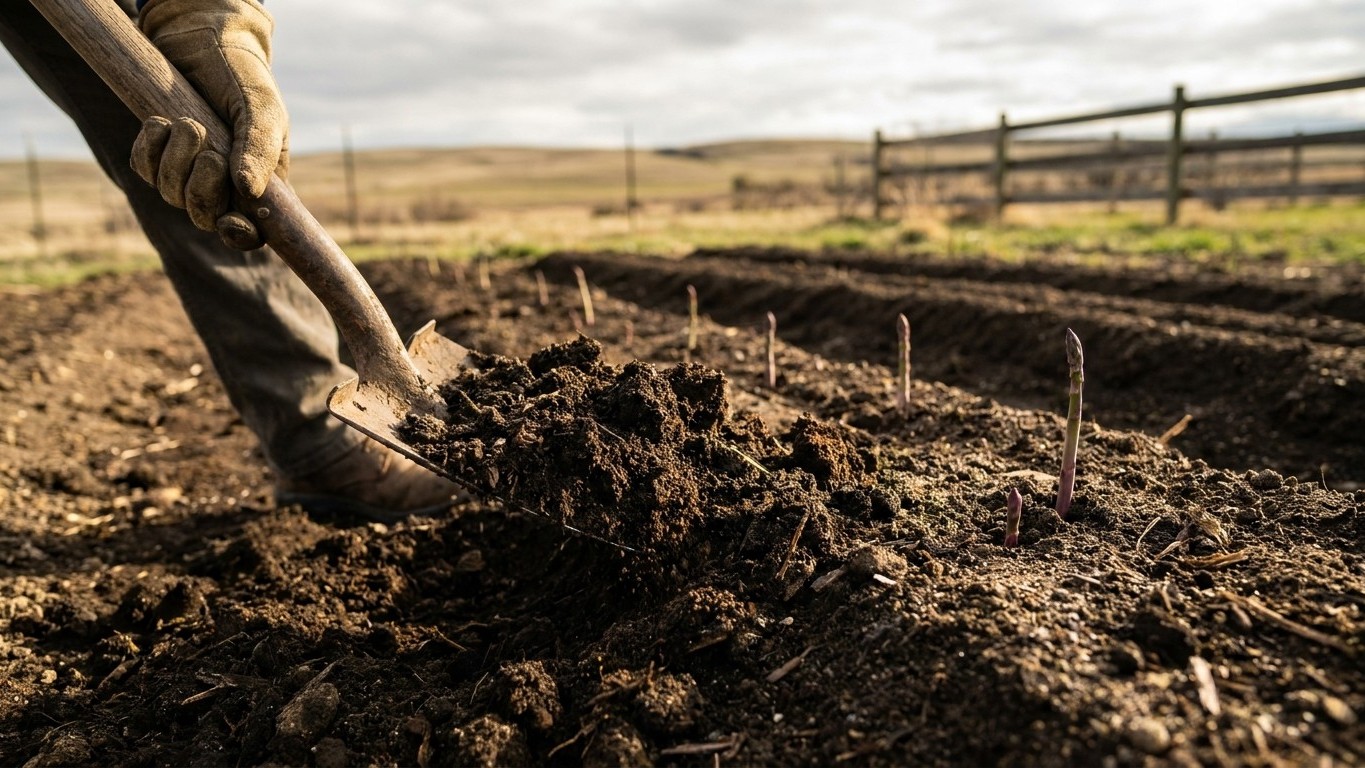

A fifteen-year commitment starts with one question: does the ground drain? Kansas’s state soil, the Harney series, does drain well, which is good news for a bed that will outlive several presidential terms in the same spot. But the state soil isn’t your soil, and that gap is where most asparagus beds succeed or fail.
The short answer
Asparagus crowns go into the ground once and, if the site is right, keep producing for 10 to 15 years before the bed needs to be moved or replaced, according to Utah State University Extension. There’s no third or fourth try with this crop the way there is with tomatoes or peppers. You pick the spot, you commit, and the only soil requirement Extension publishes is that the ground be well drained. Nothing about pH, nothing about fertility beyond what any vegetable bed needs. Drainage is the whole test.
Kansas has an answer to that test built into its own soil records. The Harney series, named the official state soil by Kansas law in 1990, is a Mollisol, the deep, dark prairie soil that built the Corn Belt. USDA soil survey data describes its surface as loam to silt, roughly 9 percent sand, 24 percent clay, and 67 percent silt, with organic matter around 2.0 percent and a surface pH near 6.7. Critically, it’s classified as well drained, which raises the real question: Will Kansas Soil Hold an Asparagus Bed for Fifteen Years? If your garden sits on ground close to this profile, an asparagus bed has a reasonable shot at draining the way this crop wants.
That’s a starting point, not a diagnosis. The Harney series describes what the state’s soil tends to do across a huge stretch of ground; it says nothing about the twenty feet of dirt behind your own garage. River bottoms hold water differently than upland fields. Hill country sheds it faster. And anywhere a builder scraped topsoil and brought in fill, the drainage story resets completely, regardless of what the county soil map says. A silty, high-clay soil that looks like Harney on paper can still puddle for days after a storm if it’s been compacted by equipment or foot traffic.
If your ground doesn’t drain the way this bed needs, the fix isn’t complicated but it is permanent, same as the crop itself. A raised bed, built up eight inches or more with a well-draining mix, sidesteps a heavy clay subsoil entirely. Working generous organic matter into a native bed before planting helps, though on genuinely poor-draining ground, raising the whole bed is the more reliable route. Whatever you choose, decide before the crowns go into their 8-inch furrows, since When to Plant Asparagus Crowns in Kansas shapes how much time you have to fix drainage issues, because after that first season of gradual backfilling, roughly two inches of soil added back every other month across the year, there’s no easy do-over.
Will the summer here water it for you?
Extension guidance calls for 1 to 2 inches of water every other week during the crop’s first two years, then a lighter schedule of watering every three weeks once the bed is established. Kansas summers don’t hand that out evenly, and the arithmetic is worth walking through.
- Start with the demand. At 1 to 2 inches every other week, a young asparagus bed wants somewhere around half an inch to a full inch of water per week, averaged out, through its first two summers.
- Compare that to what falls. NOAA’s 1991-2020 climate normals put summer rainfall at about 13.2 inches across June, July, and August combined, roughly 4.93 inches in June, 3.98 in July, and 4.3 in August. Spread over thirteen weeks of summer, that’s close to an inch a week on average, which on paper covers the bed’s stated need.
- Notice where the gap opens. July is the driest of the three months at 3.98 inches, and it’s also the hottest stretch of the growing season, when evaporation from the soil surface runs highest. A bed that looked adequately watered in June can dry out fast during a July lull.
- Account for how the rain arrives. Summer totals in this region lean on thunderstorms rather than steady soaking rain. A two-inch downpour that runs off a compacted or clay-heavy surface in twenty minutes doesn’t soak in the way a slow, gentle rain does, so the average figure overstates what actually reaches the roots.
- Plan to supplement, not skip. The safest approach treats the normal rainfall figures as a baseline that needs topping off, especially in July, rather than a guarantee that the hose can stay coiled up all summer. A rain gauge on your own plot, checked weekly, is the only way to know if a given two-week stretch actually delivered the inch or two the bed wants.
When to put the crowns in
Crowns go into the ground in early spring, according to Utah State University Extension, planted into furrows about 8 inches deep and backfilled gradually over the following months rather than all at once. In Kansas, that early-spring window sits against a last spring frost that NOAA’s 1991-2020 climate normals place around April 4 to April 18 at the reference weather station used for these figures.
That date range is worth reading as exactly what it is: a normal, not a promise. It comes from an airport weather station, and gardens away from that station, especially suburban and rural properties, typically see their last spring frost land later than the reference figure, sometimes by a week or two, and later still at higher elevation. So “early spring” for crown planting in Kansas means working around that mid-April window with some room to spare, not counting down to April 4 on a calendar. Crowns can generally go in before the very last frost risk has fully passed, since they’re planted below the soil surface and backfilled slowly, but a hard, late freeze right after planting is still worth watching for in a given season.
Seed is the alternative route Extension names, though it asks for more patience. Starting asparagus from seed adds a year to the front end of an already long timeline before crowns are ready to set out, on top of the three-year wait before any harvest begins. For a bed meant to sit in one place for a decade and a half, most home gardeners lean on crowns simply to shave that extra year off, but seed remains a legitimate option where crowns aren’t available or where a gardener wants to select from a wider set of plants.
On varieties, Extension names four without ranking them: Jersey Giant and Jersey Knight, both all-male types, and UC 157 F1 and Purple Passion, which produce both male and female plants. No flavor comparison, no yield figures, and no stated reason to prefer one over another appear in that guidance, so any claim beyond the sex of the plant is someone’s opinion, not published Extension data.
Checking this against your own county
Everything above describes tendencies: a state soil that drains well on average, a summer rainfall pattern that mostly covers demand except in a dry July, a frost window measured at one reference station. None of it substitutes for a look at your own ground and your own microclimate.
Kansas State Research and Extension is the named authority for exactly that kind of local check. County offices there can point to soil testing services, confirm frost timing that’s closer to your actual property than an airport gauge fifty miles away, and flag any local drainage issues tied to specific soil series in your area rather than the statewide Harney profile.
A fifteen-year bed is a long time to be wrong about a detail that a soil test or a phone call could have caught in the first season. Given the stakes, that one conversation with a county extension office is worth having before the first crown goes into the ground.
Common questions
How soon can I harvest after planting asparagus crowns?
Not for three years. Extension guidance is explicit that no harvest happens in the first two years after planting; year three is the first cutting, and even then the harvest window starts short, around four weeks, before extending to six weeks and then eight weeks in later years as the crowns mature.
How do I know when to stop cutting for the season?
The rule is tied to the spears themselves, not a date on the calendar. Extension guidance says to stop harvesting once most of the spears coming up are thinner than a pencil, a sign the crown’s energy reserves need to go toward growing ferns rather than more spears.
Does Kansas’s state soil mean asparagus will grow well anywhere in the state?
No. The Harney series describes the surface of representative soil components mapped across the state, with a pH near 6.7 and good drainage, but it’s not a measurement of any individual garden. Local soil can differ sharply, especially near rivers, in hill country, or on any lot where a builder has disturbed the original ground.
Is there a recommended soil pH for asparagus in Kansas?
Not published in the Extension source used here. That guidance names good drainage as the requirement and stays silent on pH, so no specific target should be assumed, whether from the state soil figures or elsewhere.