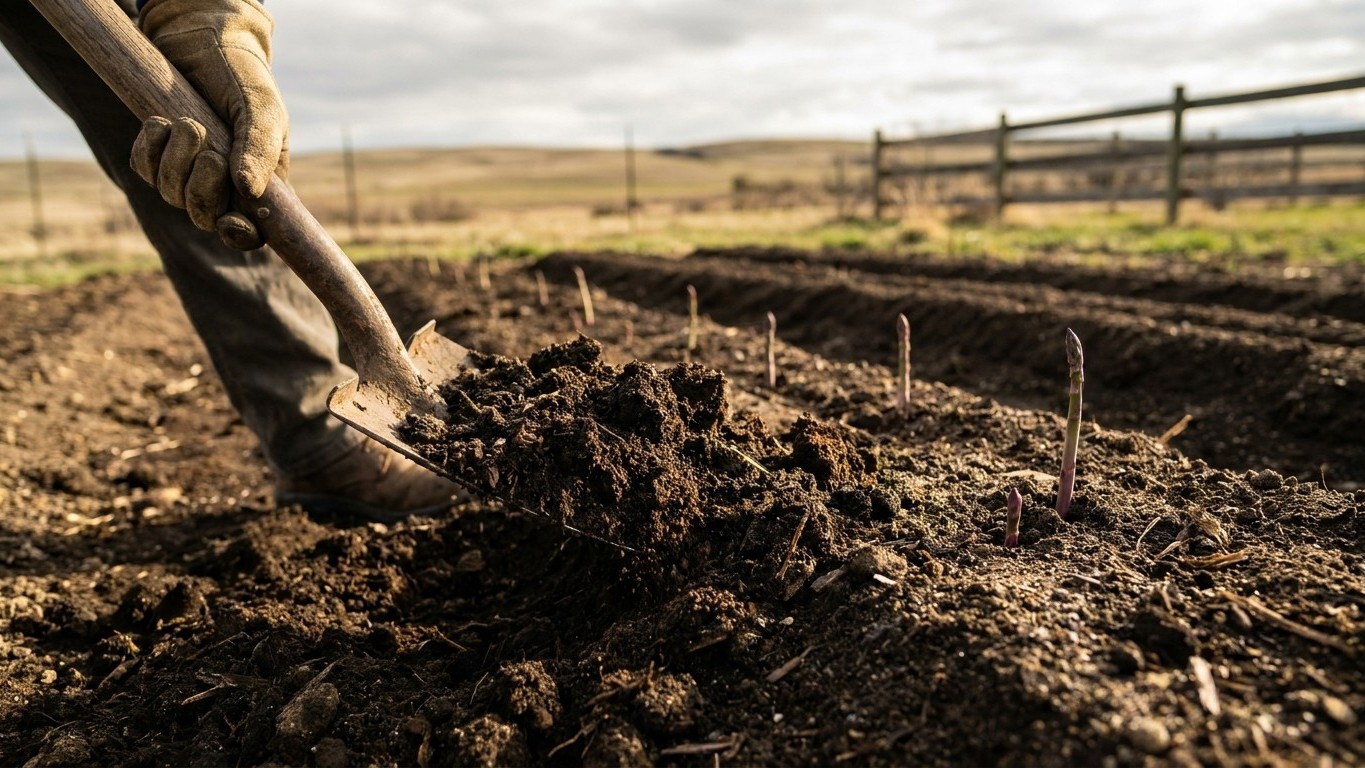

Asparagus is the one vegetable in a Utah garden that stays put for a decade or more, so the spot matters more than the seed packet. The state’s representative soil, the Mivida series, is sandy and well drained, which is what an Asparagus Bed asks for above almost anything else. Utah summers run dry, so irrigation carries most of the load once the bed is in. When to Plant Asparagus Crowns in Utah is tied loosely to the region’s frost window, as soil warms in early spring, and the first cutting waits until year three.
The short answer
A well-placed asparagus bed produces for 10 to 15 years without being dug up, moved, or replanted, which raises the question of Will Utah Soil Hold an Asparagus Bed for Fifteen Years? Utah State University Extension is blunt about what that spot needs: “most soils will do provided they are well drained.” Nothing about pH, nothing about fertility beyond the ordinary, just drainage. That single condition is why the choice of spot carries more weight here than it does for a tomato patch you’ll till under every fall.
The soil USDA lists as representative of Utah, the Mivida series, happens to answer that condition well. It runs 72 percent sand, 9 percent clay, and 19 percent silt in its surface layer, with organic matter around 1.5 percent and a surface pH near 8.1, on the alkaline side. Sand at that share drains fast almost by definition; water doesn’t sit and suffocate roots the way it would in a heavier clay loam. For a crop that will occupy the same ground for fifteen years, that’s a favorable starting condition.
It is a starting condition, not a verdict on any one backyard. The Mivida series is what USDA records as representative across the state; it says nothing about the particular patch of ground behind a specific house. Fill dirt from a subdivision build, a low spot that collects runoff, or a river-bottom lot can all behave nothing like the sandy norm, and a state soil profile can’t catch any of that. The only way to know is to dig a hole, fill it with water, and watch how fast it disappears. If it’s still standing after an hour, that spot will drown asparagus roots long before it ever produces a spear worth cutting. Raised beds or berms solve that problem directly, since they let a gardener build the drainage the native ground won’t provide.
The other piece of the fifteen-year math is patience with the harvest calendar. Nothing gets cut in years one or two; the plants are building the root system that will carry them for the rest of that run. Year three allows a short harvest window, roughly four weeks. Year four stretches that to about six weeks. From year five onward, the bed can be cut for around eight weeks each spring. After that, the rule for stopping isn’t a date on a calendar. It’s a look at the spears: once most of them come up thinner than a pencil, harvest stops for the season so the plant can rebuild itself for next year.
Will the summer here water it for you?
- Years one and two, the bed wants 1 to 2 inches of water every other week. That’s the establishment period, and it’s non-negotiable if the goal is a bed that still produces in year twelve.
- Utah’s summer doesn’t come close to supplying that on its own. Across June, July, and August combined, the region’s climate normal is about 2.0 inches of rain, against a yearly total of 15.5 inches. Most of the year’s moisture falls outside the exact months an Asparagus Bed needs it most.
- July is the driest month by a wide margin, at 0.49 inches. June comes in at 0.95 inches and August at 0.58 inches. None of the three months, alone or combined, gets near the 1 to 2 inches every other week the bed is asking for.
- After year two, the schedule eases to about every three weeks, but the rain doesn’t grow to meet it. The gap between what the plant wants and what the sky provides stays wide for the life of the bed, just on a slightly longer clock.
- The sandy Mivida-type surface makes the shortfall worse, not better. Water that drains well also drains fast, so any rain that does fall moves past the root zone quickly instead of lingering the way it would in a denser clay soil.
- In practice, irrigation is doing almost all of the work. A rain gauge on the actual plot, not a regional average, is the only honest way to know how much a specific bed is short in any given week.
When to put the crowns in
Crowns go into 8-inch furrows in early spring, while the soil is workable but before the plants have broken dormancy for the season. In the region around station USW00024127, the last spring frost falls somewhere between April 12 and April 29. That’s a normal drawn from thirty years of data, not a promise for any single year, so “around” that window is the honest framing, not a fixed calendar date.
The furrow itself isn’t backfilled in one pass. Soil goes back in gradually over the season, about two inches every other month, rather than filling the trench flush on planting day. That staged approach lets the emerging shoots keep growing toward light as the furrow slowly closes around them, instead of burying the crown all at once.
Crowns aren’t the only route in. Starting from seed is the alternative for gardeners who’d rather grow their own stock from scratch, though it adds time before the planting reaches the size a crown already has on day one. For most home gardens, buying crowns and following the early-spring furrow method is the more direct path to that year-three harvest.
Which crowns, and does it matter
Utah State University Extension names four varieties without ranking any of them on flavor or yield: Jersey Giant and Jersey Knight are all-male types, while UC 157 F1 and Purple Passion are male and female. Extension doesn’t publish a reason to prefer one over another, and no nursery is named as a source here either. The practical takeaway is that the choice between them isn’t settled by published data, only by what’s available locally.
- Jersey Giant, all-male
- Jersey Knight, all-male
- UC 157 F1, male and female
- Purple Passion, male and female
Checking this against your own county
Everything above is a regional read: one reference soil series, one weather station’s normals, one extension publication’s planting guidance. None of that substitutes for what’s actually happening on one particular lot. Frost dates shift with elevation, valleys hold cold differently than benches, and a soil map unit can change within a few hundred feet of where it’s drawn.
Utah State University Extension, at extension.usu.edu, is the resource built to answer those local questions, county by county, with staff who know how a given valley or bench behaves compared to the regional normal. Before committing a spot to fifteen years of asparagus, a call or visit there is worth more than any statewide figure.
Common questions
Can asparagus grow in Utah’s alkaline soil?
The state’s representative soil runs alkaline, around pH 8.1 at the surface, but the source used for this article is silent on what pH asparagus actually prefers. Drainage is the only requirement it states plainly, so pH isn’t published here as a deciding factor either way.
How long before an Asparagus Bed produces anything?
Nothing is harvested in years one or two. Year three allows about four weeks of cutting, year four about six weeks, and year five onward around eight weeks each spring, continuing for the life of the bed.
Does Utah’s dry summer mean asparagus needs constant watering?
It needs supplemental watering through most of the growing season. Summer rainfall here totals about 2.0 inches across June, July, and August, well short of the 1 to 2 inches every other week the bed wants in its first two years.
Is there a hard rule for when to stop harvesting each spring?
Yes, but it’s not a date. Harvest stops for the season once most of the spears coming up are thinner than a pencil, a sign the plant needs to rebuild its energy reserves rather than keep pushing new growth to be cut.