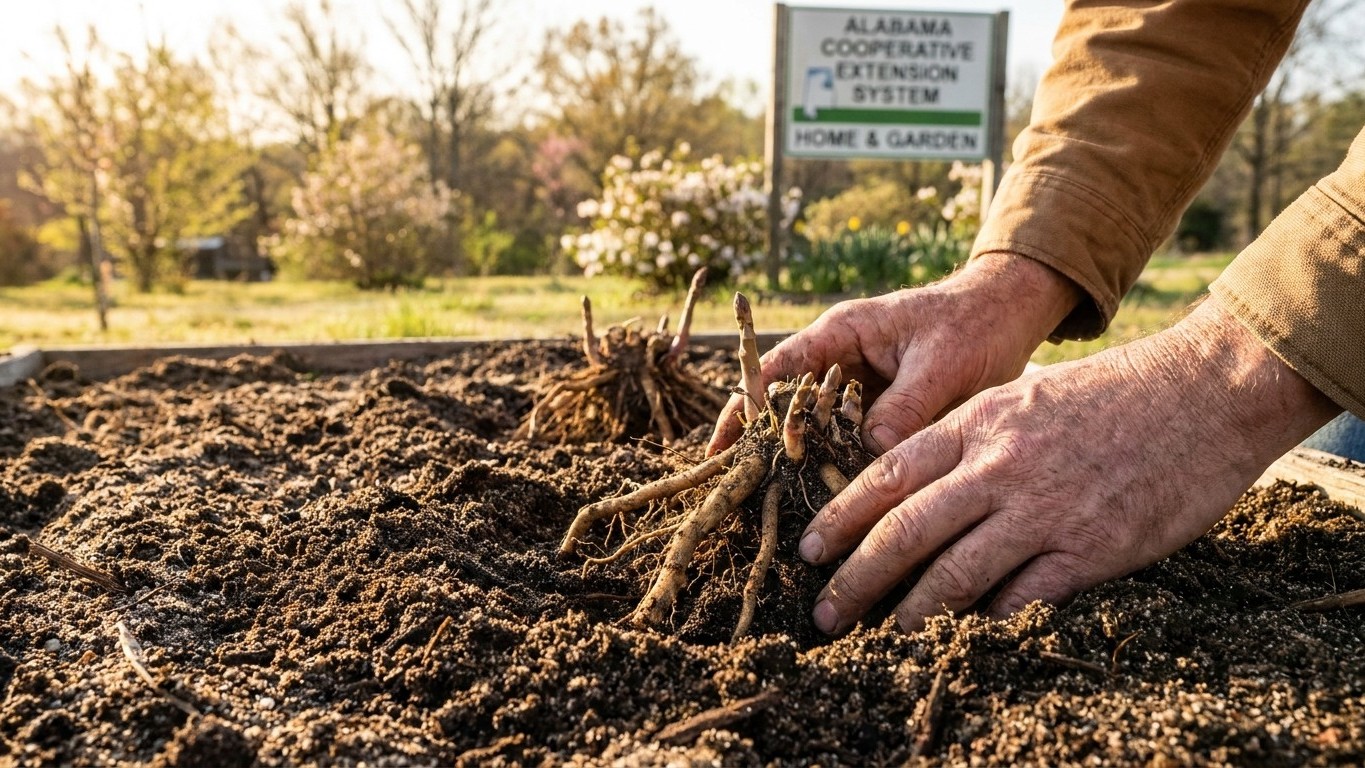

Plant Asparagus Crowns in Utah in early spring, timed to your local last frost window rather than a fixed date. Salt Lake City’s average last spring frost falls between April 12 and April 29, so most Utah gardeners get crowns into 8-inch furrows in that stretch, weather and soil temperature permitting. What happens next depends far more on your soil’s drainage and your patience than on the calendar.
The short answer
Here’s the part that trips people up: asparagus isn’t a plant-it-and-move-on crop. Once a bed is established, it produces in the same spot for 10 to 15 years. That’s not a suggestion, it’s the math of the plant’s root system, which spreads and thickens underground year after year until digging it up becomes its own project. Choosing a bed location for asparagus is closer to choosing where to put a tree than picking a spot for tomatoes.
Utah State University Extension’s guidance on the crop is almost stripped-down in its simplicity: most soils will work, provided they drain well. That single condition carries more weight than it looks like on the page. In a soil that holds water around the crowns, asparagus roots sit wet through winter and spring, and rot sets in before the planting has a chance to get going. There’s no adjusting course three years in, by then the roots are established and the bed is what it is.
So how does Utah’s ground behave? The soil that USDA lists as representative of the state, the Mivida series, is an Aridisol, the kind of dry-climate soil common across the arid West. Its surface horizon runs about 72 percent sand, with only 9 percent clay and 19 percent silt, and organic matter sits low, around 1.5 percent. Sand-heavy, low-organic-matter ground like that drains fast, often too fast for thirstier plants, but it’s exactly the profile asparagus tolerates well. The surface pH on this representative soil measures about 8.1, distinctly alkaline, though the asparagus guidance itself is silent on soil pH, so there’s no published target to chase here. Test your own dirt if you want a number to work with.
None of this means your particular yard behaves like the state soil. The Mivida series is a representative profile USDA uses to describe Utah broadly, not a survey of every backyard in it. River-bottom ground, hillside plots, and anything a builder graded and filled can drain completely differently from the state average, sometimes within the same neighborhood. If your soil is heavier, holds puddles after a storm, or feels dense and sticky when wet, don’t gamble a 15-year planting on hope. Raised beds or berms lift the crowns above the slow-draining layer and solve the problem permanently, at the cost of some upfront lumber and labor. A ten-minute check, digging a hole a foot deep, filling it with water, and timing how long it takes to disappear, tells you more about your own ground than any state-level soil description ever will.
Will the summer here water it for you?
Established asparagus wants roughly 1 to 2 inches of water every other week for its first two years, tapering to about that same amount every three weeks once the bed matures. Utah’s summer sky doesn’t come close to covering that on its own, and the shortfall is bigger than most people assume.
- What summer actually delivers. Averaged across June, July, and August, the reference station near Salt Lake City records about 2.0 inches of rain total for the entire three-month stretch. Spread over 13 weeks, that’s nowhere near the 1-2 inches every two weeks the bed is asking for in its first two seasons.
- The month that hurts most. July is the driest month of the year here, averaging just 0.49 inches. June brings 0.95 inches and August 0.58 inches, but none of the three months comes close to matching what a young or mature bed needs on its own schedule.
- What that means for the hose. In practical terms, irrigation is doing almost all the work through a Utah summer, not a supporting role. A new bed in its first two years needs the gardener supplying most of that 1-2 inches every other week directly, since rainfall alone covers a small fraction of it.
- Why the sandy soil raises the stakes. Because Utah’s representative soil runs sandy and low in organic matter, water moves through it quickly rather than lingering near the roots. That drainage is good news for preventing rot, but it also means a sandy bed dries out faster between waterings than a clay-heavy one would, so skipping a scheduled watering shows up as stress sooner.
- The number that actually matters. These are 1991-2020 climate normals for one reference station, not a forecast and not a reading from your own yard. A rain gauge staked next to the bed, checked weekly through summer, tells you exactly how much of that 1-2 inches nature covered and how much you still owe the plant.
When to put the crowns in
Crowns go into the ground in early spring, once soil has warmed enough to work and the risk of a hard freeze has mostly passed. In the Salt Lake City area, the average last spring frost falls somewhere between April 12 and April 29, a two-and-a-half-week window rather than a single fixed day. That’s a mean date built from three decades of records, not a guarantee, so treat it as the point where the odds shift in your favor rather than a switch that flips on a specific morning.
Because Utah spans a huge range of elevation, that window shifts a lot depending on where you garden. Salt Lake sits in a comparatively mild valley; higher and colder ground elsewhere in the state pushes safe planting later into spring, while the warmer south can often get started earlier. Whatever your local last-frost window turns out to be, aim for the tail end of it rather than the very first mild day, since a late cold snap on freshly planted crowns costs you nothing to wait out but costs plenty to gamble on.
The planting method itself is straightforward: crowns go into furrows about 8 inches deep. Rather than filling that furrow in all at once, backfill it gradually across the season, adding roughly 2 inches of soil back into the trench every other month as the emerging shoots grow. This slow burial protects tender new growth while still letting the plant reach light and air as it develops.
If you’d rather skip crowns entirely, seed is the other route, though it adds a year to the timeline before you’re dealing with anything resembling an established plant. Either way, the first harvest is off the table no matter what: asparagus planted this spring won’t be cut for spears until year three, and even then the harvest window starts modest, around four weeks, before stretching to six weeks and eventually eight weeks in later years as the crowns mature. The stopping point each season isn’t a date on a calendar either, you stop cutting when most of the spears coming up are thinner than a pencil, a sign the plant needs to put its energy into foliage rather than more spears.
On variety, Utah State University Extension names four options without ranking them on flavor or yield: Jersey Giant and Jersey Knight are all-male varieties, while UC 157 F1 and Purple Passion are male/female types. That’s the extent of what’s published on variety selection, no stated reason to prefer one over another, so the choice comes down to what’s available locally rather than any documented performance difference.
The Moon calendar is a separate, older custom: see when to plant asparagus by the moon, written as tradition rather than fact.
Common questions
Can I Plant Asparagus Crowns in fall instead of spring?
The guidance referenced here points to early spring planting, timed around the last frost window. There’s no published fall-planting timeline in this source, so spring remains the documented approach for Utah gardeners working from Utah State University Extension’s guidance.
How long until I get my first asparagus harvest?
Not until year three. Crowns planted this spring spend their first two seasons building root mass underground with no cutting at all. The first harvest, when it arrives, runs about four weeks, followed by six weeks the following year and eventually eight weeks as the planting matures.
Does Utah’s soil need amending before planting asparagus?
The only stated requirement is drainage, not a specific pH or fertility target. Utah’s representative state soil is sandy and well drained, which suits asparagus, but soil varies enormously by location, so a simple drainage test on your own bed matters more than any statewide description.
How do I know when to stop harvesting each season?
Watch the spears, not the calendar. Once most of the spears coming up are thinner than a pencil, that’s the plant signaling it needs to shift energy into growing foliage rather than producing more spears, and that’s when cutting should stop for the season.