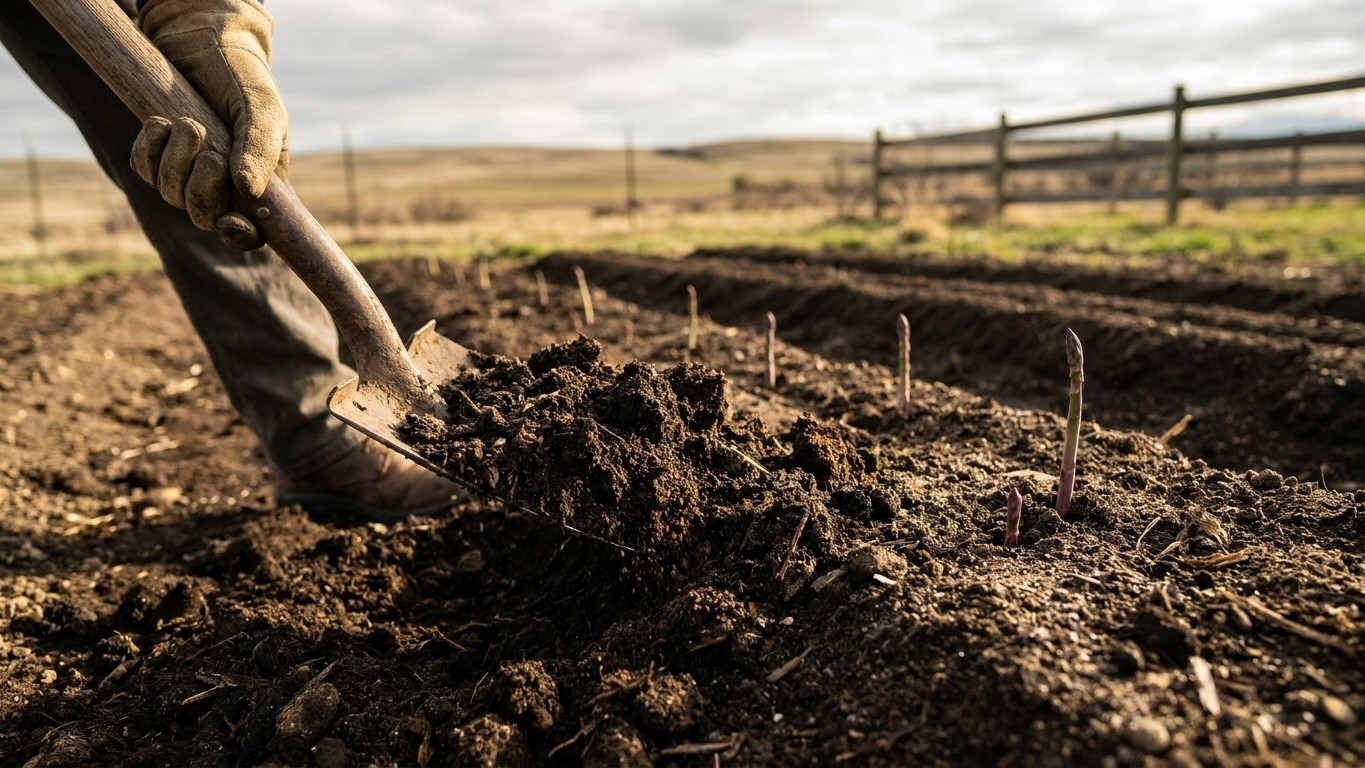

Yes, asparagus grows well across Virginia, but the real question isn’t whether it grows here. It’s whether the ground you pick can carry a bed for ten to fifteen years without drowning the crowns some wet spring. The soil that represents the state drains well on paper, crowns typically go in around late March into early April, no harvest comes before the third year, and the region’s summer rain covers a good share of the plant’s needs, though not all of it. Here’s what actually decides your own answer.
The short answer
Asparagus is the one crop on this site where the spot you choose has to work for a decade and a half. Once a crown settles into the ground and starts producing, moving it isn’t really an option, so the soil question matters more here than it does for a tomato bed you can rotate every season — which raises the real question: Will Virginia Soil Hold an Asparagus Bed for Fifteen Years? Utah State University Extension is blunt about what asparagus asks for: most soils will do, provided they are well drained. That’s the whole requirement published. No pH target, no chilling number, just drainage — though knowing When to Plant Asparagus Crowns in Virginia still matters just as much as the soil itself.
Virginia’s representative soil, the Pamunkey series, is what USDA’s NRCS Soil Data Access lists as the state’s surface reference, drawn from an average of 26 mapped components. It’s an Alfisol, a forest soil of moderate fertility that holds nutrients reasonably well, with a surface texture running about 50 percent sand, 11 percent clay and 39 percent silt, a surface pH near 6.2, organic matter around 1.2 percent, and it’s classed as well drained. On paper, that’s a workable loam-to-silt blend that lets water move through rather than pool.
None of that tells you what’s actually under your own lawn. The Pamunkey series is a starting point USDA uses to describe the state broadly, not a soil test of your yard. River bottoms run heavier and wetter. Hill country can shed water so fast the bed dries out between rains. And any lot a builder has scraped, graded or filled during construction can behave nothing like the mapped series at all, sometimes compacting into a clay pan a few inches down that holds water for days after a storm.
That last case is the one that matters for asparagus specifically. A crown sitting in standing water rots. In an annual vegetable bed, a season of poor drainage is a nuisance you fix next year with compost or a different crop. In an Asparagus Bed, it’s a decision that costs you most of your gardening decade. If a hole dug a foot deep still has water in it after a heavy rain has passed, that ground isn’t ready for crowns as is. The workaround is straightforward: build the row up into a raised bed or a mounded ridge so the crowns sit above the water table rather than in it. There’s no published pH fix here, and no reason to chase one, since the source is silent on soil acidity requirements for this crop. Drainage is the one thing worth testing before you commit ground to fifteen years of asparagus.
Will the summer here water it for you?
an Asparagus Bed has a simple, published watering rhythm: one to two inches of water every other week for its first two years while roots establish, then one to two inches every three weeks once the planting matures. Here’s how that stacks up against what Virginia’s own summer typically delivers.
- Years one and two. The bed asks for 1-2 inches roughly twice a month, which works out to something in the range of 2 to 4 inches across a full summer month if you’re supplying it all yourself.
- Year three onward. Once established, the demand drops to 1-2 inches every three weeks, closer to 1.3-2.7 inches a month.
- What the sky actually brings. At the reference station used for these figures, June averages 4.15 inches, July 5.76, and August 5.09, for about 15.0 inches across the three summer months (46.6 inches over a full year, by the same 1991-2020 normals).
- The gap you still have to fill. On paper, the monthly averages here run ahead of what the bed technically requires, even during establishment. But normals describe an average, not a single summer, and a lot of that rain arrives as a thunderstorm that dumps an inch in twenty minutes and runs off before it soaks in. Especially in a young bed’s first two years, plan to water by hand or drip during dry stretches, and let a rain gauge on your own property, not a station average, be what tells you when.
When to put the crowns in
Crowns go into the ground in early spring, timed to land after the ground has thawed but before the plant would rather be putting energy into leaf growth instead of root establishment. At the coastal reference station used for Virginia’s frost data, the mean last spring freeze at 32°F falls somewhere between March 20 and April 3. Treat that as a window, not a fixed date, since it’s built from a 30 to 70 percent probability band around an average, and any given spring can run earlier or later than the mean. Coastal Virginia Beach also sits at the mild end of the state’s climate; the Blue Ridge and southwest Virginia run weeks later into spring and weeks earlier into fall, so a gardener further inland should push planting back accordingly rather than trust a coastal date.
Furrows, backfill and varieties
Crowns are planted in furrows about 8 inches deep, according to Utah State University Extension, laid into the trench and covered lightly at first rather than buried all at once. The trench gets filled in gradually across the year, adding roughly two inches of soil back over the crowns every other month rather than closing the whole furrow at planting time. Four varieties are named in that same source, distinguished only by sex: Jersey Giant and Jersey Knight are all-male, UC 157 F1 and Purple Passion are male-and-female. No flavor comparison, no yield figure, and no reason to prefer one over another is published there, so treat the choice as a matter of availability rather than performance, and check with a local supplier or extension office for what does well nearby.
Seed is the alternative to crowns, and some gardeners do start that way instead. The source behind these figures addresses only the crown method, though, and doesn’t publish a seed-starting timeline or how much extra delay it adds before the bed matures, so that detail isn’t available here.
The wait before harvest
Patience is built into this crop by design. No spears get cut the first two years after planting, full stop. Harvest doesn’t begin until the third year, and even then it’s light, roughly four weeks of cutting, stretching to about six weeks the following year and eight the year after that. Within any given season, the signal to stop isn’t a date on the calendar. It’s the spears themselves: once most of what’s coming up runs thinner than a pencil, that season’s harvest is over, and the plant needs to put its energy back into growing fern for next year.
Checking this against your own county
Everything above describes Virginia in broad strokes, one reference soil series and one weather station standing in for a state that stretches from tidewater to mountain ridge. That’s a reasonable starting point, not a substitute for what’s actually true on your own lot. Before committing a spot to fifteen years of asparagus, a soil test and a conversation with someone who knows your specific county are worth the time.
Virginia Cooperative Extension, at ext.vt.edu, is the named resource for that. Local offices can run a soil test for drainage and fertility, confirm frost timing closer to your actual address rather than a coastal station average, and tell you what’s growing well for other gardeners nearby. Given how long an Asparagus Bed stays put once it’s in, that local check is worth making before the crowns go in the ground, not after.
Common questions
How long before I actually get asparagus to eat?
None the first two years. Light harvesting starts in the third year, around four weeks of cutting, then about six weeks the year after, and eight the year after that, per Utah State University Extension. Stop each season once most spears run thinner than a pencil.
What if my soil doesn’t drain well?
Build the row into a raised bed or a mounded ridge so the crowns sit above standing water. A soggy crown rots, and since this bed isn’t meant to move for a decade or more, drainage is worth fixing before planting rather than working around later.
Which variety should I plant?
The published record only tells you the sex type: Jersey Giant and Jersey Knight are all-male, UC 157 F1 and Purple Passion are male-and-female. No flavor or yield comparison is published, so there’s no documented reason to favor one over another here.
Can I start from seed instead of crowns?
Some gardeners do, but the source behind these figures covers only the crown method, with no seed-timing schedule published. A local extension office is the better place to ask for guidance on starting asparagus from seed in your area.