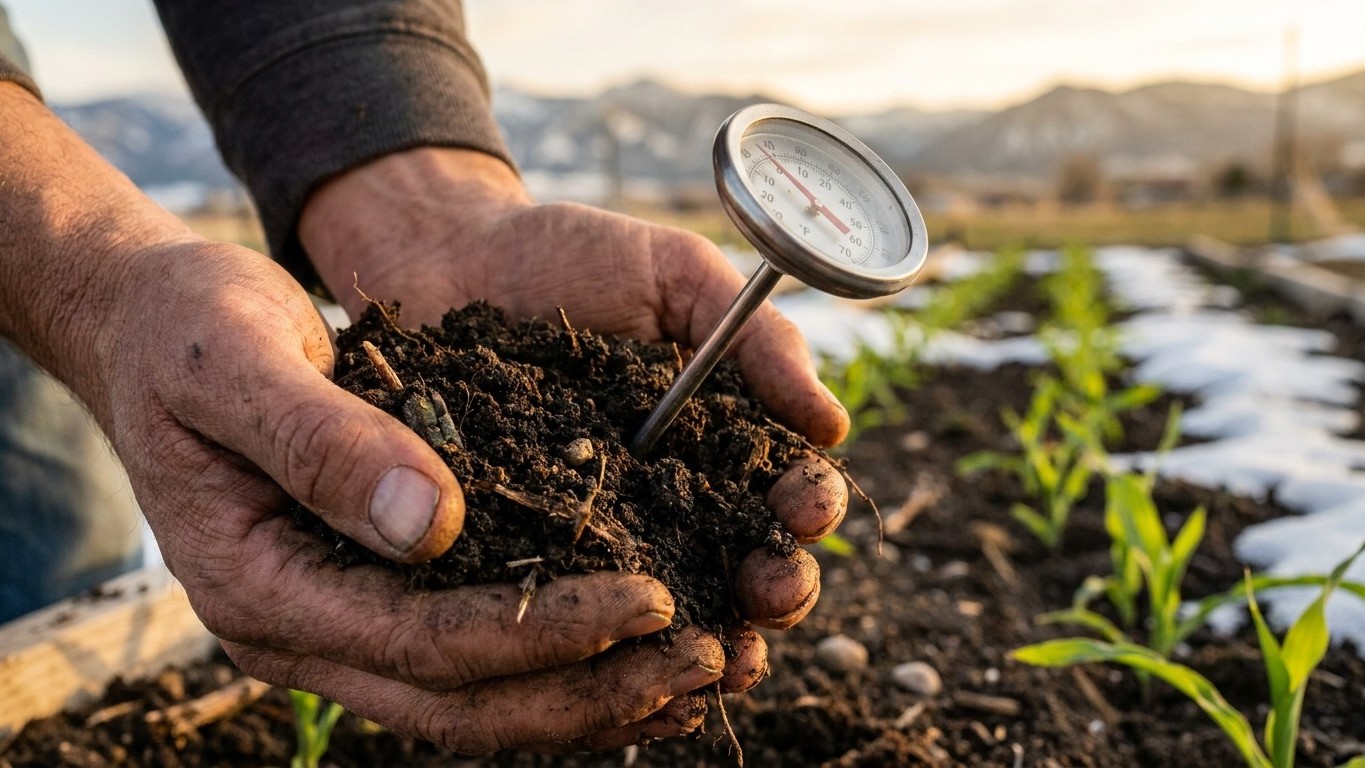

Sweet corn ripens reliably in western Washington, but only if you wait for the soil, not the calendar. The frost-free stretch here runs long enough for even a slow variety, and the real risk isn’t an early freeze cutting the season short. It’s cold, wet soil holding the crop back for weeks after gardeners elsewhere have already planted, plus a cool summer that stretches the days-to-maturity count further than the seed packet promises.
The short answer
Western Washington’s last spring frost falls somewhere between February 27 and March 18, going by three decades of freeze records at the reference station NOAA’s National Centers for Environmental Information tracks for this region. That date is not when you plant corn. When to Sow Sweet Corn in Washington depends instead on soil that has warmed past 60 degrees Fahrenheit, and in a marine climate cooled by Puget Sound and shadowed by spring cloud cover, that threshold arrives weeks after the freeze risk has passed. The frost date tells you when the danger of a killing cold snap fades. It says nothing about whether the ground is actually warm enough to sprout a kernel instead of rotting it.
This gap matters more here than in a lot of the country. Gardeners in a continental climate often see soil temperature catch up to frost dates within a couple of weeks, because once the freeze risk clears, the air warms fast and stays warm. Western Washington’s spring is slower and damper, and the ground holds onto winter chill well after the thermometer stops dropping below freezing at night. Planting corn into soil that hasn’t crossed that 60-degree line is the single most common reason a Washington garden’s corn stand comes up thin, or rots outright before it breaks the surface.
Once the soil does warm, the math gets more forgiving. Sweet corn needs 60 to 90 days from planting to harvest, depending on the variety, and the first fall frost here doesn’t arrive until somewhere between November 13 and November 30. Even a planting held back until the ground is genuinely ready still leaves a wide runway before the season’s first hard freeze shuts things down. That’s the real advantage of gardening on this side of the Cascades: a long, mild, frost-free stretch that absorbs a late start without much complaint.
The catch is heat, not time. This station averages only about 3 days a year reaching 90 degrees Fahrenheit or hotter, which means summer here is mild rather than blazing. Corn’s days-to-maturity figures are built around warmer, sunnier summers than this region typically delivers, so a variety rated for 75 or 80 days can easily run longer in practice. The season is long enough to absorb that stretch, which raises the real question of Will Sweet Corn Ripen in Washington? before fall frost arrives. It just means patience matters more than the seed packet suggests, and pinning your harvest date to a fixed number of days after planting is a mistake in this climate.
Does a late variety fit here?
The frost window here is wide enough that the question isn’t really whether a late variety can survive the season. It’s whether it finishes on a timeline that still makes sense once you factor in a slow spring and a cool summer.
A 60-day variety
A short-season type built to mature in about 60 days is the safest bet for this climate, and it lines up well with the region’s slow, cool spring. Even if soil doesn’t cross 60 degrees Fahrenheit until well into the traditional planting season, a 60-day corn planted at that point still has months of runway before the first fall frost arrives sometime between November 13 and November 30. It also sidesteps the region’s biggest weakness: a short window of true summer heat. With averages of just about 3 days a year above 90 degrees Fahrenheit, the fewer growing days a variety needs, the less exposed it is to a cool, cloudy stretch stalling things out in late summer. This is the variety to lean on if the planting date slips later than planned, which happens often here.
A 90-day variety
A full-season type rated near 90 days is a bigger commitment, but the calendar here does support it. Counting forward 90 days from even a delayed planting, once soil has finally warmed past 60 degrees Fahrenheit, still lands well ahead of the November frost window. The frost-free stretch in western Washington is simply long enough to carry a slow variety across the finish line, which isn’t true in a lot of the country. The variety fits.
What it doesn’t get is a free pass on heat. With only about 3 days a year reaching 90 degrees Fahrenheit, the growing season here rarely delivers the sustained warmth those 90-day figures assume, so real maturity often runs past the number on the packet. Expect a 90-day corn to finish later in the calendar than the label implies, likely pushing well into what other regions would consider early autumn. There’s still margin before frost, but it’s tighter than it looks on paper, and a wet, cool stretch in late summer can stretch it further. Two separate clocks are worth keeping straight here: the days-from-planting figure tells you whether the crop fits the season at all, while the days-from-silk-emergence figure, once tassels and silks appear, is what actually tells you which week to walk out and pick.
| Variety type | Typical days to maturity | Fits before the Nov 13-30 frost? | Main risk |
|---|---|---|---|
| 60-day (short-season) | About 60 days from planting | Yes, with wide margin | Minimal risk from a cool summer |
| 90-day (full-season) | About 90 days from planting, often longer in cool summers | Yes, but margin narrows | Real maturity often runs past 90 days given few 90F+ days a year |
What goes wrong here
Most sweet corn disappointments in this region trace back to one of three causes, and only two of them have anything to do with the climate.
- Soil sown too cold. Planting by the frost date instead of waiting for the ground itself to warm past 60 degrees Fahrenheit is the most common failure in western Washington gardens. Cool, wet soil either rots the seed outright or produces a thin, uneven stand that never catches up. The remedy is to check the soil directly, with a soil thermometer pushed a few inches down, rather than trusting a calendar date or the last freeze.
- A variety too late for the season. The frost-free window here is generous, but it isn’t infinite, and pairing a very late planting date with a very long-season variety can push the harvest uncomfortably close to the first fall frost, somewhere between November 13 and November 30. If the soil warms late in a given year, switching to a shorter-season variety protects the harvest instead of racing the calendar.
- Sweetness lost to timing, not climate. This one has nothing to do with Washington’s weather. When two different sweet corn types, the standard su type, the sugar-enhanced se type, or the supersweet sh2 type, tassel at the same time nearby, cross-pollination ruins the sweetness of both. The fix isn’t distance, it’s timing: grow only one type at a time, or stagger planting dates so the varieties never tassel together, while still planting each type in blocks of three or more rows rather than a single thin line, since corn is wind-pollinated and needs that block shape to pollinate itself properly.
Checking this against your own county
Everything above is built on freeze data from a single western Washington reference station, and this state does not have one climate. East of the Cascades, the growing season is shorter and drier, shaped by a high desert climate rather than the mild, marine one described here. A frost calendar built around Puget Sound doesn’t transfer across the mountains, and treating it as a statewide number is one of the easiest mistakes a gardener can make.
Washington State University Extension, at extension.wsu.edu, is the place to check local planting windows, frost records, and soil temperature guidance for a specific county rather than relying on a single reference station. County-level offices under that same extension network track local variation that a statewide average can’t capture, including how much later or earlier soil warms in a given valley, on a given slope, or along a given stretch of coastline. Before committing a full-season variety to the ground, it’s worth confirming the local numbers rather than assuming one region’s window applies everywhere the state’s name appears on a map.
Common questions
When is the soil actually warm enough to plant sweet corn in western Washington?
There’s no single published date for that here, since soil warming varies by year, soil type, and how much sun a particular garden gets. What matters is confirming 60 degrees Fahrenheit directly with a soil thermometer rather than counting forward from the last frost date, which typically falls between February 27 and March 18 and arrives well before the soil is ready.
Does eastern Washington follow the same planting window?
No. The frost and soil data described here reflect western Washington’s mild, marine climate. East of the Cascades, the climate is high desert with a shorter, more compressed season, and a gardener there should check local county extension data rather than apply this window statewide.
How can you tell sweet corn is actually ready to pick?
Three signs need to show up together: the silks have turned dry and brown, the husks are still moist and green rather than papery, and a punctured kernel releases milky juice rather than a clear or doughy fluid. Any one of these signs alone isn’t a reliable indicator on its own.
Can you grow more than one type of sweet corn in the same garden?
Yes, as long as the different types, standard, sugar-enhanced, or supersweet, don’t tassel at the same time. Staggering planting dates so their pollen sheds in different weeks protects the sweetness of both, since the failure here is about timing, not distance.