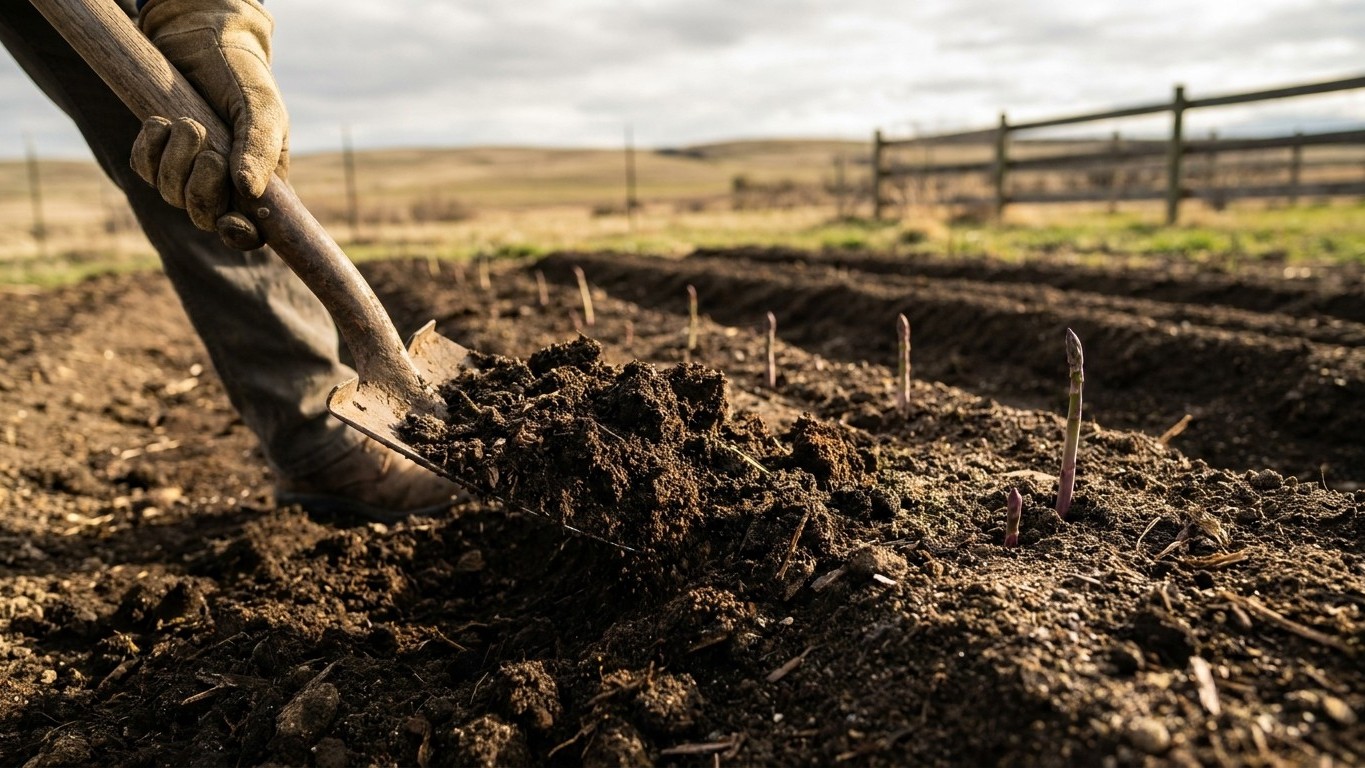

A fifteen-year commitment starts with a shovel test, not a seed packet. Yukon’s dominant soil, an imperfectly drained loam-silt Brunisol, needs help before it can host an Asparagus Bed for a decade or more. When to Plant Asparagus Crowns in Yukon centers on the June 5 average last frost, and the territory’s summer rain, about 4.2 inches over three months, won’t cover the bed’s water needs on its own.
The short answer
Asparagus doesn’t ask for rich ground. Utah State University Extension is blunt about it: most soils will work, provided they drain. That single condition matters more here than almost anywhere else on this site, because a bed planted this year is still producing spears a decade and a half from now. Will Yukon Soil Hold an Asparagus Bed for Fifteen Years? is the question worth answering before planting, since getting the drainage wrong leaves no annual do-over, just a slow decline in a spot you can’t easily move.
Yukon’s mapped agricultural soils are most commonly Brunisols, a young soil order where the horizons have barely begun to separate, typical of ground built on recent or coarse parent material. They make up 41 percent of the surveyed surface, with Gleysolic soils, which form under wet, poorly aerated conditions, coming in second. The median texture runs 47 percent sand, 15 percent clay and 38 percent silt, a loam-to-silt mix, with organic matter around 12.0 percent and a surface pH near neutral at 6.8. The drainage class recorded for this profile is imperfectly drained.
Imperfectly drained is the word that should slow a gardener down. It means water lingers longer in the root zone than a crop like asparagus prefers, and standing moisture around dormant crowns invites rot before growth even starts. That doesn’t rule Yukon out. It means the choice of exact spot on a property matters more than usual: the highest, driest corner of a plot, a slope rather than a hollow, or a raised bed built up with coarser material to get the crowns above the water table. A simple test, digging a hole a foot deep, filling it with water and timing how long it takes to disappear, tells a gardener more about their own patch than any territorial average can.
The state soil is a starting point, not a diagnosis of one garden. A river bottom, a patch of muskeg, or ground a builder has filled and graded can sit nowhere near that median. Nothing here substitutes for a shovel and a bit of patience watching how fast water moves through the reader’s own ground.
Utah State University Extension also names four asparagus varieties by nothing more than their sex: Jersey Giant and Jersey Knight are all-male, while UC 157 F1 and Purple Passion are male and female. That’s the full extent of what the source publishes, no flavor comparison, no yield claim, no reason to favor one over another.
| Variety | Sex |
|---|---|
| Jersey Giant | All-male |
| Jersey Knight | All-male |
| UC 157 F1 | Male/female |
| Purple Passion | Male/female |
Will the summer here water it for you?
The bed’s own watering rule is specific: 1 to 2 inches every other week for the first two years, then every three weeks after that. Whitehorse’s summer normals give a gardener the numbers to check that rule against, month by month.
- June, the driest of the three summer months, averages 1.28 inches of rain across the whole month, well under the 1-2 inches the bed wants inside a single two-week stretch.
- July climbs slightly to 1.5 inches for the month, still short of what two weeks of establishment watering calls for.
- August comes in at 1.41 inches, keeping the same pattern: rain spread thin across four weeks rather than concentrated where the young crowns need it.
- Add the three months together and the season delivers about 4.2 inches of rain total, against a two-year target that, stretched across a full summer, would call for something closer to 6 to 12 inches depending on how many two-week cycles fall in the growing window.
- The gap doesn’t close on its own. A new bed in its first two seasons will need supplemental watering most weeks of June through August, not just in dry stretches, because the shortfall shows up even in an average year.
- Once the bed matures past year two and shifts to the every-three-weeks schedule, the math eases a little, but Yukon’s summer total still runs on the light side for a three-week cycle, so a hose or a soaker line stays part of the routine rather than a backup plan.
These are normals for one reference station, not a forecast and not a promise about what falls on a particular property. A rain gauge staked next to the bed settles the question a climate table can only estimate.
When to put the crowns in
Crowns go into the ground in early spring, planted in furrows about 8 inches deep. In Yukon, that timing sits around the June 5 average last spring frost recorded at Whitehorse A. That date is a mean, not a guarantee: in roughly one year out of two, frost arrives later than June 5, which means a gardener working from this figure alone is planting into real risk about half the time. Treat it as the midpoint of a window that shifts year to year, and lean toward the safer side of it rather than the calendar page.
The furrow itself isn’t filled in all at once. As the young shoots emerge and grow, the trench gets backfilled gradually, about 2 inches every other month across the season, rather than buried solid the day the crowns go in. That staged filling gives the emerging spears room to push upward before soil closes in around them.
Seed is the other route in, and it works, but it adds a full growing season before those seedlings reach transplant size and go into the garden as young crowns. Either way, the source is clear that no harvest happens until year 3 of the bed’s life. When that third year arrives, harvest still starts light, about 4 weeks of cutting, then extends to 6 weeks, and eventually to 8 weeks in following seasons as the crown system matures. The rule for when to stop cutting in any given season isn’t a date on a calendar. It’s a visual cue: once most of the spears coming up are thinner than a pencil, harvest stops for that year, letting the plant put energy into building fern growth instead.
Nothing in the source speaks to a winter chilling requirement, and nothing ties a hardiness zone to a specific number of chill hours. That figure simply isn’t published here, and guessing at one would be exactly that, a guess dressed up as a fact.
Checking this against your own county
A territory-wide soil profile and one reference weather station can only go so far in describing a single backyard. The next step belongs to the reader’s own local ag office. Agriculture and Agri-Food Canada, the federal department, keeps resources and contacts for growers at agriculture.canada.ca/en, a starting point for anyone who wants a soil test read against local conditions rather than a territorial median.
A local office can also speak to frost timing in a specific district, since upland or northern areas of a large territory often run behind the Whitehorse station by a couple of weeks. Nothing here replaces that conversation. A soil test, a call to a local office, and a season spent watching how water moves through one particular patch of ground will tell a gardener more than any regional average, however carefully sourced.
Common questions
When does an asparagus bed in Yukon actually produce food?
Not before year 3, and even then only lightly, around 4 weeks of cutting that first productive season. Harvest windows extend to 6 weeks, then 8 weeks, as the bed matures over the following years.
How do I know when to stop harvesting for the season?
Watch the spears, not the calendar. When most of them come up thinner than a pencil, that’s the signal to stop cutting and let the plant grow ferns for the rest of the season.
Which variety should I plant?
Utah State University Extension names four: Jersey Giant and Jersey Knight, both all-male, and UC 157 F1 and Purple Passion, both male and female. The source doesn’t rank them on flavor or yield, so the choice comes down to what’s available locally.
Do I need to worry about winter cold killing the crowns?
The source doesn’t publish a chilling requirement or tie one to a hardiness zone, so that figure simply isn’t available here. What is clear is that soil drainage, not winter cold, is the condition the source insists on for a bed meant to last 10 to 15 years.