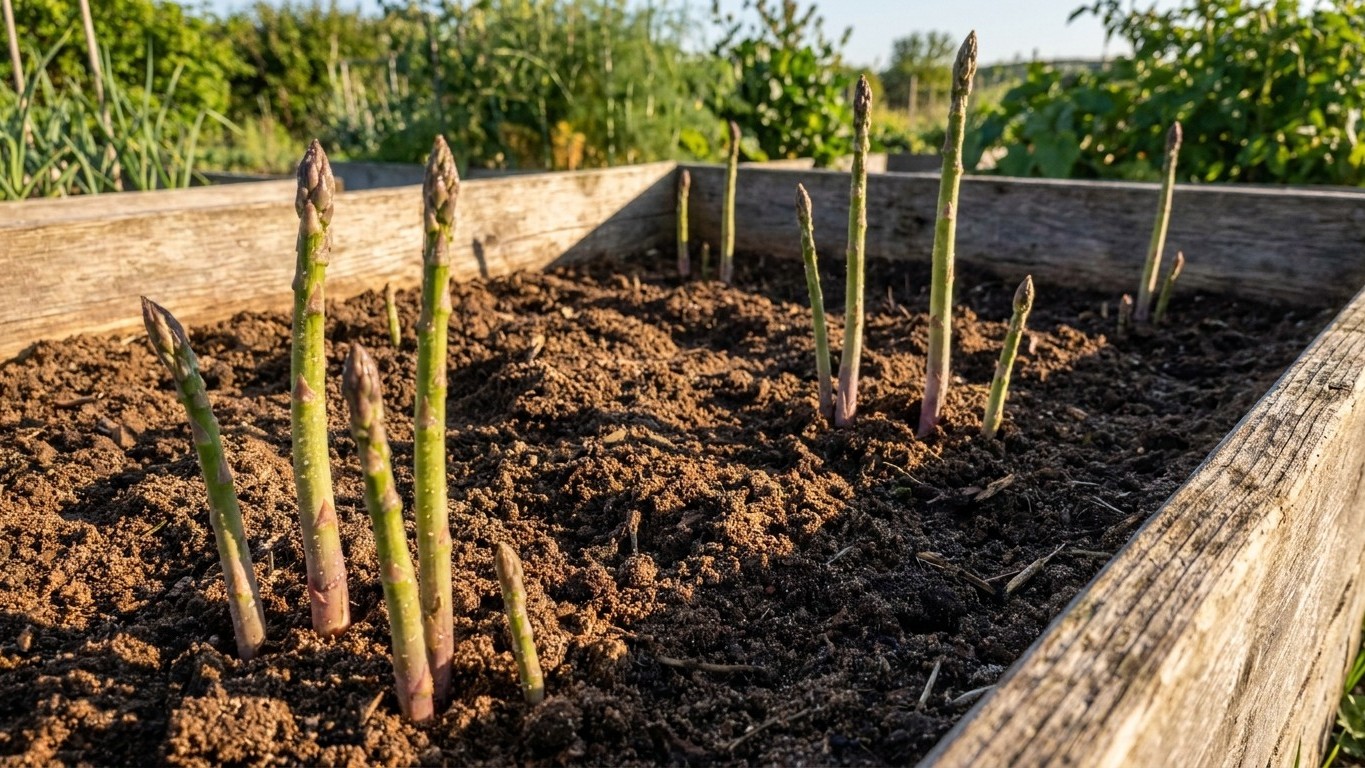

Yes, in most cases, but the territory’s ground carries a built-in caveat. The dominant Yukon soil is imperfectly drained, and asparagus asks for exactly one thing before it commits a bed for 10 to 15 years: drainage. Get that piece right on your own plot, and the rest of the bed’s decade-plus lifespan is a matter of watering and patience rather than soil chemistry.
The short answer
Across the mapped agricultural surface of the territory, the most common soil order is a Brunisol, a young soil whose horizons are still sorting themselves out, typically found on parent material that is coarse or geologically recent. It covers about 41 percent of the mapped surface, with Gleysolic soils as the runner-up. The median surface reading for that Brunisol sits close to a loam: 47 percent sand, 15 percent clay, 38 percent silt, with organic matter around 12.0 percent and a pH near 6.8, close to neutral. On paper that texture sounds like a fair home for a long-term planting. The catch is the drainage class attached to it: imperfectly drained.
Utah State University Extension, the only source behind the planting guidance used here, is blunt about what asparagus needs from soil: almost anything will do, provided it drains. That single condition matters more for this crop than for nearly anything else grown in a home garden, because a bed is not something you rework next spring if it disappoints. Crowns go in once, spears start showing at year 3, and the planting is still expected to produce a decade or more after that. A soil that sits wet through spring does not just slow one season’s growth. It can rot crowns outright, and there is no annual fix for that once the roots are established eight inches down.
So the honest read on “imperfectly drained” is this: it is a caution flag, not a rejection. Some Yukon garden plots, especially those on coarser, sandier ground consistent with that 47 percent sand figure, will shed water fine. Others, particularly low spots, old floodplain silt, or any patch a builder has filled or compacted, will hold water longer than an asparagus crown can tolerate. The territory-wide number is a starting point, not a verdict on your backyard.
What changes the answer
The fix, where drainage is genuinely marginal, is not to abandon the idea but to build up rather than dig down: a raised bed or mounded row lets excess water move off to the sides instead of pooling around the crown. Given that this is the one vegetable in the garden where the site decision is meant to outlast a decade, a single afternoon spent watching where rain actually sits on your plot after a heavy rain is worth more than any territory-wide average. If water is gone within a few hours, plant. If it lingers for days, raise the bed before you plant, not after.
Will the summer here water it for you?
Whitehorse’s climate normals put summer rainfall at about 4.2 inches total across June, July and August, with June the driest month at 1.28 inches, July at 1.5 inches, and August at 1.41 inches. Asparagus, by contrast, wants 1 to 2 inches every other week for its first two years, then roughly every three weeks once established. Laid month by month against that need, here is what the numbers mean for a hose.
- June: with only 1.28 inches falling and a young bed still needing 1-2 inches every other week, this is the month least likely to cover the requirement on its own. Expect to supplement, especially in a planting’s first two seasons.
- July: at 1.5 inches, the month comes closer to meeting a single every-other-week target, but rarely two of them back to back, so a young bed still likely needs a top-up watering at some point in the month.
- August: 1.41 inches lands in the same range as July, close to but generally short of what an actively growing bed in its first two years would use over four weeks.
- Established beds (year three and beyond): once the watering interval eases to roughly every three weeks, the territory’s roughly 1.3 to 1.5 inches per month starts to cover more of the requirement on its own, though it still leaves little buffer in a dry stretch.
None of this accounts for what your own soil does with that rain. A loam close to the territory’s median, 47 percent sand, 15 percent clay, holds moisture longer than pure sand but drains faster than heavy clay, so the same 1.3 inches of June rain behaves differently plot to plot. A rain gauge staked in your own bed for one season tells you more than any normal ever will, and it is the only way to know whether you are watering a young crown too little or, on the imperfectly drained ground common here, too much.
When to put the crowns in
Crowns go into the ground in early spring, set into furrows about 8 inches deep. In the Whitehorse area, the average last spring frost falls around June 5. That date is a mean, not a guarantee, drawn from Environment and Climate Change Canada’s 1981-2010 climate normals for the Whitehorse A station: in roughly half of all years, frost arrives later than that average, not earlier. Treat June 5 as the middle of a window rather than a safe line to plant against, and lean toward the later side of early spring rather than the earlier one if you are working from this figure alone. Gardeners outside the immediate Whitehorse area, particularly in northern or higher-elevation parts of the territory, should expect their own frost window to run behind this station’s average, sometimes by weeks.
The furrow itself is not filled in one pass. Soil goes back in gradually over the course of the year, about two inches added every other month as the crown’s shoots grow, rather than burying the whole eight inches at planting. That gradual backfill matters more on ground close to this territory’s median texture, since packing a full eight inches of loam over a crown all at once on imperfectly drained soil gives excess water more depth to sit in around the roots before it has anywhere to go.
Crowns are the standard route because they save a full year over starting from seed, but seed remains the alternative where crowns aren’t available locally: seed-started plants need an extra season of growth before they reach crown size, pushing the eventual harvest start back accordingly. Either way, no spears come off the bed in its first two years regardless of planting method. Harvest does not begin until year 3, and even then it starts light: about four weeks of cutting in that first harvest year, extending to six weeks the following year, then eight weeks in year 5 and beyond. The point to stop cutting for the season isn’t a date on the calendar; it’s a condition in the bed. Once most of the spears coming up are thinner than a pencil, that’s the signal the crown needs its energy left alone to rebuild for next year, whatever week it happens to be.
On variety, Utah State University Extension names four: Jersey Giant and Jersey Knight, both all-male hybrids, and UC 157 F1 and Purple Passion, both male/female types. The source gives no flavor comparison, no yield figures, and no reason to prefer one over another, so no recommendation is made here beyond noting which ones exist and how they’re classified by sex.
Common questions
Does asparagus need a specific soil pH in Yukon?
The source behind this planting guidance is silent on soil pH requirements for asparagus. The territory’s median surface pH runs close to 6.8, near neutral, but that figure describes the dominant mapped soil order territory-wide, not any individual garden, and it isn’t presented here as a target to hit.
How cold does it need to get for asparagus crowns to survive winter?
No winter chilling requirement is published in the source used here, and none should be inferred from the territory’s hardiness zone. That figure simply isn’t part of the available guidance.
Can I plant asparagus if my yard stays wet in spring?
It’s the one condition worth taking seriously before committing a bed for a decade or more. If water visibly sits on the surface for days rather than hours after rain, raising the bed or planting on a mounded row is the standard adjustment, done before crowns go in rather than after.
How long until I get a full harvest?
No cutting happens in years 1 or 2. Year 3 brings about four weeks of harvest, year 4 stretches to six weeks, and by year 5 the bed is up to a full eight-week harvest window, which continues through the rest of its 10 to 15-year productive life.