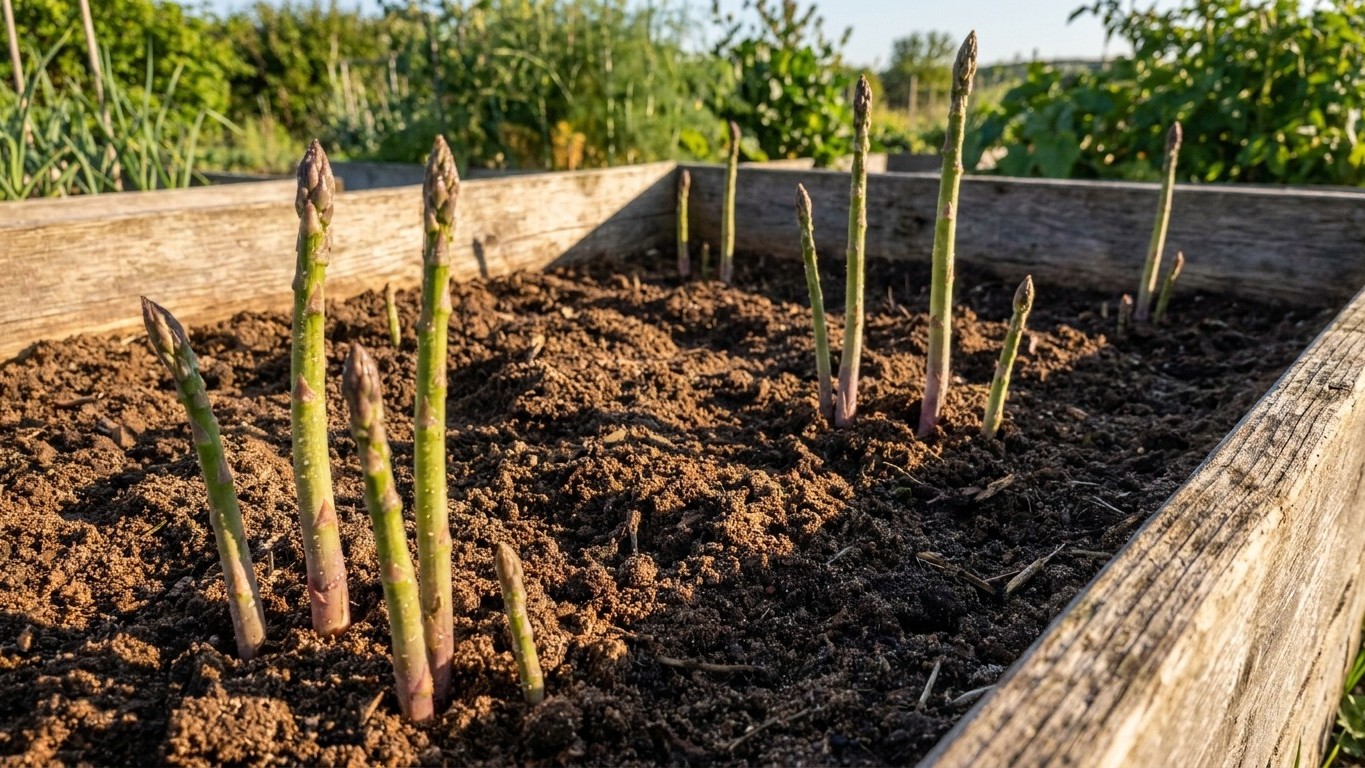

Yes, if the ground drains, and across most of Arizona’s low desert, the ground does. an Asparagus Bed asks for one thing above all else: water that moves through the soil rather than sitting in it. Get that right and a planting can keep producing for ten to fifteen years, no digging up, no replanting, just harvest and wait. Get it wrong and the crowns rot before they ever see a second season.
The short answer
The USDA’s representative soil for Arizona is the Casa Grande series, an Aridisol built for a dry climate. Its surface horizon runs 64 percent sand, 14 percent clay and 22 percent silt, a light, loose profile that lets water pass through quickly rather than pooling around a root system. NRCS lists it as well drained, and that’s the single trait Utah State University Extension flags as non-negotiable for an Asparagus Bed: crowns bred and sold everywhere from New Jersey to the Pacific Northwest will do fine in almost any dirt, provided that dirt does not stay wet.
So the short answer for a plot that resembles the state’s benchmark soil is yes. Sandy ground sheds water fast, air keeps reaching the roots even after a monsoon downpour, and there’s none of the standing moisture that rots a crown before it ever throws a spear. The same texture that makes Casa Grande soil frustrating for a vegetable garden that wants steady moisture, it can dry out between waterings, works in asparagus’s favor, because the plant would rather go a little thirsty than sit in mud for fifteen straight years.
Two numbers on that same soil survey deserve a second look before anyone assumes their own backyard matches it. Surface pH runs about 8.5, alkaline enough that it sits at the edge of what most vegetables tolerate, and organic matter averages a thin 0.8 percent, meaning there’s little in the ground to buffer nutrients or hold moisture during a dry spell. Neither figure is published as a requirement for asparagus in the Utah State University Extension guidance, so nothing here says the crop needs a particular pH to succeed. What the figures do say is that Casa Grande ground, and soil like it, will not do much of the feeding work on its own across a decade and a half. That job belongs to the gardener, not the dirt.
None of this is a verdict on one particular yard. Casa Grande is the series USDA lists as representative of the state, not a survey of every lot in it. A property near a wash, a foothill lot with rock close to the surface, or any yard where a builder scraped and refilled the topsoil can behave nothing like the benchmark. A basic drainage check, digging a hole, filling it with water, and timing how long it takes to empty, settles the question for an individual garden faster than any statewide figure can. Where water still stands after several hours, the fix isn’t a different soil test but a raised bed or mounded row that lifts the crowns above the slow-draining layer entirely.
Will the summer here water it for you?
an Asparagus Bed‘s water schedule doesn’t shift with the season the way a tomato plant’s might. Utah State University Extension calls for 1 to 2 inches every other week through the crown’s first two years, then a lighter 1 to 2 inches every three weeks once the planting is established. That’s a fixed ask, and this region’s summer rainfall records show it falls almost entirely to the gardener to meet it, not the sky.
- June: the reference station used for these normals recorded just 0.02 inches for the entire month over the 1991-2020 period, functionally zero. A bed asking for up to 2 inches every two weeks gets nothing from the sky and needs the full amount from a hose or drip line.
- July: normals show 0.91 inches, the start of the summer monsoon pattern. That can cover roughly one of the month’s two watering cycles if it falls as steady rain, but monsoon rain in the desert often arrives as a short, hard thunderstorm that runs off a sandy surface faster than it soaks in, so counting on it in full is risky.
- August: 0.93 inches on average, close to July’s total and still short of what two watering cycles in a month call for on their own.
- The three months together: 1.9 inches across June, July and August against a bed that could ask for as much as 4 to 8 inches over the same stretch depending on its age. The gap runs from roughly 2 inches to well over 6 inches, and nearly all of it falls to supplemental irrigation.
The takeaway isn’t a single number to punch into a timer, because the source gives a range, 1 to 2 inches, rather than one fixed figure, and rain in this region arrives unevenly enough that no monthly average predicts what falls on one particular week. What the normals do settle is the direction: a bed here should be treated as if summer rain doesn’t count, with irrigation carrying essentially the whole load from June through August. A rain gauge staked next to the bed is the only tool that tells a gardener, in a given week, whether that week’s storm covered the requirement or whether the hose still needs to run.
When to put the crowns in
Utah State University Extension’s planting window for asparagus crowns is early spring, set into furrows about 8 inches deep. In most of the country that means waiting for a mean last-frost date to pass. Low-desert Arizona breaks that rule almost entirely: NOAA’s 1991-2020 climate normals list the frost-free season at the reference station used for these figures as running the full 365 days of the year, and a freeze at 32F showed up in only 6 of the last 30 recorded springs, arriving, when it does show up, sometime between late December and mid January rather than in the classic March or April window gardeners elsewhere plan around.
That makes the usual frost-date calendar close to useless here. The limiting factor for planting timing in this region isn’t cold, it’s heat: an early-spring planting still needs enough mild weather ahead of it for young crowns to establish before summer temperatures climb into triple digits and stall growth for months. So “early spring” in a Casa Grande-type location means treating late winter, once the rare cold-snap risk has passed, as functionally equivalent to the early-spring window growers further north wait for after their last frost. Because any given year’s cold snap, in the years it happens at all, is drawn from three decades of averaged records, “around” is the honest word for it, not a firm date to circle on a calendar.
Crowns aren’t the only route in. Utah State University Extension also covers starting asparagus from seed, a slower path that pushes the eventual harvest back further than crowns do, since the plant needs to build a root system from scratch rather than from the head start a one- or two-year-old crown provides. Four named varieties appear in that guidance, split only by their reproductive habit: Jersey Giant and Jersey Knight are all-male selections, while UC 157 F1 and Purple Passion are male-female mixes. The source stops there. It doesn’t rank them for flavor, yield or suitability to a particular soil, so nothing published here says one outperforms another in Casa Grande-type ground or any other.
Common questions
Does the asparagus bed need a particular soil pH to succeed in Arizona?
Not according to the Utah State University Extension guidance this page relies on. That source specifies drainage as the requirement and stays silent on pH. Casa Grande series surface pH runs about 8.5, but that number describes the state’s representative soil, not a rule for the crop, and it isn’t necessarily the reader’s own soil either. A local soil test is the only way to know one garden’s actual number.
What if a soil test shows poor drainage?
Build up rather than dig in. A raised bed or a mounded row lifts the crowns above a slow-draining layer without needing to overhaul the ground underneath. That’s a general fix for slow-draining soil rather than a figure tied to any specific source, but it’s the standard way gardeners work around heavy or compacted ground when the crop in question is staying put for a decade or more.
When can I actually harvest asparagus from a bed planted in Arizona?
Not in the first two years, and not right away in the third either. Utah State University Extension’s schedule holds no matter where the bed sits: no harvest at all until year three, then about 4 weeks of cutting, followed by roughly 6 weeks the year after, then about 8 weeks once the planting is fully established. Within any given season, the cue to stop isn’t a date on the calendar but the spears themselves: once most of what’s coming up runs thinner than a pencil, that season’s harvest is done.
Do I need to backfill the planting furrow all at once?
No. The 8-inch furrow the crowns go into is backfilled gradually, roughly 2 inches every other month across the growing season, rather than filled in one pass at planting time. That staged approach lets the developing shoots keep pushing up through loose soil rather than fighting through a deep, freshly packed trench right out of the gate.