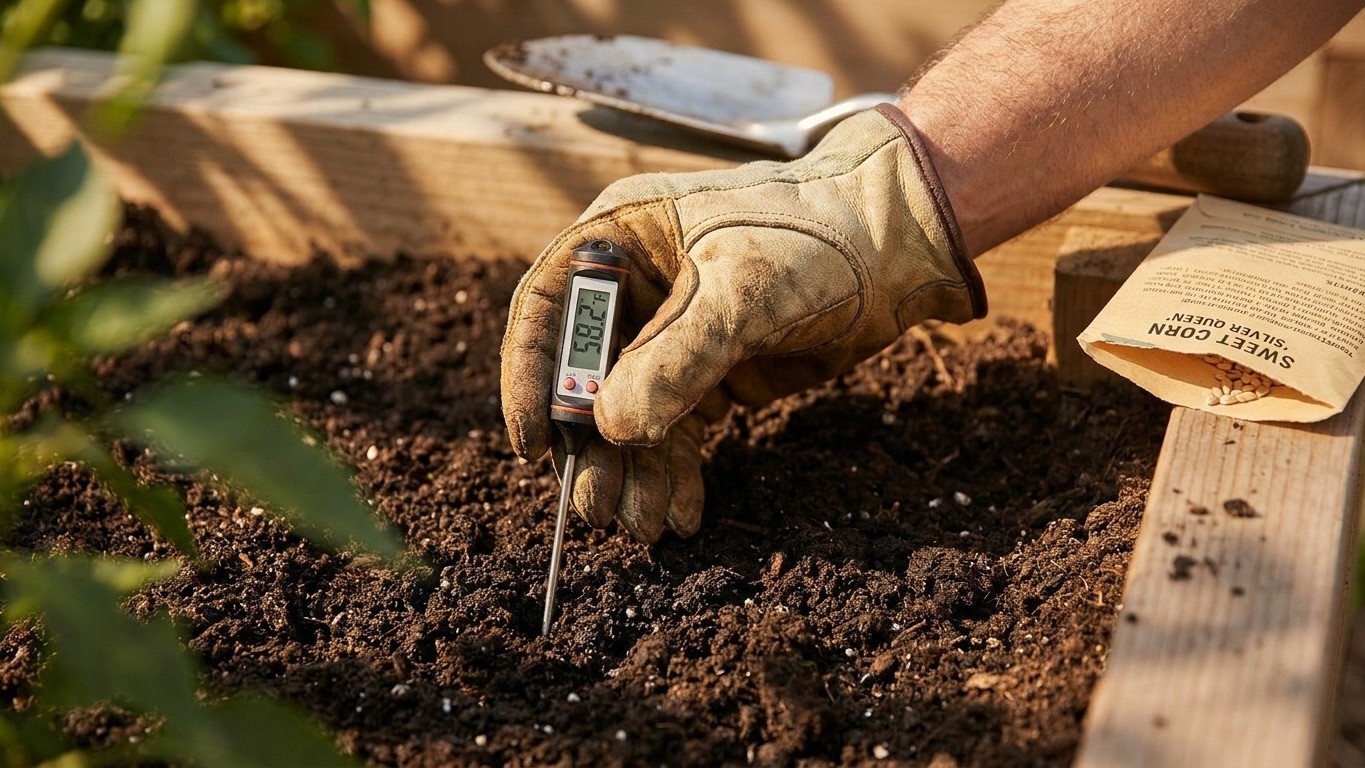

In Arizona’s low desert, sweet corn goes into the ground once soil is reliably above 60°F, which usually means later winter sliding into early spring. A second window opens again after summer’s worst heat breaks. Frost barely enters the equation here. Heat does.
The short answer
Soil warming to 60°F in low-desert Arizona happens well after any frost risk has passed, and that gap matters more than most planting calendars admit. According to NOAA’s 1991-2020 Climate Normals and daily records for the Phoenix-area reference station (NOAA NCEI / NOAA RCC ACIS, station USW00023183), a freeze at 32°F showed up in only 6 of 30 recorded springs, and even then the cold snap was confined to a narrow stretch between late December and mid-January. Most years, there’s no freeze at all. So the old habit of counting weeks from “last frost” doesn’t really apply. Soil doesn’t sit around waiting for a frost date that rarely arrives; it simply keeps climbing through the winter months until it clears 60°F on its own timeline, which for this territory lands later than gardeners in colder states would expect, simply because there’s no hard freeze forcing an early start.
What actually rations the calendar is the other end: heat. The reference station averages 168.9 days a year at 90°F or higher, a heat load that stalls pollination and stresses corn plants for months at a stretch. Sweet corn needs 60 to 90 days from planting to harvest, and that window has to land somewhere between the point soil clears 60°F and the point daytime heat turns punishing enough to shut fruit set down. In practice, that means an early planting timed as soon as soil holds steady above 60°F, so the crop tassels and fills ears before the deep heat months take over, rather than during them.
Because there’s no reliable fall freeze either, that same 60-to-90-day math can run again later in the year. Once the worst of the heat eases, soil cools back into a workable range, and a second sweet corn planting can mature in the milder weeks that follow, ahead of whatever slim chance of a late-December cold snap might show up. Two mild bookends, one scorching middle. That’s the shape of the Arizona low-desert growing year, and it’s the reason a frost-based sowing calendar simply doesn’t hold up here. Track soil temperature directly with a thermometer pushed a few inches into the bed rather than watching the sky for frost warnings that, most years, never come.
Does a late variety fit here?
Whether a given sweet corn variety fits this climate comes down to matching its days-to-maturity against those two narrow mild windows bracketing the heat. A short-season type has room to spare. A long-season type does not, at least not for a spring crop.
A 60-day variety
A 60-day sweet corn fits comfortably into either mild window. Planted as soon as soil clears 60°F in later winter, it can complete its cycle and finish harvest well before the run of 90°F-plus days really sets in. The same variety planted again once summer heat breaks has plenty of runway to mature before any risk of a rare cold snap returns in the following winter. Short-season types give a buffer on both ends, which matters in a climate where the safe growing weeks are compressed between one long stretch of extreme heat and a comparatively brief cool season.
A 90-day variety
A 90-day sweet corn does not fit this territory as comfortably, and for a spring planting, it plainly doesn’t work well. Soil only reaches a reliable 60°F later in winter, and a full 90 days from that point pushes maturity deep into the stretch when 90°F-plus days start piling up, right when the plant should be tasseling and filling ears, not struggling through heat stress. For a fall planting the math loosens slightly since there’s no hard frost cutoff forcing an early finish, but the crop still has to contend with shortening days and cooling soil slowing its own clock down. A 90-day variety is a riskier bet in either window here, and gardeners working this climate are generally better served sticking with something shorter.
| Variety length | Spring window fit | Fall window fit |
|---|---|---|
| 60-day | Comfortable, finishes before deep heat | Comfortable, matures in cooling weeks |
| 90-day | Does not fit reliably | Tight, weather down the clock |
What goes wrong here
- Soil sown too cold. Seed put into ground still below 60°F tends to rot or sprout weakly rather than establish. The fix is simple: check soil temperature with a thermometer rather than guessing from air temperature or the calendar, and hold off until the reading stays above 60°F for a few consecutive days.
- A variety too late for the season. Choosing a 90-day type for a spring planting leaves the crop trying to fill ears right as the heat load climbs toward those 168.9 average days above 90°F. The remedy is picking a shorter-season variety, especially for the spring window, and saving any longer-season attempt for the fall planting where there’s a bit more room.
- Sweetness lost because two types tasselled together. This one has nothing to do with heat or soil. Standard sweet (su), sugary-enhanced (se), and supersweet (sh2) types cross-pollinate if their tassels shed pollen at the same time, and the result is starchy, disappointing ears regardless of how well the climate cooperated. There’s no published isolation distance for this; what matters is timing, not feet or rows. The fix is staggering planting dates so the different types don’t tassel in the same window, or growing only one type per season, while still planting each block in three or more rows so pollination within that block works properly, according to Utah State University Extension.
Common questions
Can sweet corn grow year-round in Arizona’s low desert? Not practically. While the frost-free season runs nearly the full year, the growing season for sweet corn is still bounded by the roughly 169 days a year that reach 90°F or higher, which halts pollination for a long stretch in the middle of the year regardless of frost.
Does frost really matter for Arizona sweet corn planting? Barely. NOAA records show a 32°F freeze in only 6 of 30 recorded springs at the reference station, and it’s confined to late December through mid-January. Soil temperature, not frost date, is what should drive the planting decision here.
How do I check if soil has reached 60°F? Push a soil thermometer a few inches into the bed in the morning before the day heats up, and take readings over several consecutive days rather than relying on a single check, since a single warm afternoon can give a misleading reading.
Why did my sweet corn turn out starchy instead of sweet? The likely cause is cross-pollination between different sweet corn types (su, se, or sh2) tasseling at the same time nearby, not a soil or heat problem. Stagger planting dates between types, or grow just one type per planting.