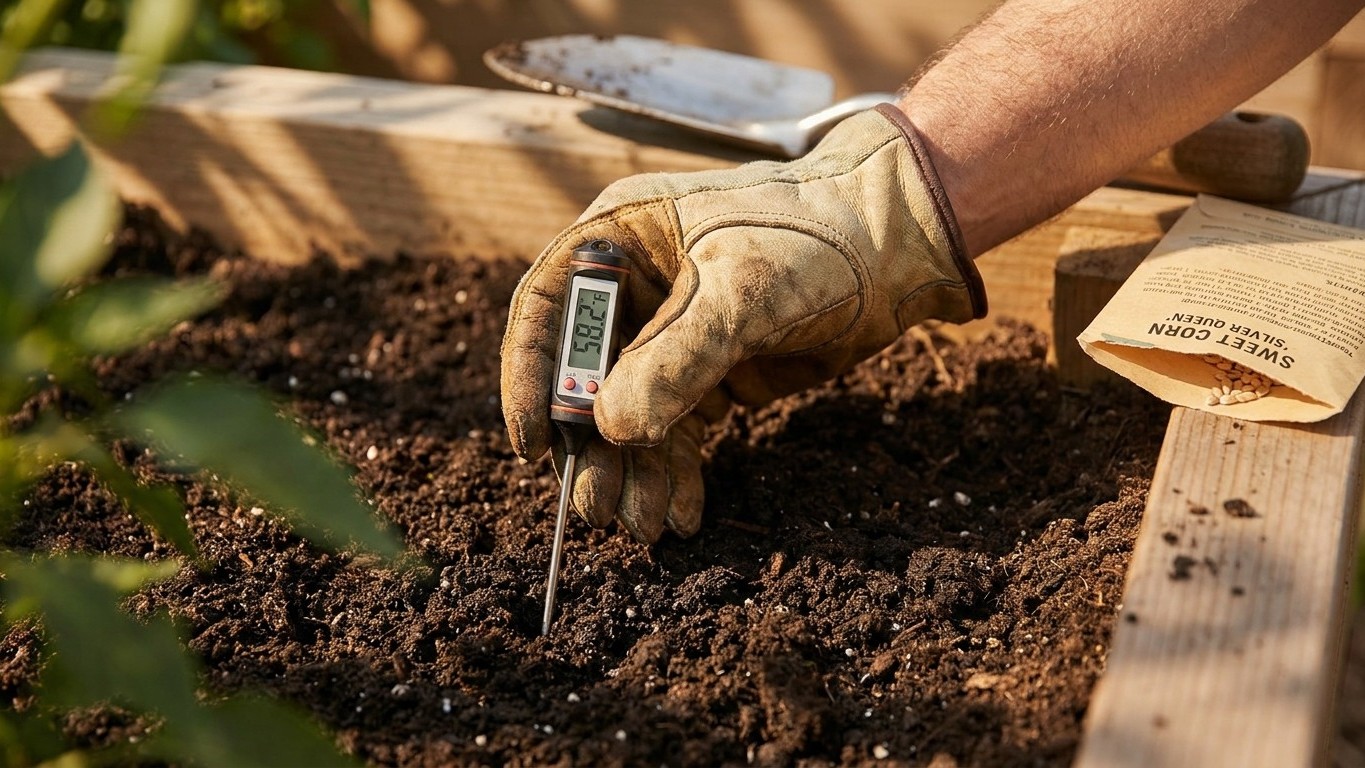

In Jacksonville and the rest of north Florida, sweet corn seed doesn’t go into the ground on the last frost date. It waits until soil temperatures climb past 60 F, a threshold that lands weeks after frost risk fades in late winter. From that point, most sweet corn varieties need 60 to 90 days to mature, and the long stretch before the first fall frost gives that window plenty of room. Central and south Florida run on a different calendar entirely.
The short answer
NOAA NCEI’s 1991-2020 Climate Normals put the 30-70% probability band for a 32 F freeze at the Jacksonville reference station (USW00013889) between February 16 and March 7. That range marks when frost risk drops into moderate territory, not the day the soil is ready for seed. Sweet corn planted into cold, wet ground below 60 F germinates poorly and rots more than it sprouts, and soil temperature lags well behind air temperature because the ground holds winter’s chill longer than the atmosphere does.
Exactly how many weeks separate the frost window from a reliable 60 F soil reading isn’t published for this station, and guessing at a date would do a gardener more harm than good. The practical move is to treat the frost window as the earliest possible marker, then confirm soil warmth directly with a soil thermometer before dropping seed. Waiting an extra week or two past the frost date costs nothing here, since the season ahead is long.
That length matters. The first fall frost at the same station falls between November 26 and December 13, months away from any reasonable spring planting date. Even a cautious sowing well into the second half of spring leaves 60 to 90 days of growing time with room to spare before that fall frost window opens. Running out of days before winter simply isn’t the risk in this part of Florida.
The real constraint shows up in a different number. The Jacksonville reference station averages 73.2 days a year at 90 F or hotter, a measure of how much heat load the growing season carries once summer sets in. Sweet corn pollination is sensitive to sustained high heat, and a planting timed so that silking and pollen shed land in the thick of that heat stretch tends to fill kernels poorly no matter how healthy the plants look. The short answer, then, has two parts: confirm 60 F soil before sowing, and time the planting so pollination doesn’t fall inside the region’s hottest weeks rather than worrying about the calendar running out.
Does a late variety fit here?
Both a short-season and a full-season sweet corn variety can be sown within north Florida’s frost-free stretch without bumping into the fall frost date. Whether either one actually suits the local climate is a separate question, and the answer differs between them.
A 60-day variety
A variety that reaches maturity 60 days from planting fits this territory with room to spare. Planted once soil holds above 60 F, it matures well ahead of the summer’s hottest stretch if sown early, and there’s enough calendar left afterward to consider a second planting later in the season. The shorter clock also means less exposure to any single stretch of extreme heat, since the plant moves from seed to harvest quickly.
A 90-day variety
A full-season type also fits the frost calendar without trouble. Even sown later in spring, 90 days still lands comfortably before the November 26 to December 13 frost window. But those extra 30 days push silking and pollen shed further into the calendar, closer to the stretch where the region averages 73.2 days above 90 F a year. Corn pollen and silk tissue both lose viability under sustained high heat, and a 90-day variety timed without care can end up pollinating right through the worst of it. The days-to-maturity number fits the season here; the heat load doesn’t make it comfortable. Unless the planting date is pushed early enough to move pollination ahead of peak summer, a longer-season variety is the riskier choice in this climate.
| Variety type | Days to maturity | Fits frost window? | Heat exposure at pollination |
|---|---|---|---|
| 60-day (short season) | 60 days | Yes, with wide margin | Lower, if planted early |
| 90-day (full season) | 90 days | Yes, by date | Higher, risk of overlap with peak heat |
What goes wrong here
- Soil sown too cold. Seed goes into the ground right after the last frost date, before soil has actually reached 60 F. In north Florida’s cool, damp late-winter ground, that means weak germination or outright rot. Check soil temperature with a thermometer instead of trusting the frost date alone, and wait for a consistent 60 F reading before sowing.
- A variety too late for the season. A 90-day type planted without accounting for the region’s heat load ends up silking during the stretch of days that regularly top 90 F, which weakens pollination and leaves ears poorly filled. The fix isn’t planting earlier for the sake of the frost calendar, since that’s already generous here. It’s planting early enough that pollen shed and silking happen before summer’s heaviest heat sets in, or choosing a shorter-season variety for anything sown later.
- The one that has nothing to do with climate. Sweetness is lost when su, se and sh2 types tassel at the same time nearby, regardless of how well the season or soil was managed. Cross-pollination between different sweetness types turns a sweet, tender crop starchy and tough. Never let two different types shed pollen in the same stretch of days near each other, stagger planting dates so tasseling doesn’t overlap, and grow each planting in blocks of three or more rows rather than single rows, since blocks pollinate far more reliably than a lone row ever will.
Common questions
Should I plant by the frost date or wait for soil to warm?
Wait for soil to warm. The 32 F freeze probability band at the Jacksonville reference station runs February 16 to March 7, but sweet corn needs soil above 60 F, a threshold that arrives later. Use a soil thermometer rather than the calendar alone.
Can I get two sweet corn plantings out of one season here?
The frost-free stretch between soil warming in spring and the first fall frost (November 26 to December 13) is long enough to consider it. Just make sure plantings of different sweetness types don’t tassel at the same time, and watch where each planting’s pollination window falls relative to the region’s hottest weeks.
Does this timing apply to Orlando or Miami too?
No. Central and south Florida are effectively frost-free, and the growing calendar there inverts: the main sweet corn season runs through winter, and summer becomes the difficult stretch. The frost dates and heat figures here are specific to the north Florida, Jacksonville-area station.
How do I know when to plant versus when to actually pick?
These are two different clocks. Days from planting to maturity, 60 to 90 depending on variety, tells you whether the crop fits the season. Picking time is judged separately, roughly 17 to 24 days after silks first appear, and readiness is confirmed by three signs together: dry brown silks, husks still moist and green, and milky juice from a punctured kernel. One sign alone isn’t enough to judge ripeness.