
In most of Maryland, the answer is around early spring, timed to the region’s last frost, which the National Centers for Environmental Information places somewhere between April 3 and April 16 depending on where you garden. But that single answer hides a bigger decision: an asparagus bed isn’t a season’s project. It’s a fifteen-year lease on a patch of ground, and the soil under it matters more than the calendar does.
The short answer
Before anything gets planted, there’s a question that outranks timing: will this spot still be draining water properly a decade from now? Asparagus crowns, once settled into a bed, produce for 10 to 15 years. You don’t rotate them out after a disappointing season the way you would tomatoes or lettuce. The only hard requirement the University Extension literature attaches to the crop is that the soil drains well. Everything else, spacing, sun, fertility, is negotiable. Drainage isn’t.
Maryland’s representative soil, the Sassafras series that USDA NRCS lists for the state, actually works in the gardener’s favor here. It’s sandy, about 67 percent sand against just 10 percent clay, and USDA records it as well drained. Water moves through that kind of profile instead of pooling in it, which is close to ideal for a crop that will sit undisturbed for a decade and a half. The same series runs naturally acid at the surface, with organic matter around 1.6 percent, low but not unusual for a soil that’s been weathered and leached over a long stretch of time.
That’s the state’s representative number, not a verdict on any one backyard. Maryland spans river-bottom clay, coastal sand, and plenty of ground a builder has compacted or filled with subsoil that behaves nothing like the mapped series. If water still stands in a test hole an hour after a hard rain, that’s the soil talking, not the state average. The fix, before crowns ever go in the ground, is to build the bed up: a raised mound or framed bed lifts the root zone above the standing water table and lets excess drain to the sides instead of sitting under the crowns all winter. Skipping that step on heavy ground is how a fifteen-year planting turns into a five-year one, rotted out from below.
One more thing the source material stays quiet on: winter chilling requirements and soil pH targets for asparagus aren’t published in the Extension guidance this article draws from, so no number gets invented here. A basic soil test, run through your local Extension office, is the way to get an actual pH reading for your own bed rather than borrowing the state’s.
Will the summer here water it for you?
Once the crowns are in, the two years before first harvest are the thirstiest stretch the bed will ever see. The recommended rhythm is 1 to 2 inches of water every other week through that establishment period, dropping to roughly every three weeks once the planting matures. Maryland’s summer doesn’t hand that over evenly, so it helps to walk through what the numbers actually mean against the region’s climate normals.
- June is the gap month. Average rainfall sits at 3.98 inches for the month, the lowest of the three summer months on record for the reference station. Spread across four-plus weeks, that’s close to the low end of what a young bed needs, and on the Sassafras series’s sandy surface, water that does fall moves through quickly rather than lingering for the next dry stretch.
- July and August run a bit heavier. July averages 4.48 inches, August 4.09, for a three-month summer total near 12.6 inches. On paper that’s in range for a first- or second-year bed’s watering target. In practice, summer rain in this region tends to arrive as thunderstorms, a lot of water in an hour, then nothing for a stretch, rather than the steady weekly soak a young asparagus root system prefers.
- Sandy soil changes the math. The same rainfall total behaves differently on the state’s representative soil than it would on a clay-heavy plot. Sand lets water through fast, which is good for drainage and bad for moisture retention. A bed on that kind of ground will likely need a supplemental soak in dry stretches even in a summer that meets the seasonal average on paper.
- A rain gauge settles it, not the regional average. These figures are 1991-2020 normals for one reference station, not a forecast and not a reading from any individual yard. A slope, a nearby tree line, or a few miles’ distance from the station can shift real totals. The only way to know if a bed is actually getting 1 to 2 inches every other week is to measure it at the bed.
By year three and beyond, once the watering target eases to roughly every three weeks, Maryland’s summer rainfall is close enough to that reduced demand that supplemental watering becomes more of an insurance policy during a dry spell than a routine chore.
When to put the crowns in
Crowns go into the ground in early spring, and in Maryland that window is anchored to a last frost date that runs from around April 3 to April 16, depending on location. That’s a mean date built from 30 years of records, an average, not a guarantee, so treat it as a planning target rather than a fixed line on the calendar. Western Maryland’s mountain counties, Garrett and Allegany, sit weeks behind that range because of elevation, while the Eastern Shore tends to warm a bit earlier. A gardener working from a seed catalog rather than a state map should lean on the local county Extension office for a frost date specific to their own ground.
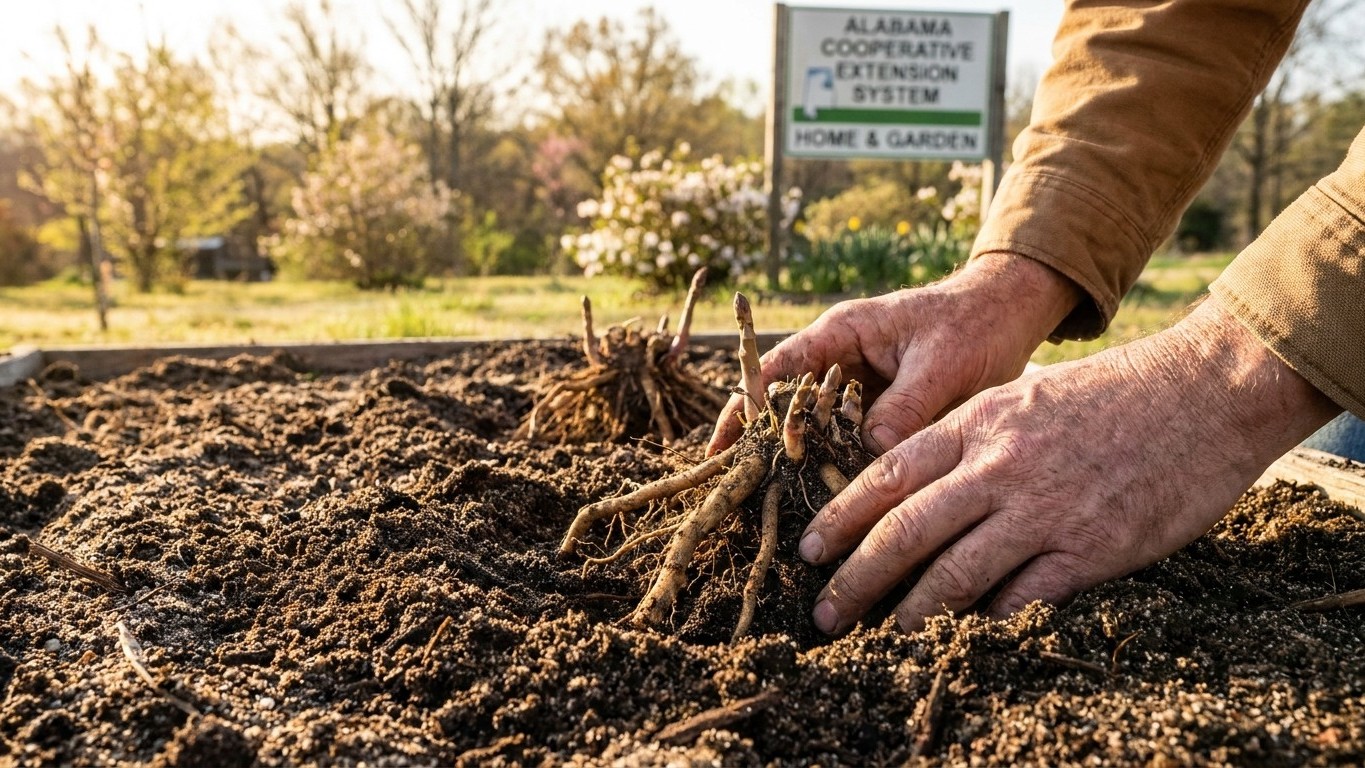
The planting method itself is straightforward: crowns are set into furrows dug about 8 inches deep. That depth isn’t filled in all at once. The furrow gets backfilled gradually across the season, roughly 2 inches of soil added back every other month, rather than covered completely on planting day. That staged approach lets the emerging spears push through loose soil instead of forcing their way up through a deep, freshly packed trench.
Crowns aren’t the only way in. Starting asparagus from seed is the alternative route, though it’s a slower one, since seed-grown plants need extra time in a nursery bed before they’re strong enough to move into their permanent spot. For a gardener working around Maryland’s spring frost window, crowns remain the more direct path from planting to an established bed, since they arrive already a year or more along compared with a seed just germinating.
Whichever route a gardener picks, the target stays the same: get the roots into workable, drained soil as the ground warms past the last hard frost, not before it, since a late freeze on freshly planted crowns can set the bed back before it’s even started.
Common questions
Which asparagus variety should I plant in Maryland?
The available guidance names four varieties by sex rather than by performance: Jersey Giant and Jersey Knight are all-male, while UC 157 F1 and Purple Passion are male/female varieties. No flavor comparison, yield figure, or regional preference is published alongside those names, so this article won’t manufacture one. The choice between all-male and mixed varieties comes down to whether a gardener wants to avoid the volunteer seedlings that female plants produce, which is a maintenance question, not a productivity one, since no yield data distinguishes them here.
When can I actually harvest the asparagus I plant?
Not in the first two years, and not lightly in the third. Harvest doesn’t start until year three, and even then it’s a short, carefully limited cut: about 4 weeks of harvest in that first cutting year, extending to roughly 6 weeks, and eventually up to about 8 weeks in later years as the crowns fully mature. The stopping point each season isn’t a date on a calendar. It’s a visual cue: once most of the spears coming up are thinner than a pencil, harvest stops for the year, so the plant can put energy into building next year’s crown instead of being cut back further.
Do I need to worry about winter cold or soil acidity before planting?
Neither a chilling requirement nor a target soil pH is published in the Extension guidance this article relies on, so no figure gets offered for either. What is documented is that the crop needs well-drained soil, which Maryland’s representative Sassafras series provides at the state level. For an actual pH reading on a specific plot, a soil test through a local Extension office is the reliable next step, not a number borrowed from a statewide average.
What if my yard’s soil doesn’t drain like the state average?
The state soil profile is a starting point, not a diagnosis of any one garden. River bottoms, hillsides, and any lot that’s been graded or filled during construction can behave completely differently from the mapped Sassafras series. If water lingers in a test hole after rain, building the bed as a raised mound before planting crowns is the way to lift the root zone clear of standing water, since a bed meant to produce for a decade or more can’t afford to sit on soil that holds water through the winter.