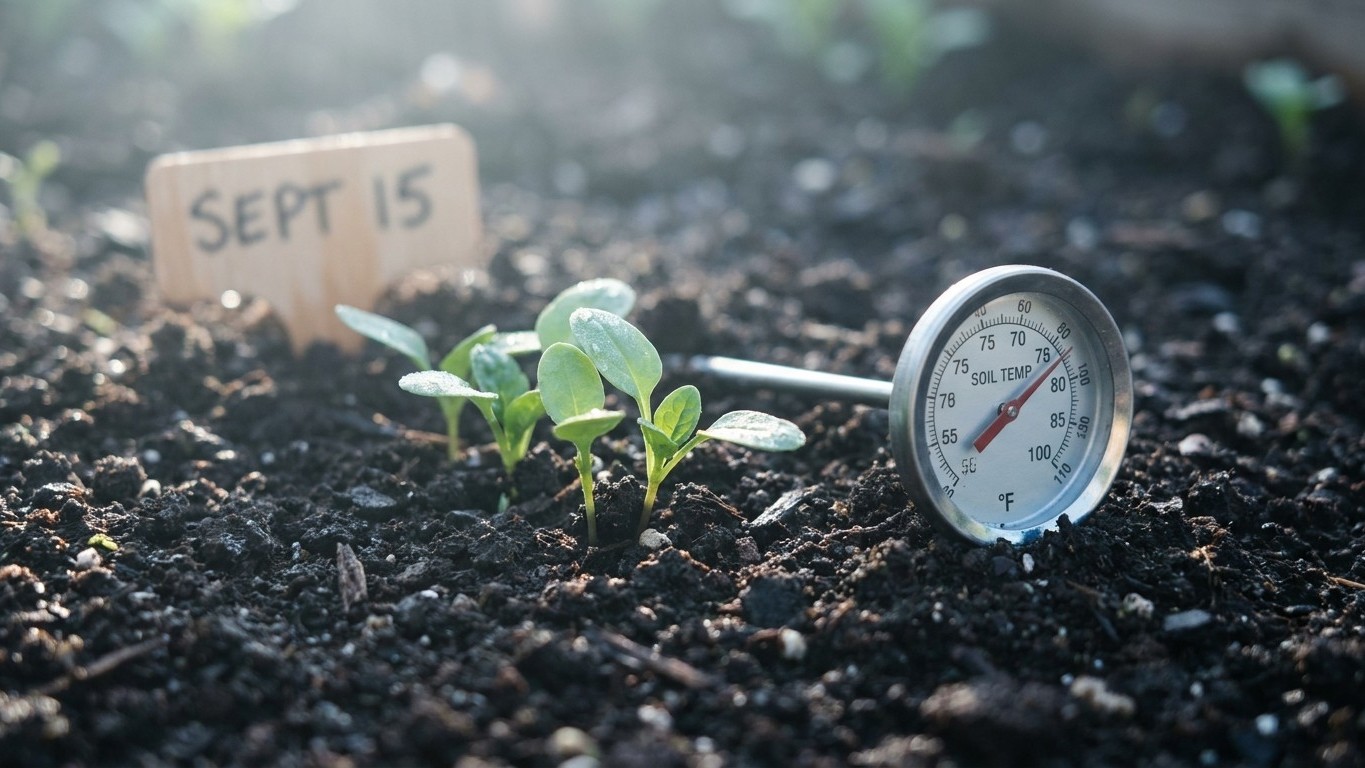

In Maryland, spring spinach goes into the ground two to three weeks before the last frost, which lands between April 3 and April 16 depending on where you garden. That puts most spring sowing in mid-to-late March. The autumn crop works backward from harvest: count 50 to 75 days before the date you want to pick, aiming to land before the first fall frost (October 26 to November 5). The trick is timing it around soil that’s still too hot to sprout seed.
The short answer
Start with the number that actually runs the show here: 14 hours and 45 minutes of daylight on the longest day of the year. That’s not a fact about heat. It’s a fact about light, and for spinach, light is a trigger all its own. Long days push spinach toward flowering (bolting) whether or not the thermometer cooperates. A cool, cloudy Maryland summer would not rescue the crop, because the day length alone is enough to send it to seed once June arrives.
That’s the surprising part. Most gardeners assume heat is the enemy and a mild summer buys extra time. It doesn’t work that way for spinach. The plant reads the calendar through its leaves, sensing how long the sun stays up, and once days stretch well past 14 hours, flowering stalks start forming even in a shady, breezy spot.
Heat piles on top of that. Maryland’s reference station averages 24.6 days a year at 90 degrees or hotter, and spinach growth quality falls apart above 75 degrees, the same number that marks where leaves start turning bitter. So the honest answer is that both mechanisms work against the crop at once. Day length sets the deadline no amount of shade cloth can move. Heat makes the last few weeks before that deadline taste worse and grow slower.
What that means practically: there is no version of “just wait for a cooler week” that saves a late spring sowing. Once day length climbs past the mid-14-hour mark, the plant is on a clock. The only real lever a gardener has is choosing which side of summer to plant on, spring or fall, and getting the timing tight enough that the crop matures before day length and heat gang up on it.
This is also why spinach and onions behave like opposites on the same calendar. Long days build an onion bulb. Long days ruin a spinach leaf. Same number, 14 hours and 45 minutes at the summer solstice here, means something completely different depending on which crop is standing in the row.
How long the spring window really is
- Sowing date: two to three weeks ahead of the last frost. With last frost falling April 3 to April 16 at the reference station, that puts seed in the ground roughly mid-to-late March across central Maryland. Western Maryland’s mountain counties, Garrett and Allegany, run weeks behind that, so sowing there slides into early April. The Eastern Shore, milder, can start a bit sooner.
- Growth ceiling: quality holds up as long as temperatures stay under 75 degrees. Above that line, growth slows and leaves turn bitter, the same threshold doing double duty as both a growth limit and a flavor limit.
- Where the window closes: Maryland springs don’t linger under 75 degrees for long. By the time day length pushes deep into the 14-hour range in May, afternoon highs are routinely crossing that ceiling too. The two pressures arrive together, closing the spring window in roughly eight to nine weeks from a mid-to-late March sowing.
That’s a workable stretch, but not a generous one. It’s enough time for baby leaf harvests and a couple of full cuttings if you sow promptly and pick often, but it’s not a season you can stretch by waiting out a warm spell. The source behind Maryland’s spinach guidance, Utah State University Extension, names four varieties commonly grown for cool-season harvest, Bloomsdale, Melody, Teton, and Olympia, but publishes no days-to-maturity figures for any of them. So rather than inventing a number, the honest planning approach is to watch the calendar pressure above, not a seed packet’s promised date, and harvest early rather than late.
The autumn crop, and when the soil lets you sow
Fall spinach flips the problem. Instead of racing lengthening days, you’re racing the calendar backward from a frost that will eventually shut things down, while waiting for soil that’s still holding summer’s heat to cool off enough to let seed germinate at all.
Soil still too warm to germinate
Utah State University Extension notes that spinach seed germination drops once soil temperatures climb above 80 degrees. Maryland’s summers, averaging 24.6 days a year at 90 degrees or higher at the reference station, keep soil warm well past the calendar date most gardeners think of as “late summer.” Sowing too early, in the thick of August heat, often means seed that simply sits and rots rather than sprouting. The practical fix is to wait for a stretch of cooler nights, typically as August turns to September, before putting seed in the ground.
The frost that ends the season
First fall frost at the reference station falls between October 26 and November 5. Counting back the source’s recommended 50 to 75 days from that range puts a workable sowing window anywhere from mid-August through mid-September, with the later end of that range lining up better with cooler, more germination-friendly soil. In practice, most Maryland gardens do best sowing in early-to-mid September, trading a few of the slowest early days for seed that actually comes up.
Regional frost timing shifts the math at either end of the state:
| Region | Fall frost tendency | Spring frost tendency |
|---|---|---|
| Western Maryland (Garrett, Allegany) | Arrives earlier, mountainous cold settles in sooner | Lingers later into spring |
| Central Maryland (reference station) | October 26 to November 5 | April 3 to April 16 |
| Eastern Shore | Arrives later, milder coastal air | Ends sooner in spring |
Gardeners in the mountain counties should shift fall sowing earlier and count from an earlier expected frost, while Eastern Shore gardeners can push sowing a bit later and still make the 50-to-75-day math work before frost shuts the crop down.
Common questions
Can I sow spinach in Maryland in midsummer to get ahead of the fall window?
No. Midsummer soil regularly exceeds the 80-degree germination ceiling, and day length is still long enough to push any seedling that does sprout toward bolting rather than leaf growth. Waiting for soil to cool is not optional.
Does a light frost kill an established fall spinach crop?
The facts here don’t cover cold tolerance thresholds, only the first fall frost date itself. What’s clear is that the 50-to-75-day sowing math is built around that frost date as the practical end point for planning, not a guarantee about what survives past it.
Why doesn’t a cool, rainy Maryland summer let spinach keep growing?
Because bolting is triggered by day length as much as by heat. Even in a summer with mild temperatures, days stretching past 14 hours signal the plant to flower. Heat makes it worse, but it isn’t the only cause.
Which spinach variety matures fastest for a tight fall window?
Bloomsdale, Melody, Teton, and Olympia are the varieties named in the Utah State University Extension guidance behind this timing, but that source publishes no days-to-maturity numbers for any of them. Planning around the 50-to-75-day harvest window, rather than a specific variety’s speed, is the more reliable approach.