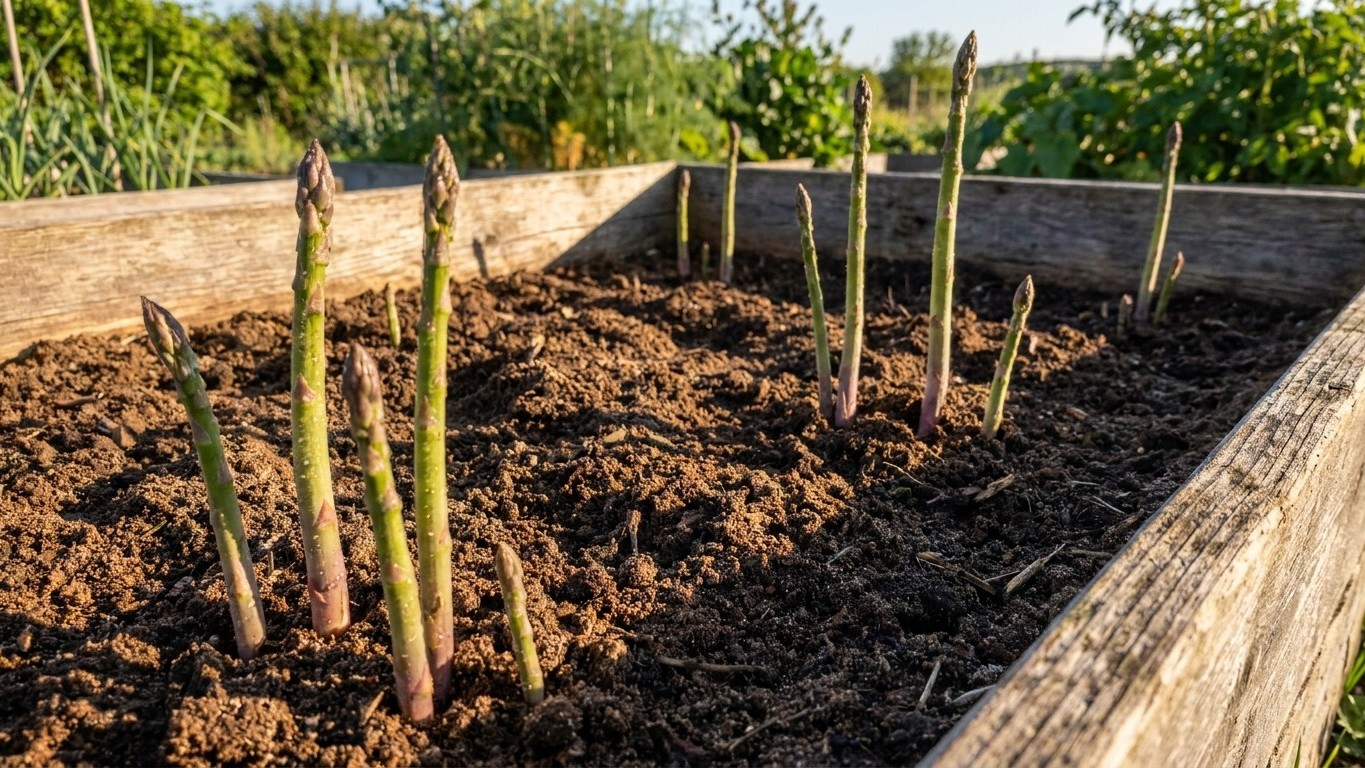

Yes, in most cases. Nebraska’s official state soil, the Holdrege series, is classed as well drained, and a well-drained spot is the only real soil demand an Asparagus Bed makes across its ten- to fifteen-year life. That’s the map-level answer. What actually decides whether a bed thrives in a particular yard is narrower than a state soil survey, and it comes down to drainage, water supply, and timing, three things a gardener can check without waiting fifteen years to find out.
The short answer
Start with what the crop actually asks for. Utah State University Extension, the only source behind the planting guidance here, is specific about one requirement and silent on almost everything else: asparagus crowns go into 8-inch furrows in early spring, the bed isn’t harvested until its third year, and after that it can keep producing for ten to fifteen years. The source names no soil pH preference and no chilling requirement, so neither belongs in this answer. The single condition it does state, repeatedly, is drainage. Most soils will grow asparagus, the guidance says, provided they are well drained.
That’s where the Holdrege series becomes useful. USDA’s Soil Data Access records the surface horizon of this series, named Nebraska’s state soil by state law in 1979, as a loam-to-silt mix: 11 percent sand, 22 percent clay, and 67 percent silt, with organic matter around 2.0 percent and a surface pH near 6.2. The series is classed as well drained. Silt-heavy soils like this hold moisture well without turning to standing water, which is close to the ideal middle ground for a plant that will occupy the same eight inches of ground for over a decade.
None of that is a diagnosis of any one garden. A state soil survey describes hundreds of mapped series, and the Holdrege series represents a broad swath of the Corn Belt, not the specific patch behind a particular house. River-bottom ground drains differently than upland loam. A yard where a builder scraped topsoil and regraded fill drains differently again, sometimes badly. The only way to know a specific bed’s drainage is to dig a hole about a foot deep, fill it with water, and watch how long it takes to disappear. If water sits for more than a few hours, that ground is not ready for a plant meant to live there for fifteen years without complaint.
Where drainage falls short, the fix isn’t to change the crop’s requirement, it’s to change the bed. Building a raised bed with amended, coarser soil, or choosing a different spot on the property with a natural slope, solves the drainage problem without touching anything the source is silent on, like pH adjustment or fertility programs. Given the length of the commitment, that upfront work is cheaper than restarting the planting in year six.
Will the summer here water it for you?
The watering schedule Utah State University Extension lays out is plain: 1 to 2 inches every other week for the first two growing seasons, then a lighter rhythm of about every three weeks once the bed is established. Weighed against what a Nebraska summer typically delivers, based on 1991-2020 climate normals from a Nebraska reference station, the numbers land close, but not close enough to ignore a rain gauge.
- Years one and two. Watering every other week across a roughly 13-week summer means six to seven applications of 1 to 2 inches each, or somewhere between 6 and 13 inches total just in the June-through-August stretch.
- What summer actually brings. The normals put total summer rainfall at about 12.6 inches: 4.44 inches in June, 3.55 in July, and 4.6 in August. On paper, that sits inside the range a new bed needs.
- The gap is July. July is the driest of the three months, and normals describe an average, not a delivery schedule. Rain in a Nebraska summer tends to arrive as scattered thunderstorms rather than a steady drip, so a young bed can go two or three dry weeks in the exact month it most needs consistent moisture, even in a summer that averages out fine.
- Year three and beyond. Once the bed is established, the every-three-weeks rhythm needs roughly four applications across the summer, or about 4 to 8 inches total, well under the seasonal average. An established bed is far less likely to need supplemental water in a normal year.
- What that means for a hose. A new bed should not rely on rainfall alone through its first two summers, particularly in July. A rain gauge on the actual property, checked weekly, is the only way to know whether that week’s storm covered the requirement or whether the hose needs to fill the gap.
When to put the crowns in
Crowns go into the ground in early spring, timed to the last frost rather than a fixed date on the calendar. The reference station’s 1991-2020 normals put the average last spring frost somewhere between April 12 and April 23. That’s a mean, built from three decades of freeze data, not a promise for any single spring, and suburban and rural gardens away from the reference station often see their own last frost run later, sometimes by a week or two. Planting crowns around that window, once the soil has warmed and dried enough to work, gives the plant a full season to establish before the following winter.
The furrow itself goes in 8 inches deep. Rather than backfilling it all at once, the guidance calls for filling it in gradually across the season, adding about 2 inches of soil back over the crowns every other month as the emerging spears grow through it. That staged backfill protects young growth while still letting the crown settle to its full planting depth by the time the season winds down.
Whatever happens in that first year, no spears get cut. The plant isn’t harvested at all in year one or year two; the earliest harvest comes in year three, and even then it’s a short window, roughly four weeks, before the bed is left alone to grow ferns for the rest of the season. The harvest window widens after that, to about six weeks and then eight weeks in following years, but the point at which to stop cutting each spring isn’t a date. It’s a condition: stop once most of the spears coming up are thinner than a pencil, which signals the crown’s stored energy is running low for that push.
Crowns are the standard route because they save a year of waiting compared with seed, which has to grow to crown size before it can even be transplanted into the furrow. Utah State University Extension names four varieties by their flower type alone, nothing about flavor or yield: Jersey Giant and Jersey Knight are all-male varieties, while UC 157 F1 and Purple Passion are male-and-female. No nursery is named here, and no reason to prefer one variety over another is published; the choice, on the evidence available, comes down to what’s actually stocked locally.
| Variety | Flower type | Flavor or yield data |
|---|---|---|
| Jersey Giant | All-male | Not published |
| Jersey Knight | All-male | Not published |
| UC 157 F1 | Male and female | Not published |
| Purple Passion | Male and female | Not published |
Common questions
Does Nebraska soil need a pH amendment before planting asparagus?
The source behind this planting guidance doesn’t state a pH preference for asparagus, so none is given here. The Holdrege series carries a surface pH near 6.2, but that figure describes a mapped state soil, not any individual garden. A soil test on the actual planting site is the only way to know a specific bed’s pH.
Can asparagus grow in heavier, slower-draining Nebraska clay?
Only if that clay drains reasonably well. The one soil condition the planting guidance insists on is drainage, not texture. A simple hole-and-water test on the actual bed site settles the question faster than guessing from a soil survey map.
How soon can spears actually be cut after planting?
Not for two full growing seasons. The first harvest comes in year three, and it’s a short one, about four weeks, before the plant is left to grow ferns again. Cutting earlier weakens the crown before it has stored enough energy to support years of future harvests.
Is a raised bed necessary if the ground doesn’t drain well?
It’s one solid option, along with picking a different, naturally sloped spot on the property. Because the bed is expected to stay in place for ten to fifteen years, fixing a drainage problem before planting is far less work than trying to relocate an established crown years later.