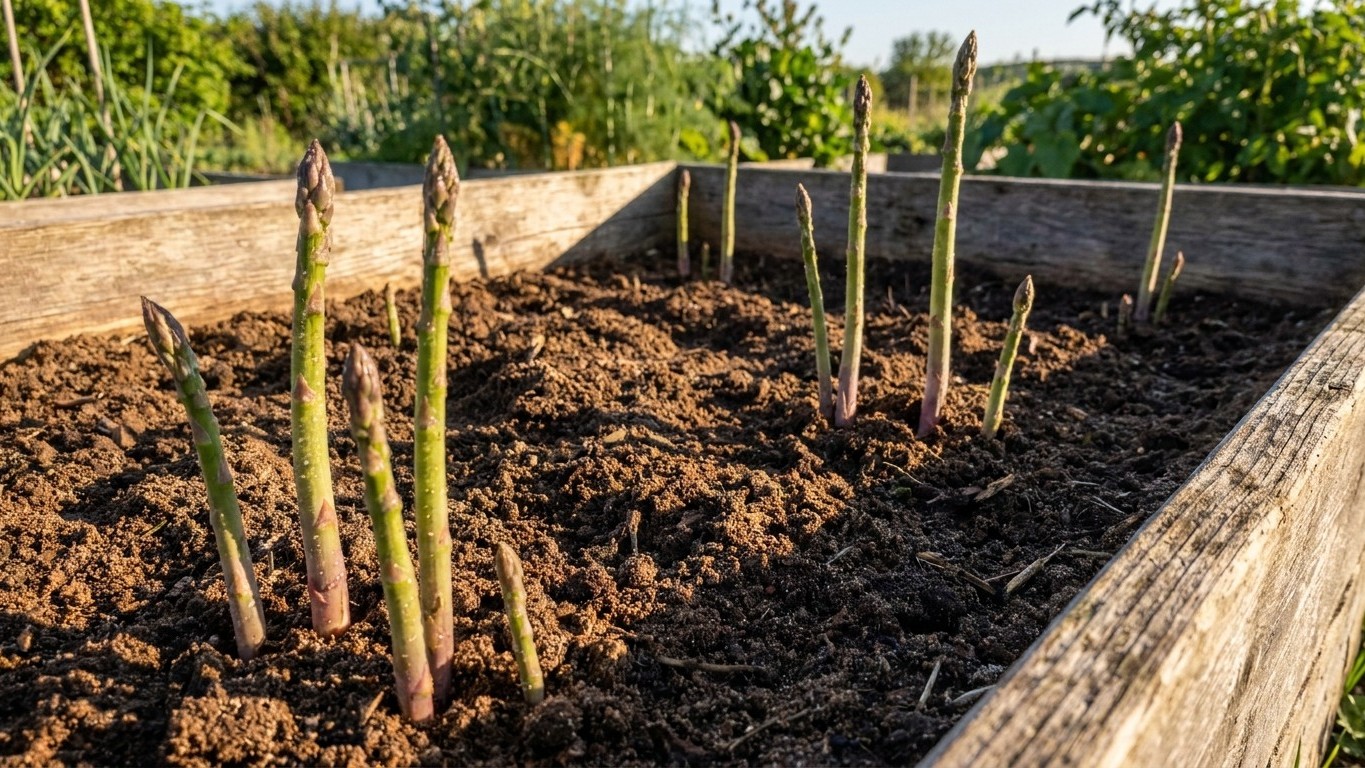

New Hampshire’s ground can carry an Asparagus Bed for the full stretch, but the answer hinges on one word: drainage. The soil most associated with the state, the Marlow series, is naturally well drained and acid, which covers the source’s only hard requirement for this crop. Whether your own patch behaves the same way is a separate question, and one worth settling before the crowns go in the ground for a decade or more.
The short answer
The soil that USDA lists as representative of New Hampshire is the Marlow series, a Spodosol that typically forms under conifer stands. It runs sandy, with 57 percent sand, 5 percent clay and 38 percent silt in the surface horizon, and it carries a surface pH around 3.5, which counts as strongly acid. The organic matter figure recorded for that surface, about 85 percent, points to a natural forest litter layer rather than anything resembling a worked garden bed. None of that changes the one line that matters most here: the Marlow series is classified well drained.
Asparagus, according to Utah State University Extension, tolerates most soils as long as they drain. That single condition is why the Marlow series, on paper, is a reasonable match for a crop that gets planted once and then left alone for ten to fifteen years. A bed that sits in standing water rots at the crown within a season or two. A bed on sandy, well-drained ground simply dries faster, which is a watering problem, not a survival problem.
Here is where the state soil stops being useful. Marlow is what USDA records as broadly representative of New Hampshire, not a measurement of any particular yard. Hundreds of other soil series exist across the state, and a garden sitting on a river bottom, a filled lot, or ground a builder compacted during construction can behave nothing like the sandy, leached profile described above. The published pH of about 3.5 belongs to the Marlow series specifically, not to the crop’s requirement and not to your soil. The source is silent on what pH asparagus actually prefers, so nobody should treat 3.5 as a target or a warning without a soil test in hand.
The practical move, before committing a corner of the yard for fifteen years, is a simple drainage check: dig a hole about a foot deep, fill it with water, and see how long it takes to empty. If water is still standing after several hours, the ground needs help before crowns go in, whether that means working in coarse organic matter, choosing a different spot with a natural slope, or building a raised bed with an open bottom so excess water has somewhere to go. If it drains within an hour or two, you are working with something closer to the sandy Marlow profile, and the main task ahead is keeping enough moisture in it, not getting rid of the excess.
Will the summer here water it for you?
An asparagus bed has a moisture schedule that does not bend much: 1 to 2 inches of water every other week for the first two years while the crowns establish, then a lighter routine of watering every three weeks once the plants are mature. Stack that against what a New Hampshire summer typically delivers and the numbers land close, but not close enough to hand off the job entirely to the sky.
- Total summer rainfall. The reference station’s 1991-2020 normals put June through August at about 10.7 inches combined, out of 40.4 inches for the year. Spread evenly, that is roughly 3.5 inches a month, which sits in the same range as what a young bed asks for on an every-other-week basis.
- The driest month. July is the low point at 3.3 inches, with June at 4.04 and August at 3.35. A dip in July is exactly when a two-year-old bed still needs consistent moisture to push root growth, so this is the month most likely to fall short.
- How the rain actually arrives. Monthly totals hide the pattern. A single thunderstorm can drop an inch in twenty minutes and most of it runs off before it soaks in, especially on a sandy, well-drained surface like the Marlow profile. A bed on that kind of ground can go dry within days of a storm that looked generous on paper.
- What that means for a new bed. During the first two summers, treat the normals as a rough baseline and check the soil directly rather than trusting the rain gauge alone. If the top few inches feel dry a week after a storm, that is the every-other-week schedule kicking in, not optional extra care.
- What changes once the bed matures. By year three and beyond, the every-three-week rhythm is more forgiving, and a New Hampshire summer’s roughly 3.3 to 4 inches per month usually covers it without much supplemental watering, except in a stretch with several dry weeks in a row.
- The one instrument that settles it. A rain gauge on the actual bed, not a regional average, is what tells a gardener whether this particular July needs a hose or not. Normals describe what a station recorded from 1991 to 2020; they do not describe this season.
When to put the crowns in
Crowns go into the ground in early spring, set into furrows about 8 inches deep. In this part of New Hampshire, the reference station’s mean last spring frost falls somewhere between April 16 and April 27, and that window is a fair anchor for planning, not a guarantee for any single county or elevation. Suburban and rural gardens away from the airport station that generates this figure often see their own last frost run later, sometimes by a week or two, so treat the date as the general shape of the season rather than a fixed calendar entry.
Once the crowns are in the furrow, the backfilling happens gradually rather than all at once: about 2 inches of soil added back every other month over the course of the year, rather than filling the trench flush on planting day. That staged approach lets the emerging spears push through loose soil rather than fighting a solid cap.
Seed is the other route in, for gardeners who would rather start earlier in the process or who can’t source crowns locally. It takes longer to reach a productive bed than starting from crowns, but the underlying timeline that matters most for planning stays the same regardless of which starting point you choose: no harvest at all in the first year, and none in the second either. The first cutting doesn’t happen until the third year, and even then it’s limited, roughly four weeks of harvest that first productive season, then six weeks the year after, then eight weeks once the bed is fully established. The stopping point each season isn’t a date on the calendar; it’s a visual cue. When most of the spears coming up are thinner than a pencil, harvest stops for the year so the plant can put its energy into building the fern growth that feeds next year’s crop.
On variety, Utah State University Extension names four: Jersey Giant and Jersey Knight, both all-male types, and UC 157 F1 and Purple Passion, which run male and female. The source stops at that classification. It does not rank them by flavor, yield, or suitability for a particular climate, so there’s no published reason from this source to prefer one over another for a New Hampshire bed specifically. Anyone choosing between them is choosing based on availability and personal preference, not on a documented performance difference.
Common questions
Does the acidity of New Hampshire’s representative soil mean I need to add lime before planting asparagus?
The Marlow series carries a surface pH around 3.5, which is strongly acid, but the source describing asparagus’s soil needs is silent on what pH the crop actually prefers. There’s no published target to lime toward here. A soil test on the actual bed site is the only way to know what, if anything, needs adjusting.
Can I harvest a few spears in the second year if the plants look strong?
No. The source is direct on this: no harvest until year 3, regardless of how vigorous the fern growth looks in year one or two. Cutting early pulls energy the crown needs to build a root system that will produce for the next decade-plus.
What if my yard doesn’t drain like the Marlow series does?
Test it before planting, since this is a fifteen-year decision that’s hard to reverse. A hole dug a foot deep and filled with water should empty within an hour or two on well-drained ground. If it doesn’t, a raised bed or a different, better-drained spot in the yard is worth the extra effort up front.
How do I know when to stop harvesting each season?
Watch the spears, not the calendar. Once most of what’s coming up runs thinner than a pencil, that’s the signal to stop cutting for the year and let the plant grow its fern top, which is what rebuilds the crown’s reserves for next season’s harvest.