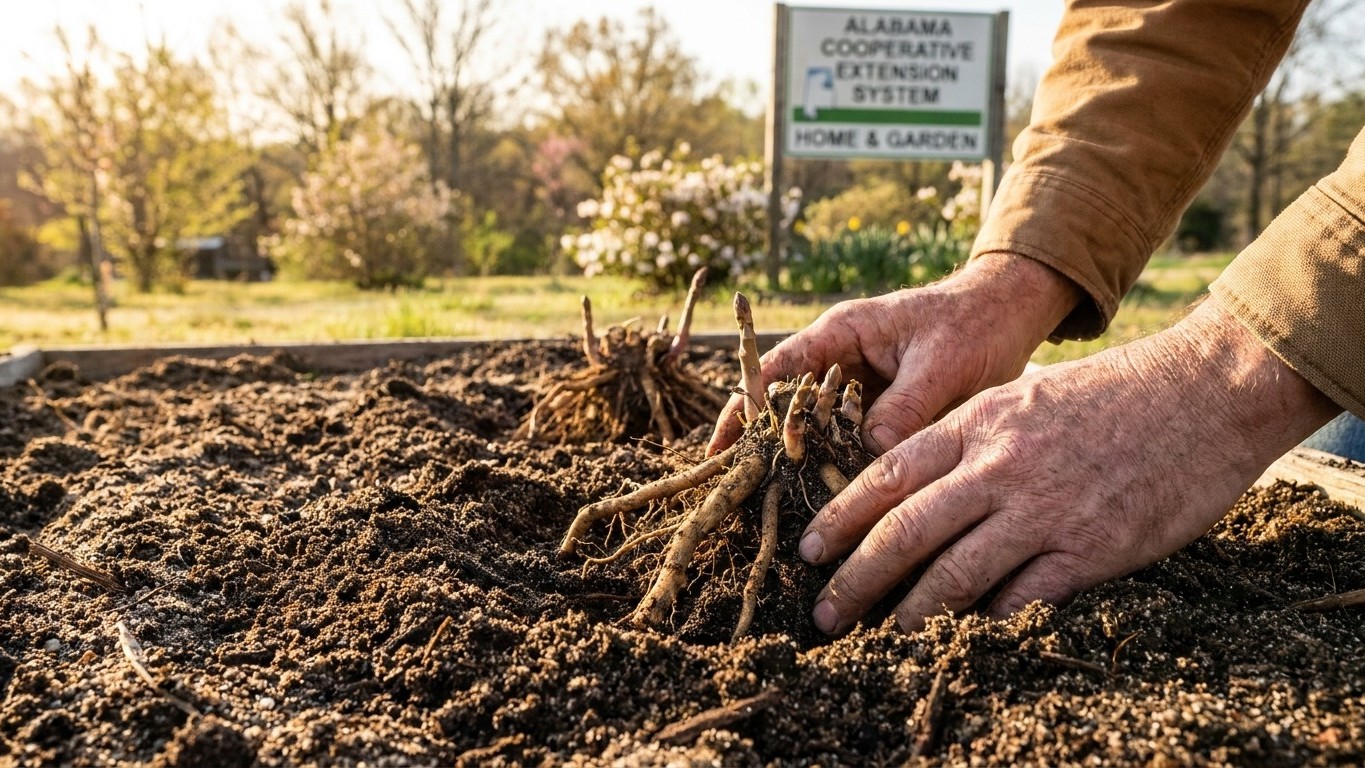

Plant Asparagus Crowns in New Mexico in early spring, timed around the region’s typical last frost window, setting each crown into an 8-inch furrow. That’s the short version. The longer answer depends on what’s underneath your feet, because this crop asks for a spot you won’t disturb for a decade or more.
The short answer
Asparagus isn’t a plant-it-and-move-on crop. Once a bed is established, it produces for 10 to 15 years, according to Utah State University Extension. That single fact changes how you should think about the ground you choose. A tomato bed that turns out to be a mistake costs you one bad season. an Asparagus Bed that turns out to be a mistake costs you a decade of soggy crowns, stunted spears, or rot that shows up the third spring and never really goes away.
The source’s soil requirement for asparagus is narrow but non-negotiable: it needs to drain. Most soils will do, provided water doesn’t sit around the roots. So the question for a New Mexico gardener isn’t “is my soil good enough” in some abstract sense, it’s specifically “does water move through it.”
The soil that USDA lists as representative of New Mexico is the Penistaja series, an Aridisol, which is the kind of dry-climate soil that tends to run alkaline and sometimes carries salts. The surface horizon comes in sandy, at 69 percent sand against just 15 percent clay and 16 percent silt, with organic matter around 1.4 percent. That sand-heavy texture is, structurally, good news for asparagus: USDA records this series as well drained. A texture that light lets water pass through quickly rather than pooling around a crown.
But that’s the state, not your yard
Here’s the catch, and it matters more for this crop than almost any other on this site: the Penistaja series is what USDA lists as representative of the state as a whole, not a reading of the dirt in your particular garden. New Mexico spans a huge range of ground, from sandy mesas to heavier valley bottoms along the Rio Grande and its tributaries, and any lot that’s been graded, filled, or compacted during construction can behave nothing like the regional norm. A river-bottom garden or a lot with heavier clay brought in as fill can hold water far longer than the state figures suggest.
If you dig a test hole, fill it with water, and it’s still standing after several hours, don’t plant asparagus there as-is. The fix isn’t complicated: build a raised bed or mound the row 8 to 10 inches above grade so the crowns sit above the standing water table. Given that you’re committing this ground for a decade or more, a half day spent digging a drainage test now is cheap insurance against a bed that fails in year four.
Will the summer here water it for you?
An asparagus bed has a fairly specific thirst, and it changes as the planting ages. In its first two years, it wants 1 to 2 inches of water every other week. Once established, that eases to roughly the same amount every three weeks. New Mexico’s summer rainfall doesn’t come close to covering either number on its own, which means irrigation isn’t optional here, it’s the main event.
- June delivers the least help of the growing season, at just 0.57 inches for the entire month, well short of even a single watering cycle for a young bed needing 1 to 2 inches every two weeks.
- July picks up to 1.64 inches, still landing short of what a first- or second-year bed needs across four weeks, and often arriving as scattered thunderstorms rather than steady soaking rain.
- August settles at 1.31 inches, again below the target, closing out a three-month summer total of about 3.5 inches against a full-year normal of 8.8 inches.
Add it up and New Mexico’s summer supplies roughly 3.5 inches over June, July, and August combined, while a young asparagus bed alone could call for something closer to 6 to 12 inches across that same stretch, depending on how the every-other-week schedule falls. That gap has to be closed with a hose, drip line, or irrigation system, not hoped away.
The sandy surface typical of this region’s dominant soil adds a second layer to the math. Sand lets water move through fast, which is exactly what you want for drainage, but it also means less of each watering sticks around for the roots to use. A thunderstorm that dumps half an inch in twenty minutes on a sandy bed can drain past the root zone before the plant gets much benefit from it, whereas the same rain on a heavier soil would linger longer. Practically, that means a rain gauge on your own plot, not the seasonal averages, is what should decide your watering schedule. Treat the numbers above as the floor you’re working against, and expect to add water on a set schedule rather than waiting for the sky to do it for you.
When to put the crowns in
Crowns go into the ground in early spring, and in New Mexico that window sits around the region’s typical last spring frost, which the reference weather station places between March 31 and April 12. That’s an average drawn from three decades of records at one station, not a guarantee for every county, so treat it as a starting point rather than a calendar date to circle. Suburban and rural gardens, especially at higher elevation, often see their actual last frost run one to two weeks later than the reference-station figure, so it’s worth checking your own county’s typical pattern before you dig.
Once you’ve settled on a week, dig furrows 8 inches deep and set the crowns in, spreading the roots out like the spokes of a wheel. Don’t fill the furrow all at once. The backfilling happens gradually across the year, adding about 2 inches of soil every other month rather than covering the crown completely on planting day. That gradual approach lets the emerging shoots keep finding light as they push up, rather than getting buried under a full 8 inches of soil before they’ve had a chance to establish.
If you’d rather start from seed
Crowns are the faster route, since they’re already a year or more into development when you buy them. Seed is the alternative, though it adds real time to the front end of the process, since seedlings need to be raised and grown to transplant size before they go into the permanent bed. For most home gardeners in a region with a frost window this specific, crowns remain the more practical starting point, simply because they compress the timeline and let you hit that early spring planting date with plants that are already established enough to handle the ground.
Either way, patience is baked into this crop from the start. Whether you begin with crowns or seed, the bed still needs to mature before it produces anything you can cut, which is the trade-off for a planting that, once established, keeps producing for well over a decade.
Common questions
How deep should asparagus crowns be planted?
Set them in furrows 8 inches deep, then backfill gradually rather than all at once, adding roughly 2 inches of soil every other month over the course of the year as the shoots emerge.
How long until I get an actual harvest?
None in the first two years. Utah State University Extension notes no harvest until year three, and even then the picking window starts modest, at around 4 weeks, then extends to 6, then 8 in later years as the crowns mature. Rather than counting to a specific week each season, stop cutting once most of the spears coming up are thinner than a pencil, since that’s the plant’s own signal that it needs to rebuild its reserves.
What asparagus varieties are worth planting?
Utah State University Extension names four: Jersey Giant and Jersey Knight, which are all-male varieties, and UC 157 F1 and Purple Passion, which include both male and female plants. The source identifies them only by that trait, with no published comparison of flavor or yield between them, so there’s no documented reason from that source to prefer one over another.
Does soil pH matter for asparagus in New Mexico?
The Utah State University Extension guidance on asparagus doesn’t address soil pH at all, so no target number is available from that source. What is published is that most soils work provided they drain well, which is the more useful test for a New Mexico garden given how alkaline the region’s dominant soil series tends to run. A basic soil test through your local extension office is the more reliable route if pH is a concern for your particular plot.