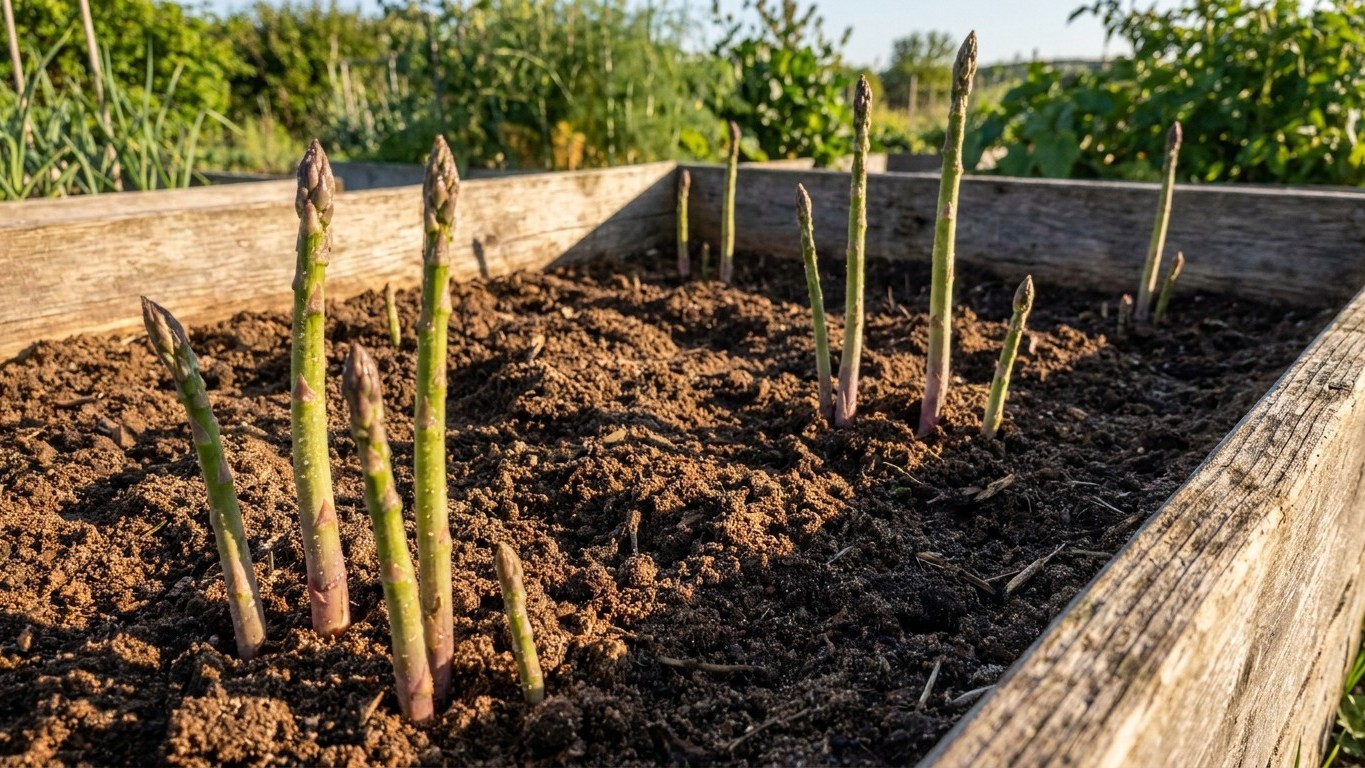

Yes, in most cases: the dominant soil across the Northwest Territories drains well, which is the only requirement Utah State University Extension attaches to a fifteen-year asparagus bed. That’s the good news. The catch is that “dominant” is a territory-wide average, not a verdict on any one backyard, and a bed you can’t dig up for over a decade deserves better than an average.
The short answer
The mapped soil surface of the Northwest Territories is overwhelmingly a Cryosol, the kind of ground where permafrost sits somewhere in the profile and only a shallow layer thaws out each summer. That description covers 99 percent of the mapped surface, with Regosolic soils making up most of the rest. Texture-wise, it runs loam to silt: about 55 percent sand, 39 percent silt, and just 6 percent clay, with organic matter sitting around 2.4 percent. According to Agriculture and Agri-Food Canada’s Canadian Soil Information Service, that surface horizon is classed as well drained.
That’s the part that matters for asparagus. Utah State University Extension’s guidance on growing asparagus in the garden is almost casual about soil type. Most soils will work, the source says, provided they drain. No pH target, no mention of clay percentage, no chilling requirement, none of that is published. The single hard line is drainage, because asparagus crowns sitting in standing water rot before they ever get a chance to send up a spear, and a bed that fails in its second year has wasted two years of waiting for a harvest that hasn’t even started yet.
Given that the territory’s own soil survey already labels the surface as well drained, and the texture leans sandy-loam to silt rather than heavy clay, the odds favor a workable bed on paper. Low clay content (6 percent) is exactly what keeps water moving through rather than pooling.
What this number does not tell you
None of this is a diagnosis of your particular ten-by-thirty-foot patch of ground. The survey behind these figures covers the agricultural regions of the territory, meaning the far north isn’t part of the sample at all. It also averages across 80 mapped soil components, so a river bottom, a patch of muskeg, or any yard where a builder scraped topsoil and brought in fill could sit nowhere near that median. The only way to know your own plot drains is to dig a hole about a foot deep, fill it with water, and time how long it takes to disappear. If it’s still standing after a few hours, don’t fight the ground: build a raised bed, at least 10 to 12 inches deep, and fill it with a loose, well-drained mix. A raised bed sidesteps the drainage question entirely, and for a planting you won’t touch again for over a decade, that’s a reasonable insurance policy.
Will the summer here water it for you?
an Asparagus Bed has a two-stage thirst. For its first two seasons in the ground, it wants 1 to 2 inches of water every other week. After that establishment period, the need eases to 1 to 2 inches every three weeks. Compare that against what a Northwest Territories summer actually delivers, using the 1981-2010 normals recorded at the Yellowknife A station: about 4.3 inches of rain across June, July, and August combined, with June running driest at 1.14 inches, July at 1.61 inches, and August at 1.55 inches.
- Add up the summer’s own supply. Roughly 4.3 inches falls naturally over the three-month stretch that spans most of the growing season, spread thin and heaviest in July.
- Add up what a new bed asks for. At 1 to 2 inches every two weeks, a thirteen-week summer calls for something in the range of 6 to 13 inches over that same window, well above what the sky is providing on its own.
- Spot the gap. Even taking the low end of the bed’s needs, natural rainfall covers only a portion of it during establishment. The shortfall has to come from a hose or a drip line, and June, the driest month on record here, is exactly when a young bed is least forgiving of missed watering.
- Recheck once the bed matures. By year three and beyond, the ask drops to 1 to 2 inches every three weeks, or roughly 4 to 8 inches across the summer. That narrows the gap but doesn’t close it; supplemental watering during dry stretches still keeps established plants from stalling.
- Treat the territory number as a starting estimate. These are long-term averages, not this year’s forecast, and a slope, a windbreak, or simple daily sun exposure changes how fast that rain disappears from a given patch of ground. A rain gauge staked next to the bed settles the question far better than any regional average can.
When to put the crowns in
Asparagus crowns go into the ground in early spring, set into furrows about 8 inches deep. In the Northwest Territories, “early spring” has to be read against the local frost calendar rather than a calendar date. The mean last spring frost recorded at Yellowknife A, based on 1981-2010 normals, falls around May 25. That’s a mean, not a guarantee: in roughly half of all years on record, frost has actually arrived later than that date. Treat May 25 as the middle of a window, not a green light, and lean toward planting after it rather than on it if the ground still feels cold and wet.
Once the crowns are in the furrow, resist the urge to bury them all at once. The furrow gets backfilled gradually across the season, about 2 inches of soil added every other month, rather than filled in flush on planting day. That staged approach lets the emerging shoots keep pushing through loose soil instead of fighting their way up through a solid foot of packed dirt.
Seed is the other route in, and it’s a longer one. Starting asparagus from seed adds an extra year to the timeline before crowns are ready for transplanting, on top of the three-year wait before any harvest at all. Most home gardeners skip that detour and buy crowns instead, simply because the payoff, a first light harvest, arrives a full year sooner.
Which crowns, exactly
Utah State University Extension names four varieties, and the only detail published about them is sex, not flavor, not yield, not any reason to favor one over another.
| Variety | Type |
|---|---|
| Jersey Giant | All-male |
| Jersey Knight | All-male |
| UC 157 F1 | Male and female |
| Purple Passion | Male and female |
All-male varieties tend to put their energy into spear production rather than seed, since they never set the berries that female plants do, but the source stops short of recommending one variety over another on those grounds. Beyond sex, the choice is left open.
Common questions
Can I harvest asparagus the first year after planting crowns?
No. The bed isn’t harvested at all until the third year in the ground, regardless of how vigorous the ferny growth looks in year one or two. That wait is what makes the site decision upfront so important; there’s no shortcut around it.
How long does the harvest window last once it starts?
It builds gradually: about 4 weeks of cutting in the first harvest year, extending to roughly 6 weeks the year after, and up to about 8 weeks once the bed is fully established. Rather than stopping on a fixed date, the signal to quit for the season is the spears themselves: when most of what’s coming up is thinner than a pencil, harvest ends for that year, whatever week it happens to be.
Does Northwest Territories soil need its pH adjusted before planting asparagus?
That figure simply isn’t published, either for the territory’s mapped soil surface or in the Utah State University Extension guidance on asparagus. Rather than guess at a target, a basic soil test kit is the more reliable way to know where a specific plot stands.
What about winter cold, does the bed need any chilling to grow back each year?
The source is silent on any winter chilling requirement, and no such figure should be inferred from the region’s hardiness zone. What’s actually documented is drainage as the deciding soil factor and the watering schedule tied to the bed’s age, nothing more.