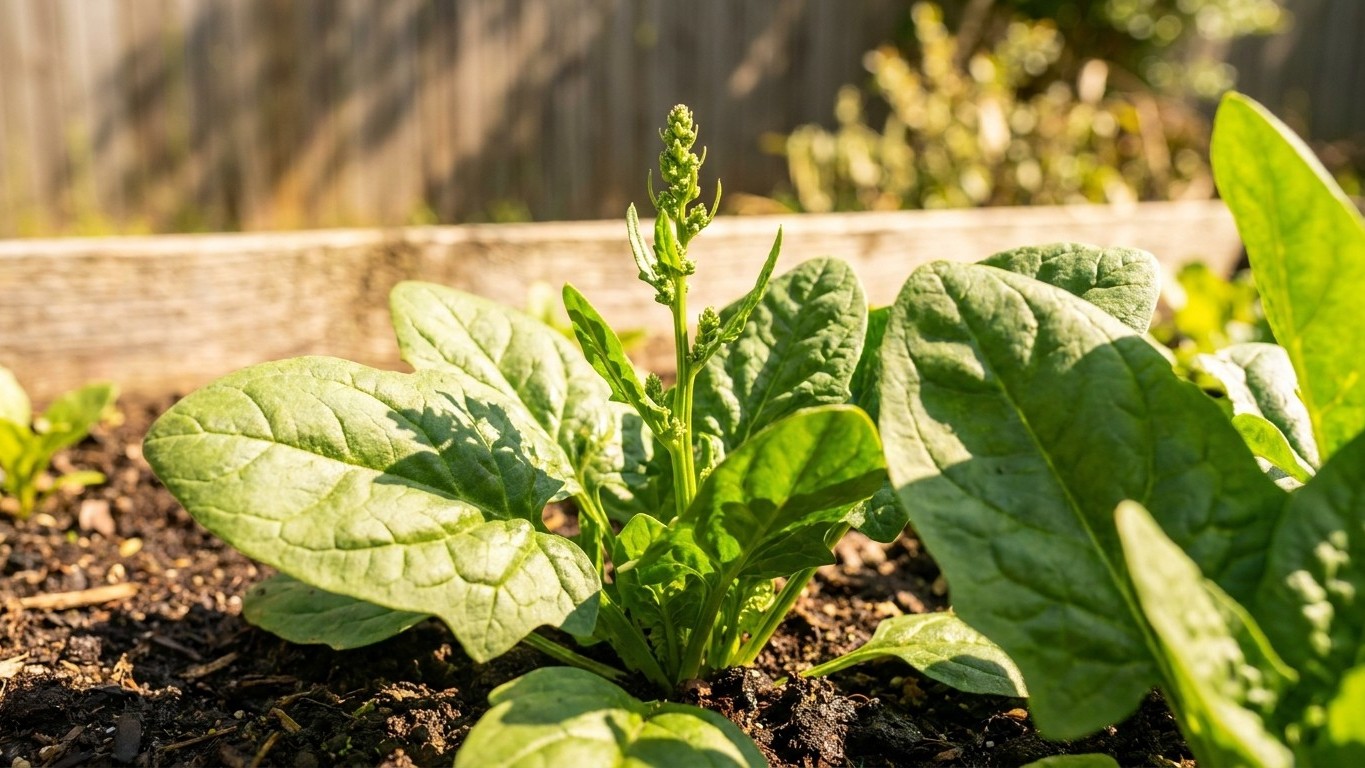

Yes. In Prince Edward Island, spinach bolts early not because summers get hot, but because summer days get long. On the longest day of the year, Charlottetown sees 15 hours and 36 minutes of daylight, and that stretch of light, combined with any warmth at all, is what pushes spinach to flower. The Island’s mild summers don’t buy extra time. The calendar does the damage here, not the thermometer.
The short answer
Spinach flowers in response to two triggers working together: long days and warm temperatures. Prince Edward Island supplies plenty of the first and very little of the second. The reference station at Charlottetown records an average of 0.0 days per year reaching 90 F. That’s not a typo. Heat stress, the kind that pushes spinach past its 75 F growth ceiling in a Midwestern or mid-Atlantic summer, almost never happens here. If heat were the only trigger, PEI gardeners could grow spinach clear through July and August.
But it isn’t the only trigger. Day length climbs on its own schedule, independent of temperature, and by late spring the Island is already logging well over fourteen hours of daylight. That long-day signal reaches spinach whether the air is 60 F or 75 F. A cool, foggy PEI June still counts as a long-day June. The plant reads the clock, not the weather report, and once the days stretch far enough, flowering starts even in temperatures that feel perfectly comfortable to a gardener in a sweater.
So the honest answer, for this territory specifically, is that day length is the limiting factor, and heat is barely a factor at all. That’s a different situation from a spinach grower in Kansas or Georgia, where the 75 F ceiling gets blown past by June and heat does most of the bolting on its own. On the Island, the near-total absence of 90-degree days means a gardener could, in theory, keep spinach in cool, damp soil all summer without cooking it. The plant still won’t cooperate, because the days themselves are long enough to flip it into reproduction mode regardless of the mercury.
This matters for planning because it changes what a gardener should chase. Shade cloth and extra watering fight heat. Neither one fights day length. The only real lever on Prince Edward Island is timing: getting a crop of leaves harvested before the daylight hours climb into bolting range, and then waiting until the days shorten again in late summer before trying a second round. Choosing among them is a matter of local trial, not published figures.
How long the spring window really is
Working out the usable spring window on Prince Edward Island means starting from one fixed point and working forward.
- Start with the average last spring frost. At the Charlottetown A station, that date sits at May 16. This is a mean from the 1981-2010 Canadian Climate Normals, not a safe cutoff. In roughly half of all years, frost arrives later than May 16, so treat it as the midpoint of a window rather than a guarantee.
- Sow two to three weeks ahead of that date. That puts a realistic sowing window somewhere between late April and the first days of May, since spinach seed tolerates cool soil far better than a frost-tender crop would.
- Check what heat does during that stretch. Almost nothing. With an average of 0.0 days a year reaching 90 F, there’s essentially no risk that late-spring warmth will push soil or air past the 75 F growth ceiling before the plants get established. Heat is not the constraint in May or early June here.
- Track what daylight is doing instead. By late April, days are already lengthening quickly toward the June 21 peak of 15 hours 36 minutes. That climb, not temperature, is what eventually flips the plant toward flowering.
- Add it up. A sowing date in late April to early May, followed by roughly six weeks of harvestable growth before the lengthening days catch up with the crop, gives a realistic spring cropping window running from late April into the first half of June.
That’s a shorter window than the mild, cool-summer climate might suggest at first glance. The absence of heat stress feels like it should stretch the season. Instead, the day-length trigger closes it down on its own timetable, regardless of how comfortable the temperatures stay.
The autumn crop, and when the soil lets you sow
A fall spinach crop faces the spring problem in reverse: the days are getting shorter and less dangerous, but two other obstacles bracket the window instead.
Soil still too warm to germinate
Utah State University Extension notes that spinach germination drops off once soil temperature climbs above 80 F. On Prince Edward Island, air temperatures rarely get anywhere near that in late summer, given the 0.0 average days a year above 90 F. But soil, especially the sandy, well-drained loam the Island is known for, can still warm faster than the air above it in direct sun during late July and early August. A gardener sowing a fall crop shouldn’t assume PEI’s mild climate rules out the warm-soil problem entirely. Waiting for soil to cool, or sowing in a partly shaded bed, keeps germination rates from dropping the way they would in a hotter region.
The frost that ends the season
At the same Charlottetown A station, the average first fall frost lands on October 17. Like the spring figure, this is a mean date from the 1981-2010 Canadian Climate Normals, not a hard line. Roughly half of all years see frost arrive later than October 17, and northern or upland parts of the province typically run behind the coastal station’s timing. Working backward from a realistic harvest target near that mid-October date, the source’s guidance of sowing 50 to 75 days before the desired harvest puts fall sowing somewhere between early August and late August. Sow closer to early August for a harvest well ahead of the average frost, or push toward late August if a lighter, later harvest is acceptable and the season runs true to its average timing.
No days-to-maturity figure for spinach is published in the source used here, so this 50-to-75-day window is the only planning tool available, and it should be treated as an estimate rather than a fixed schedule.
Common questions
Does PEI’s cool summer mean spinach can be grown all season long?
No. The near-absence of 90-degree days removes heat as a problem, but the long summer days, up to 15 hours 36 minutes at the solstice, still trigger flowering on their own. Day length is the constraint here, not temperature.
What’s the safest time to sow spring spinach in this region?
Two to three weeks before the average last frost date of May 16 puts sowing in the late April to early May range. Remember that May 16 is a mean, not a guaranteed frost-free date, and frost arrives later than that in about half of all years.
Why would warm soil matter in a climate with almost no 90-degree days?
Soil temperature and air temperature aren’t the same thing. Sandy soil exposed to direct summer sun can climb above the 80 F germination threshold even when the air stays well short of the 90-degree mark that’s essentially absent from PEI’s climate record.
How is the fall sowing window calculated?
By counting back 50 to 75 days from a realistic harvest date, using the average first fall frost of October 17 as the anchor point. That works out to sowing sometime between early and late August, depending on how close to that average frost date the harvest is planned.