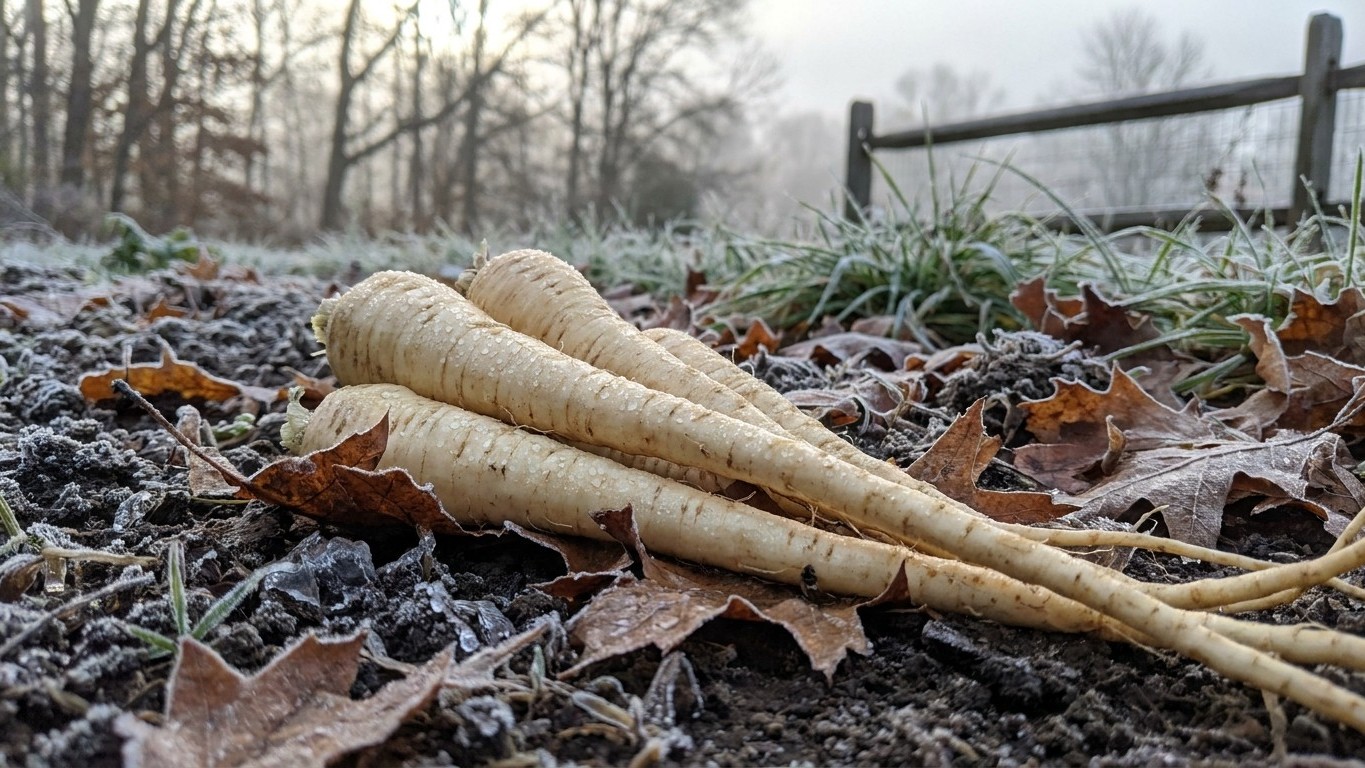

Lift parsnips after several weeks of frost, not after the first one. Newfoundland and Labrador supplies those weeks, so roots left in the ground into late fall turn sweet. Once dug, topped parsnips keep four to six months at 32 to 34 °F with very high humidity, as long as no apples or other ripening fruit share the space. Ethylene from fruit turns them bitter.
The short answer
Does this territory deliver several frosty weeks? Yes. At the St. John’s reference station, the mean daily minimum of the coldest month is -8.7 °C. That is a long way below freezing, and it comes after a fall in which frost arrives on average around October 17. The station has about 140 frost-free days between its mean last spring frost on May 30 and that first fall frost. A parsnip grown here will sweeten, not merely grow, provided it stays in the ground long enough.
Treat both dates as the middle of a window. In one year out of two the first fall frost comes earlier than October 17, and in one year out of two the last spring frost falls later than May 30. Those figures also come from a single station on the Avalon. Northern and upland districts, and Labrador, run weeks behind it. If you garden away from St. John’s, your county or regional agriculture office can tell you how far your ground departs from the station.
The sweetening comes from exposure to frost, and a comfortable hardiness zone does not supply that. Utah State University Extension says parsnips taste best after several weeks of cool, frosty weather, which converts stored starch to sugar. Here the cold is not in doubt. What matters is patience.
When should you lift parsnips in Newfoundland and Labrador?
Wait until the tops have been hit by frost several times and the weather has stayed cold for a few weeks. With an average first frost around October 17, that points to November rather than October. Dig a few roots at a time as you need them. Before the ground freezes hard, pile a thick layer of straw or leaves over the row, so you can still fork out roots on a mild day.
How long do parsnips keep once they are dug?
USDA Agricultural Handbook 66 puts storage at 4 to 6 months at 0 to 1 °C (32 to 34 °F) with 98% relative humidity (USDA Agricultural Handbook 66). That assumes the temperature and humidity hold steady, which almost no house manages. A cold cellar or an unheated porch comes closer than a kitchen. Parsnips are not chilling sensitive, so the cold never harms them. Ethylene does. Parsnips make very little of it themselves, but low levels from nearby apples or other ripening fruit cause bitterness. Keep them apart from fruit. Top them after digging, and never cut into the crown.
Does the season fit?
It fits comfortably. Parsnips are sown in place, and the 100 to 120 days run from seeding. Utah State University Extension suggests sowing two to three weeks before the last spring frost. Here is how that plays out against the St. John’s dates.
- Sow in early to mid May. The mean last spring frost is May 30, so two to three weeks earlier lands between about May 9 and May 16. Cold ground in some springs pushes sowing later, and the next steps show how much room there is.
- Watch the bed for germination, and be patient. Parsnip seed is slow. Bare soil for two or three weeks is normal, so do not dig it up and re-sow. Mark the row so you do not hoe the seedlings out when they finally appear.
- Count 100 to 120 days from seeding. A May 9 sowing reaches 100 days on August 17. A May 16 sowing reaches 120 days on September 13. Even a sowing on May 30 reaches 120 days on September 27.
- Compare with the first fall frost. The mean first frost is October 17, and half of years it comes earlier. Roots from an early or mid May sowing are full size weeks beforehand. Those weeks, plus the frosty ones after, are what make the roots sweet.
The margin shrinks with a cold, late spring or a northern site, where both frost dates run weeks behind St. John’s. A sowing that slips to the first week of June still finishes, but the roots enter fall with little extra time. Sow as soon as the soil can be worked, and keep the seed bed evenly moist, but not soggy, until the seedlings are up. The guide to growing parsnips in Newfoundland and Labrador covers soil prep and thinning in more detail.
What goes wrong here
Most failures trace back to a handful of causes. Each has a fix.
- Forked roots in heavy or stony ground. A root that meets a stone or a layer of clay splits into several legs. Much of the island’s soil is rocky and acidic. Utah State University Extension recommends deep sandy soil, and says heavy soil must be double dug. Remove stones and break up the bed to a full spade’s depth or more before sowing. On ground that stays heavy, grow parsnips in a raised bed filled with loose, stone-free soil.
- Forked roots from overwatering. This is a separate cause. Soil kept constantly wet can make the root branch even in good ground. Keep the bed moist while the seed germinates, then water deeply and less often. In a wet summer, a bed that drains well matters as much as watering habits.
- A season that runs out. A late sowing in a cold spring, or a northern garden with an early fall, leaves thin roots. Sow as early as the ground allows, and watch the bed for germination. Thin seedlings early so the remaining roots get room to fatten. If frost is close and roots are small, leave them in the ground and mulch heavily rather than digging small roots.
- Roots that never turn sweet. At a mean coldest-month minimum of -8.7 °C, a winter too mild is unlikely. The usual cause here is lifting too early, after a single frost, while the starch is still in the root. Wait for several frosty weeks and use the raw-slice test. The frost-sweetening guide for Newfoundland and Labrador goes deeper on timing.
- Bitter roots in storage. The cause is usually ethylene from apples or other ripening fruit in the same cellar or fridge drawer, and cold storage does not prevent it. Keep parsnips in a separate space from fruit. Do not trim into the crown when topping, since a cut there can shorten keeping time.
- Damage from pests. Tunnels and rot at the root can ruin a row before you dig it. See what eats parsnips in Newfoundland and Labrador, and when for the timing.
Common questions
Can parsnips stay in the ground all winter in Newfoundland and Labrador?
They can stay until the ground freezes solid, and a deep mulch of straw or leaves keeps the soil workable longer. Roots left through winter can be dug in spring as soon as the soil thaws. Dig them early in spring, before new top growth starts.
How many frosty weeks do parsnips need?
Utah State University Extension says several weeks of cool, frosty weather. Skip a precise count and use the taste test on a scrubbed root, since sweetness varies with how cold the weeks were and how long the roots sat in them.
Should I wash parsnips before storing them?
Brush off the loose soil, but do not scrub them soaking wet. Top the leaves, leave the crown intact, and store the roots cold and humid. Handbook 66 puts the ideal at 98% relative humidity. In a home cellar, a box of slightly damp sand is a common way to approach that.
Why did my parsnips come up so late?
Parsnip seed germinates slowly, and cold soil slows it further. Seedlings that have not shown after three weeks may still be on their way, so check the row closely for a thread of green before you re-sow. Fresh seed also germinates better than old seed, so buy a new packet each year.