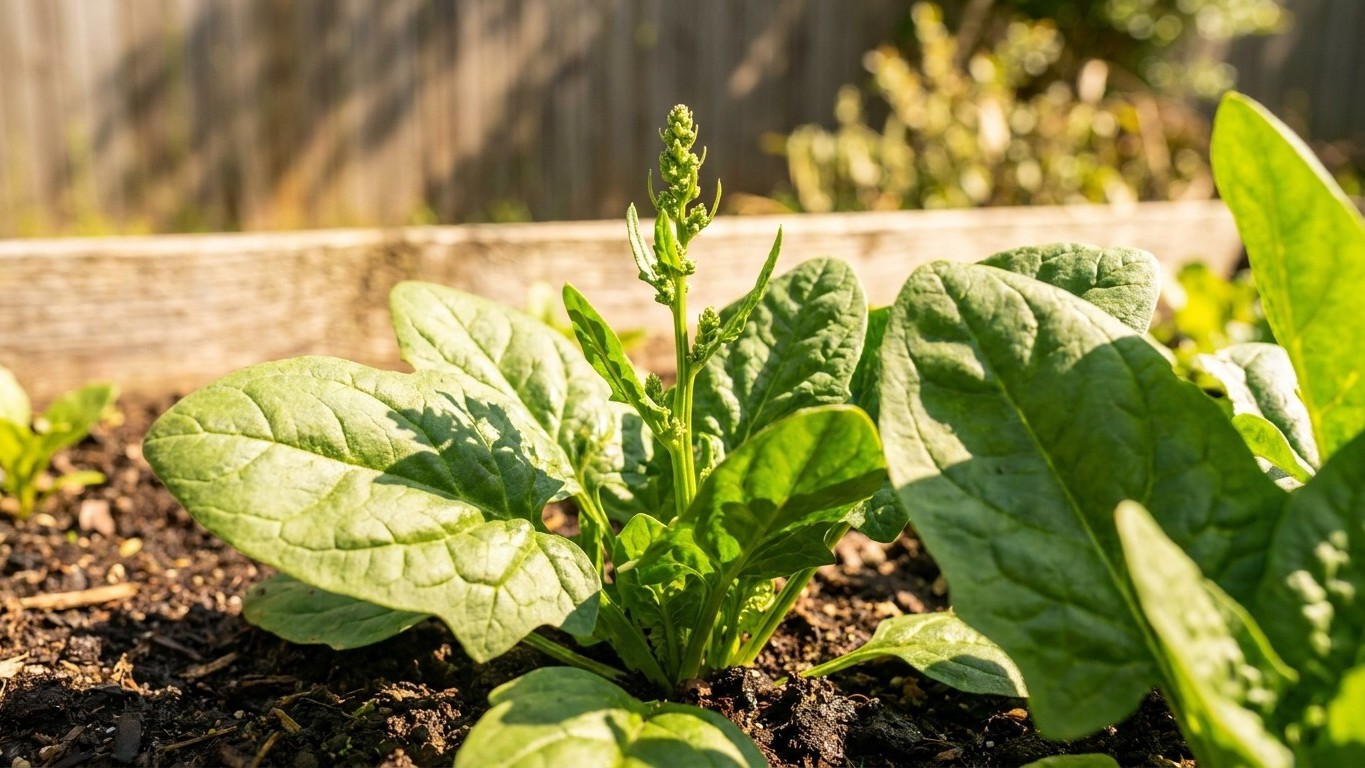

Spinach bolts early almost everywhere in Rhode Island, and the reason has less to do with a cool coastal summer than with the clock. Long days push spinach toward flowering no matter how mild the temperature stays, and Providence’s 15 hours and 2 minutes of daylight on the longest day is more than enough to trigger it. The spring crop is a race against the calendar, not the thermometer.
The short answer
Start with the number that actually decides this: 15 hours and 2 minutes of daylight on the summer solstice at the reference station near Providence. That is the trigger. Spinach flowers in response to long days combined with warmth, and once day length climbs into that range, the plant shifts its energy from leaves to seed stalk whether the air feels like a mild June or a scorcher. A cool summer here does not buy extra weeks of harvest, because the day length keeps climbing on the same schedule every year regardless of what the weather is doing.
So which is it, day length or heat? Both, but they don’t arrive on the same timetable. Day length is the first domino. It rises steadily from the spring equinox onward and reaches its long-day peak in late June, and spinach responds to that lengthening photoperiod well before the peak itself. Heat is the second domino, and in Rhode Island it’s a milder one than in much of the country. The reference station averages only 9.4 days a year at 90 F or hotter, which tells you summer heat load here is modest by national standards. Spinach’s own ceiling sits at 75 F for good growth, a threshold that plenty of Rhode Island days cross by late spring even without hitting the 90s.
That 75 F number does double duty. It’s the point where growth quality drops off, and it’s also roughly where the leaves start turning bitter. So even a plant that hasn’t visibly bolted yet can be sliding into unpleasant eating quality as the days warm past that mark. Put the two mechanisms together and the picture is clear: day length sets the outer boundary on how late spring spinach can run, and rising temperatures close in on flavor and texture from the other direction at close to the same time. Neither one is forgiving, and they tend to arrive within a few weeks of each other in a state where spring warms up fast once April turns to May.
None of this means spinach can’t be grown well in Rhode Island. It means the crop has to be treated as two short, separate windows, a spring one and a fall one, rather than one long summer planting the way tomatoes or peppers get grown. Gardeners who try to stretch a March sowing into July are fighting day length itself, and day length always wins.
How long the spring window really is
Work backward from the two fixed points the region actually has, the last spring frost and the arrival of long, warm days, and the spring window turns out to be short but workable if timed carefully.
- Frost date at the reference station: the last spring freeze at the Providence-area station falls between April 7 and April 17. Gardens outside the immediate urban area, especially inland or at any elevation, typically see frost linger one to two weeks later, so check local conditions before committing to a date.
- Sowing date: spinach seed goes into the ground 2 to 3 weeks before the last frost, since the seed germinates in cool soil and the young plants tolerate a freeze. That puts a realistic sowing window somewhere between mid-March and the first days of April for most Rhode Island gardens, a bit later for spots that run cold.
- Good growth period: from sowing through roughly mid-to-late May, plants are building leaf mass while day length is still climbing but hasn’t yet reached its long-day extreme, and temperatures are mostly still under the 75 F ceiling.
- The closing point: as day length keeps lengthening into late May and June, spinach shifts toward bolting regardless of whether a given week happens to stay cool. With only 9.4 days a year above 90 F at the reference station, heat rarely delivers the final blow in spring here; day length usually gets there first.
- Net usable window: roughly eight to ten weeks from a mid-to-late March sowing to a harvest that needs to wrap up by late May or very early June, before the lengthening days finish the job.
That’s a tighter window than most vegetables get, and it rewards succession sowing. Small plantings every week or two through the sowing period spread the harvest instead of dumping the whole crop into a single, brief window before the plants bolt.
The autumn crop, and when the soil lets you sow
Fall Spinach in Rhode Island runs into the opposite problem from spring: instead of racing lengthening days, the gardener is waiting out warm soil, then racing a shortening season before frost shuts it down for good.
Soil still too warm to germinate
Spinach seed germinates poorly once soil temperature climbs above 80 F, and that’s exactly the condition through much of a Rhode Island midsummer. The reference station’s average of 9.4 days a year at 90 F or above shows summer heat here isn’t extreme, but soil at the surface still holds warmth well into August even after air temperatures ease off, especially in beds with dark mulch or full sun exposure. Sowing directly into that warm soil produces poor, uneven germination or none at all. The practical fix is to wait for soil to cool, which in most Rhode Island gardens doesn’t happen reliably until late August, sometimes not until early September on sites that hold heat.
The frost that ends the season
The first fall frost at the reference station arrives between October 24 and November 3, though rural and inland gardens often see it a week or two earlier. Utah State University Extension’s guidance for a fall crop is to sow 50 to 75 days before the date you want to harvest, and no separate maturity figure is published for spinach beyond that window. Counting back from a harvest target near the first frost date puts the sowing window somewhere between early August and mid-September, depending on which end of the harvest range is used.
Lay those two obstacles side by side and the real fall sowing window in Rhode Island narrows to roughly late August through mid-September: late enough that soil has cooled below the 80 F germination threshold, early enough that 50 to 75 days of growth still lands before frost closes things out. It’s a narrower target than it first appears, and missing it in either direction, sowing too early into hot soil or too late to reach maturity, costs the whole crop rather than just a few weeks of it.
Four spinach varieties come up often in growing guides for regions like this one: Bloomsdale, Melody, Teton, and Olympia. No performance data, days-to-maturity figures, or bolt-resistance ratings for any of them appear in the sourced guidance here, so treat variety choice as a separate decision from the timing questions above rather than a shortcut around them.
Common questions
Can I grow spinach through a Rhode Island summer if I keep it shaded?
Shade can reduce the leaf-surface temperature spinach experiences, which helps against the 75 F growth ceiling, but it does nothing about day length. Since long days are what trigger bolting, a shaded plant sitting under 15-plus hours of daylight in June still receives the photoperiod signal to flower.
Does the reference station’s frost date apply to my whole county?
No. The dates given, April 7 to April 17 for last spring frost and October 24 to November 3 for first fall frost, come from the airport weather station used for these climate normals. Suburban and rural gardens, and anywhere with elevation, commonly see frost arrive later in spring and earlier in fall, sometimes by one to two weeks. Check local conditions before locking in a sowing date.
Is heat or day length the bigger problem for fall-sown spinach?
For the fall crop, warm soil above 80 F blocking germination is the first obstacle, not day length, since days are shortening rather than lengthening after the summer solstice. The second obstacle is simply running out of season before the first fall frost arrives.
Why does bitterness show up before the plant visibly bolts?
The 75 F mark referenced by Utah State University Extension functions as both a growth ceiling and a bitterness threshold. Leaves can lose eating quality as temperatures push past that point even before a visible flower stalk appears, so harvesting promptly as warm weather approaches protects flavor as much as it protects the harvest itself.