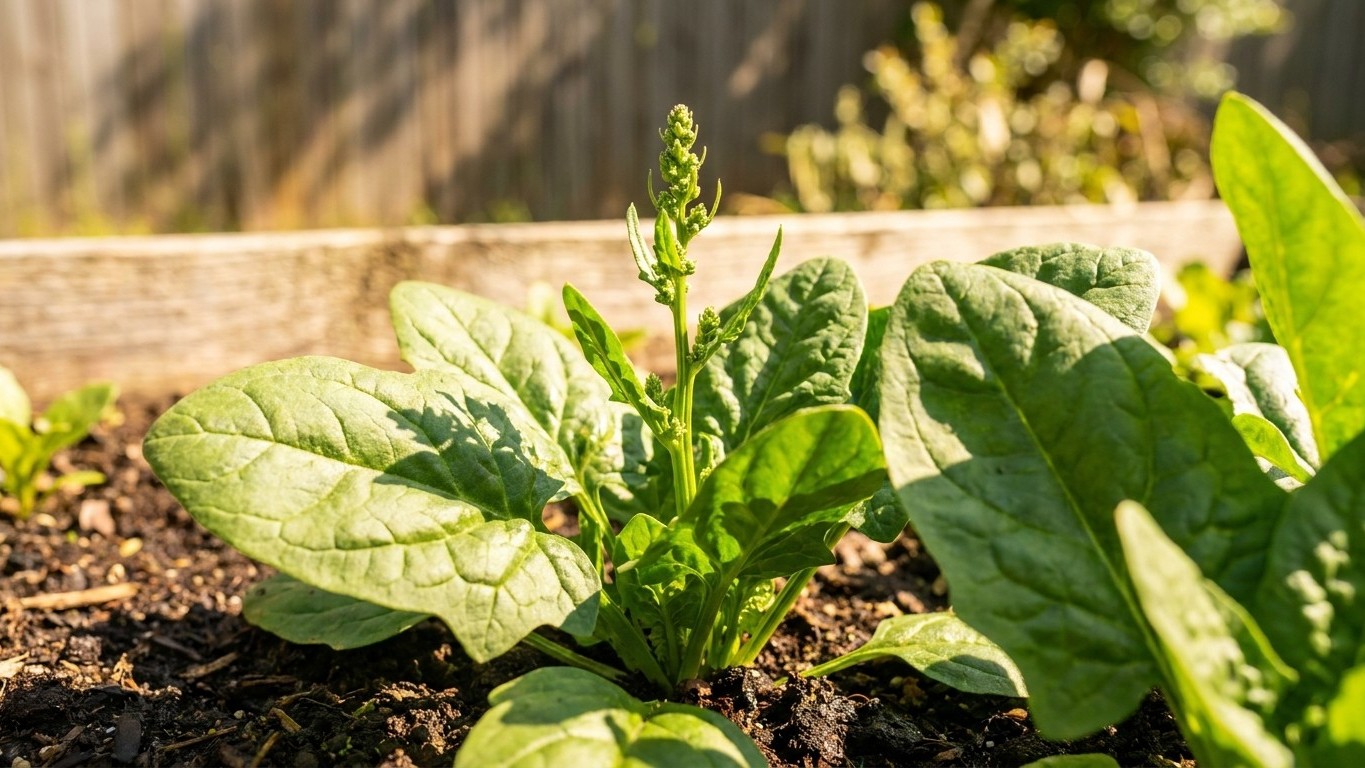

Yes. Middle Tennessee’s summer days stretch to 14 hours and 28 minutes at their longest, long enough on their own to push spinach into flower. Add a summer that averages 40 days above 90°F, and both the day-length trigger and the heat trigger are working against the plant at once. A mild June doesn’t change the day-length math, so there’s no shortcut around an early bolt.
The short answer
On the longest day of the year, the sun stays up for 14 hours and 28 minutes at the reference station used for this page. That number matters because spinach doesn’t wait for a heat wave to start flowering. Long daylight alone flips the switch. The plant reads the lengthening days of spring the same way a calendar reads a deadline, and once the hours of light cross a certain point, spinach shifts its energy from leaf production into a seed stalk, whether the thermometer cooperates or not.
This is the piece that trips up a lot of Tennessee gardeners who assume a cool, cloudy spring means more time. It doesn’t. A stretch of 60-degree days in April will not stop the plant from bolting once daylight hours climb high enough, because the trigger is light exposure, not temperature alone. Tennessee’s early summer sun delivers that long-day signal well before the region’s true heat arrives, which means the crop is already leaning toward flowering before the mercury even becomes the bigger problem.
And the mercury does become a problem. Spinach grows best where temperatures stay under 75°F, and Middle Tennessee averages 40 days a year at 90°F or hotter. That’s a lot of heat load stacking up right behind the day-length trigger. Once air and soil temperatures climb past that 75°F mark, growth quality drops and the leaves that do form turn bitter, so even a plant that hasn’t fully bolted yet stops being worth harvesting.
So the honest answer to whether spinach bolts early here is that it’s not one single culprit. Day length gets there first, heat arrives right on its heels, and together they close the door on spring spinach faster than gardeners moving from a cooler climate tend to expect. Both mechanisms are working against the crop, and neither one waits for the other.
How long the spring window really is
Working backward from the region’s frost data and the plant’s own limits lays out just how tight the spring run actually is.
- Last spring frost at the reference station runs from March 31 to April 12, with East Tennessee and the Cumberland Plateau typically running a bit later and cooler than that.
- Spinach seed is sown 2 to 3 weeks before that last frost date, which puts a realistic sowing window in the middle two to three weeks of March for most of Middle Tennessee.
- From there, growth stays productive only while conditions remain under that 75°F ceiling, and the same long days that are ticking upward toward the June solstice are simultaneously nudging the plant toward flowering.
- Put those two pressures together and the practical harvest window runs roughly six weeks from a mid-March sowing, closing out sometime before the daylight and heat combination fully takes over.
- Gardeners in the cooler pockets of East Tennessee or up on the Cumberland Plateau can expect that window to open and close a little later than in the Nashville basin, simply because their last frost date runs later too.
Six weeks isn’t nothing, but it’s a narrower stretch than what gardeners moving south from a longer-shouldered climate often plan around. The practical move is to treat the spring crop as a fast, early harvest rather than a season-long supply, and to get seed in the ground as close to that three-weeks-before-frost mark as soil conditions allow. Waiting even a week or two past that point eats directly into a window that was already short.
The autumn crop, and when the soil lets you sow
Fall spinach in Tennessee isn’t limited by cold the way most people assume. It’s limited by heat, twice over, once in the soil and once at the far end of the season when frost finally shows up.
Soil still too warm to germinate
Spinach seed germination drops off once soil temperatures climb above 80°F, and Tennessee’s late-summer ground holds onto that heat well past the point when the air starts to feel like fall. Sowing too early, while the soil is still baking from a summer that averaged 40 days above 90°F, means poor or spotty germination even if the calendar looks right. The practical fix is patience: wait until soil temperature has actually dropped below that 80°F line rather than sowing by date alone. In much of Middle Tennessee that means holding off until deeper into late summer than gardeners expect, since surface soil temperature lags behind cooling air by several weeks.
Counting back from the first frost
The first fall frost at the reference station arrives somewhere between October 28 and November 8, with the cooler East Tennessee valleys and the Cumberland Plateau typically seeing it a bit earlier. Fall spinach is sown 50 to 75 days before the date you want to harvest, which means counting backward from that frost window lands the sowing date somewhere in the second half of August through the middle of September. That’s a fairly wide range, and it needs to be checked against the soil-temperature rule above: a sowing date that falls too early in that range may still be fighting soil that hasn’t cooled below 80°F yet, which pulls the practical window toward the later end, closer to early or mid-September for many Tennessee gardens.
Four spinach varieties commonly come up in seed catalogs and extension guidance: Bloomsdale, Melody, Teton, and Olympia. There’s no published days-to-maturity or bolt-resistance data for any of them from the source behind these figures, so treat variety choice as a separate decision from the timing math above rather than a way to stretch the calendar.
Common questions
Does a shady spot delay bolting? Shade can lower leaf temperature somewhat, but it doesn’t shorten the actual hours of daylight the plant is exposed to, and day length is the trigger that matters first. Shade helps more with the heat side of the equation than the light side.
Is fall spinach easier than spring spinach in Tennessee? The daylight hours are shrinking rather than growing through a fall crop, which removes the day-length pressure that dogs the spring planting. The tradeoff is the warm-soil germination problem at the start of the season, so fall growing solves one obstacle by trading it for another.
Can succession sowing extend the spring harvest? Succession sowing spreads out the harvest of a given planting, but it can’t outrun the day-length trigger. Every sowing made during that same narrowing spring window is heading toward the same wall as daylight hours climb toward the solstice.
What actually ends the spring crop, the heat or the light? Both, and they arrive close together in Tennessee. The lengthening days start pushing the plant toward flowering first, and the region’s heat, with 40 days a year averaging 90°F or better, finishes the job by pushing air and soil past that 75°F growth ceiling soon after.