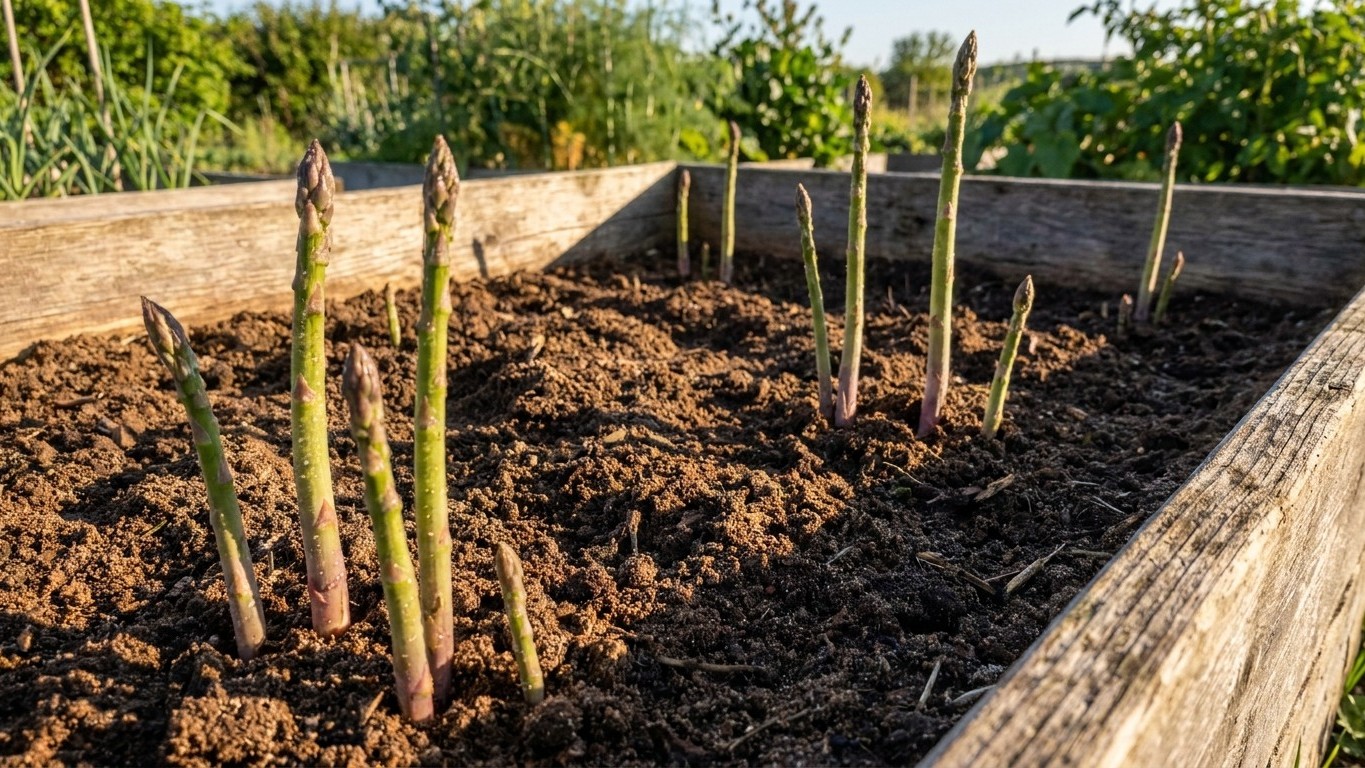

Yes, but with a condition attached. Fifteen years is the outer edge of an asparagus bed’s life, and the only soil rule that matters is drainage, not fertility or pH. Washington’s representative soil, the Tokul series, is a light, porous volcanic-ash soil that’s rated moderately well drained rather than fully well drained. That’s a workable starting point for most gardens in the state, but it’s not a guarantee for any one backyard, and the fix if your own plot runs wetter is straightforward: raise the bed.
The short answer
Fifteen years is a long time to commit a single patch of ground to one crop. Utah State University Extension, the only authority behind these figures, is blunt about what that patch needs: most soils will work, as long as they drain. No mention of pH, no mention of a particular texture, no fertility threshold. Just water has to move through, not sit.
That’s where the state’s representative soil gets interesting. The Tokul series, the soil USDA lists as characteristic of Washington, is an Andisol, meaning it formed from volcanic ash. Andisols are famous among soil scientists for being unusually light and porous, and unusually good at holding onto both water and phosphorus at the same time. The surface texture runs 45 percent sand, 45 percent silt and only 10 percent clay, which is a loam-to-silt mix that generally lets water pass rather than pooling. USDA’s own drainage class for this soil, though, is “moderately well drained,” a step below the “well drained” rating that would make this an easy yes with no further questions.
Moderately well drained soil can still work for a fifteen-year asparagus bed. It just means water moves through more slowly than ideal, and in a wet spring the crown zone could stay saturated a little longer than the crop prefers. Asparagus roots that sit in standing water rot; asparagus roots in soil that drains within a day or two are fine for over a decade.
Here’s the caution that matters more than any of these numbers: the Tokul series describes a mapped average, not your yard. A state spans hundreds of soil series. River bottoms drain fast and can flood. Hill country sheds water almost too well. Any lot a builder has graded, filled or compacted will behave nothing like the undisturbed surface horizon USDA sampled. The organic matter figure recorded for this series, about 75 percent, is itself a flag: that level only shows up in a natural peat, muck or forest-litter layer, never in a worked garden bed, which tells you the mapped surface isn’t describing cultivated ground at all.
So the practical move, before you dig a single furrow, is a simple test of your own soil after a hard rain. Dig a hole a foot deep, fill it with water, and watch how long it takes to disappear. If it’s gone within a few hours to a day, plant in the ground. If it lingers, build the bed up eight to twelve inches with amended soil instead of fighting the native drainage for fifteen years. Either way, the payoff doesn’t start immediately: asparagus gives you nothing to eat in year one or two, and the first cutting doesn’t come until year three. That’s the real commitment behind this crop, not the soil test, the wait.
Will the summer here water it for you?
An asparagus bed has a specific thirst curve. Utah State University Extension calls for 1 to 2 inches of water every other week for the crop’s first two years, tapering to every three weeks once it’s established. Compare that to what a Washington summer actually delivers, using the 1991-2020 normals for the reference station in this region, and the gap becomes obvious fast.
- June: the normal is 1.45 inches for the month, spread across roughly four weeks. Asparagus wants 1-2 inches every two weeks, so June alone is already short of the target during a young bed’s first summer.
- July: the driest month of the growing season, at just 0.6 inches. That’s a fraction of what a two-week watering cycle calls for, and it’s the month a new bed will suffer most without supplemental water.
- August: 0.97 inches, still well under what a fourteen-day cycle needs, though slightly better than July.
- Season total: about 3.0 inches across June, July and August combined, against a full year total of 39.3 inches. Almost all of Washington’s rain, falls outside the exact months an asparagus bed is thirstiest.
- The gardener’s job: plan to add water by hand or irrigation through the entire summer stretch, treating the 3-inch summer normal as a baseline you’ll be topping up nearly every week, not a supply you can count on.
None of this is a forecast. It’s a normal, an average built from three decades of data at one reference station, and a rain shadow, a slope, or a nearby city can shift the real number on your own lot in either direction. A rain gauge staked in your own garden, checked weekly through summer, is what actually tells you whether you’re behind on the every-other-week schedule or ahead of it. Given how dry July runs across the board, most Washington gardeners should plan on that gauge reading low far more often than high.
When to put the crowns in
Crowns go into the ground in early spring, planted into furrows about 8 inches deep. In western Washington, where the reference station for these normals sits, the last spring frost typically falls somewhere around February 27 to March 18. That’s a wide band, and it’s worth treating it that way: a mean frost date is an average built from decades of years that varied a lot, not a promise about any single spring.
That window also comes with a catch specific to this part of the state. A mild last-frost date doesn’t necessarily mean an early planting date. Western Washington’s soil in early spring tends to run cold and wet, and low light through late winter slows everything down regardless of what the thermometer says. Waiting until the ground has actually warmed and dried enough to work, even if that’s a few weeks after the frost window closes, generally serves the bed better than rushing crowns into cold mud the day the frost risk technically clears.
One more regional note worth flagging plainly: this frost window describes western Washington’s mild, maritime climate. East of the Cascades, the state turns into high desert with a much shorter, harsher growing season, and that Seattle-area window simply doesn’t apply there. Anyone gardening on the dry side of the mountains needs their own local frost data, not this one.
Crowns aren’t the only route in. Utah State University Extension also lists seed as an alternative starting point, though it’s the slower path. Starting from seed adds time before the plant reaches transplant size, compared to setting an already one-year-old crown directly into its furrow. For a bed that’s supposed to produce for a decade or more, most home gardeners lean on crowns simply because it shaves a full growing season off the wait before that first real harvest in year three.
Whichever way you start it, the furrow itself isn’t filled in all at once. Utah State University Extension describes backfilling gradually across the season, adding about two inches of soil back into the trench every other month rather than burying the crown under a full 8 inches on planting day. That slow fill lets the emerging shoots keep reaching light as the trench closes in stages.
Common questions
Does Washington’s state soil mean asparagus will do well anywhere in the state?
No. The Tokul series is the soil USDA lists as representative of Washington on a mapped, statewide basis, not a measurement of any particular garden. It’s a useful signal of what the region’s ground tends to do, generally porous, moderately well drained, but river bottoms, hill country and disturbed or filled lots can all behave completely differently. A soil test on your own plot settles the real answer.
What if my soil doesn’t drain well?
Build the bed up. A raised bed, eight to twelve inches above grade and filled with soil that drains freely, sidesteps a native soil’s slow-draining tendencies entirely. Given that even the state’s representative soil rates only “moderately well drained,” raising the bed is a reasonable default for anyone unsure of their own ground.
How much water does a new asparagus bed actually need each week?
The published guidance calls for 1 to 2 inches every other week for the first two years, then every three weeks once established. Against a Washington summer normal of about 3.0 inches total for June through July and August, most of that water needs to come from a hose or irrigation line, not the sky.
Are some asparagus varieties better suited to Washington’s soil or climate?
Utah State University Extension names four varieties by sex only, all-male types Jersey Giant and Jersey Knight, and male/female types UC 157 F1 and Purple Passion. No flavor, yield or regional suitability is published for any of them, so there’s no sourced basis for recommending one over another for Washington conditions specifically.