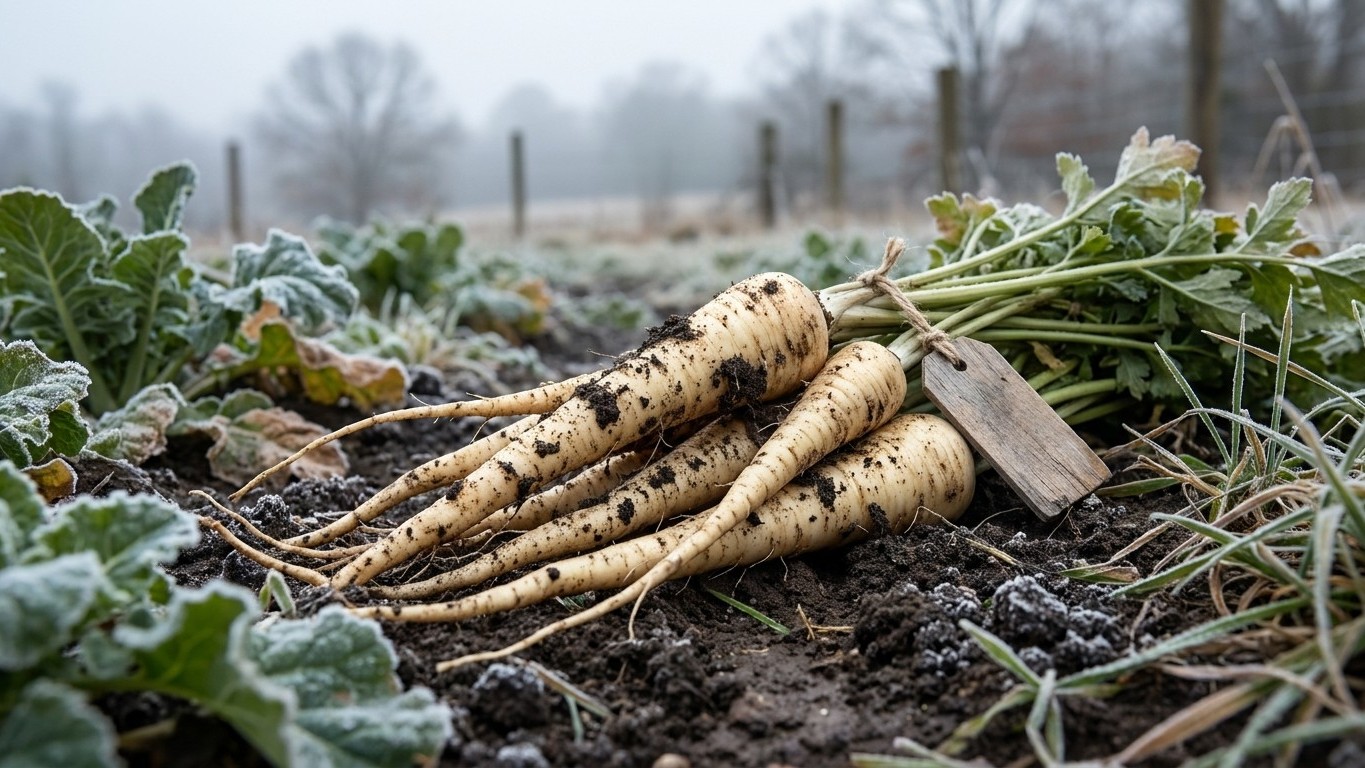

Western Washington‘s maritime winters rarely deliver hard, sustained frost. The coldest month averages a minimum of 37.1°F, well above freezing, so parsnips here will grow long, straight roots but the sugar conversion that frost triggers happens only in scattered cold snaps, not the sustained frosty weeks the crop wants. Expect a fine parsnip. Don’t expect a candy-sweet one every year.
The short answer
The question that settles this isn’t whether Washington gets cold. It’s whether the cold sticks around long enough, and cold enough, to convert starch into sugar inside the root. That conversion is a frost-driven chemical process, not a calendar event, and it needs repeated exposure to freezing temperatures over several weeks. Western Washington’s climate data, drawn from the Seattle reference station, puts the mean daily minimum of the coldest month at 37.1°F. That’s not a record low or a average temperature for the month. It’s the average low on an average day in the coldest stretch of winter, and it sits five degrees above freezing.
That single number changes the whole conversation. A territory where the coldest month averages below 32°F delivers frost most nights for weeks on end, which is exactly the exposure a parsnip needs to sweeten reliably. Western Washington doesn’t clear that bar. Some nights will dip into the 20s during a cold snap, especially inland from Puget Sound, but the average night in the coldest month stays above freezing. That means frost here is intermittent rather than sustained.
The practical result: parsnips grown in western Washington will size up nicely and store well, because the moderate winters here are never harsh enough to damage roots left in the ground. But the deep, reliable sweetness that gardeners in colder inland climates get from six or eight weeks of hard frost is not something this climate delivers every year. Some seasons bring enough cold snaps to nudge the sugar content up. Other seasons stay mild enough that the roots taste good but not remarkably sweet.
Eastern Washington is a different story entirely. Once you cross the Cascades into the high desert side of the state, winters turn continental, with harder and more sustained freezes. The Seattle-based figures in this article describe only the mild, marine side of the state. Anyone gardening east of the mountains should not use these numbers as a stand-in for their own conditions.
So the honest answer for a gardener west of the Cascades: yes, the crop will grow well, and yes, it can still sweeten to some degree if you leave roots in the ground through a cold snap, but this climate does not guarantee the deep sweetening that comes from a long, hard winter. Growing the parsnip is easy here. Getting the maximum sweetness out of it is a matter of luck with the weather, not a sure thing baked into the local climate.
Does the season fit?
Parsnips need 100 to 120 days from seeding to maturity, and they’re sown directly in the ground where they’ll grow, not started indoors and transplanted. Here’s how that timeline lines up against western Washington’s frost calendar.
- The last spring frost in this region falls somewhere between February 27 and March 18, based on 1991-2020 climate normals for the Seattle reference station. Seed can go in the ground two to three weeks before that date, but cold, wet soil and low late-winter light typically hold gardeners back from actually sowing that early, whatever the calendar says.
- Germination itself takes 14 to 21 days, a slow start that’s easy to mistake for a failed sowing. Gardeners who dig up the row after a week or two, assuming nothing took, are pulling up seed that simply hasn’t sprouted yet.
- Counting forward from a realistic sowing date in early to mid-April, once soil has warmed and dried enough to work, the 100 to 120 day maturity window lands the crop’s earliest readiness somewhere in mid to late July.
- The first fall frost arrives between November 13 and November 30. That leaves a wide gap between when the roots reach eating size in midsummer and when the first real frost shows up in the fall.
- That gap is a gift, not a problem. Parsnips are hardy enough to sit in the ground well past maturity, and gardeners here can simply leave the roots in place through summer and into fall, harvesting only after a cold snap has had a chance to work on them.
- Doing the arithmetic end to end: a season that runs from late February to late November, six to nine months depending on the year, comfortably absorbs a 100 to 120 day crop sown in April with weeks to spare before the first frost even arrives.
The season fits here with room to spare. The tighter question isn’t whether there’s enough time, it’s whether the frost that eventually arrives is cold and sustained enough to do its job, which circles back to the mild winter numbers above.
What goes wrong here
- Forked, split roots from heavy or stony ground. Parsnips send down a single long taproot, and anything that deflects it, compacted clay, rocks, or a hardpan layer, causes the root to fork or twist. Deep, sandy soil is the crop’s preference, and Utah State University Extension recommends double digging heavy ground before sowing so the root has a clear, loose path straight down.
- Forked roots from overwatering. This is a separate cause from soil texture, and the two get confused often. Too much moisture, especially inconsistent watering that swings between soggy and dry, can also cause roots to split or fork even in decent soil. The fix is steady, moderate watering rather than heavy soaking followed by dry spells.
- A winter too mild to sweeten. Given a coldest-month average minimum of 37.1°F, some years simply won’t deliver the sustained frost exposure that converts starch to sugar. There’s no soil fix for this one. The remedy is patience and timing: leave roots in the ground as late into winter as practical, harvesting after any hard cold snap rather than on a fixed date, so the roots catch whatever frost the season does offer.
- Slow, uneven germination mistaken for failure. Because seed can take 14 to 21 days to emerge, gardeners sometimes re-sow a row that was actually just slow, ending up with two staggered plantings competing for space. Marking the sowing date and waiting the full three weeks before judging a row a failure avoids this.
Common questions
Do parsnips need a hard freeze to taste good?
They need repeated exposure to frost, not necessarily a single hard freeze. The starch-to-sugar conversion builds up over several cold weeks, which is why a climate with one or two frosty nights won’t sweeten a crop the way weeks of sustained cold will.
Can I sow parsnips earlier than April in western Washington to get a head start?
The last frost date allows sowing as early as late February in theory, but cold, saturated soil this time of year slows or prevents germination regardless of frost risk. Waiting until soil has warmed and dried in early to mid-April is more reliable than chasing the earliest frost-based date on paper.
Should I harvest parsnips before the first fall frost to avoid damage?
No. Unlike tender crops, parsnips benefit from staying in the ground through frost, since that’s exactly what sweetens them. Harvesting early, before any cold snap, means missing out on whatever sweetening the season is willing to offer.
Does the mild Seattle climate data apply to all of Washington?
No. These figures come from a reference station representing western, maritime Washington. Eastern Washington, across the Cascades, has a high-desert continental climate with a shorter season and different frost behavior entirely, and none of the numbers here should be applied to that side of the state.