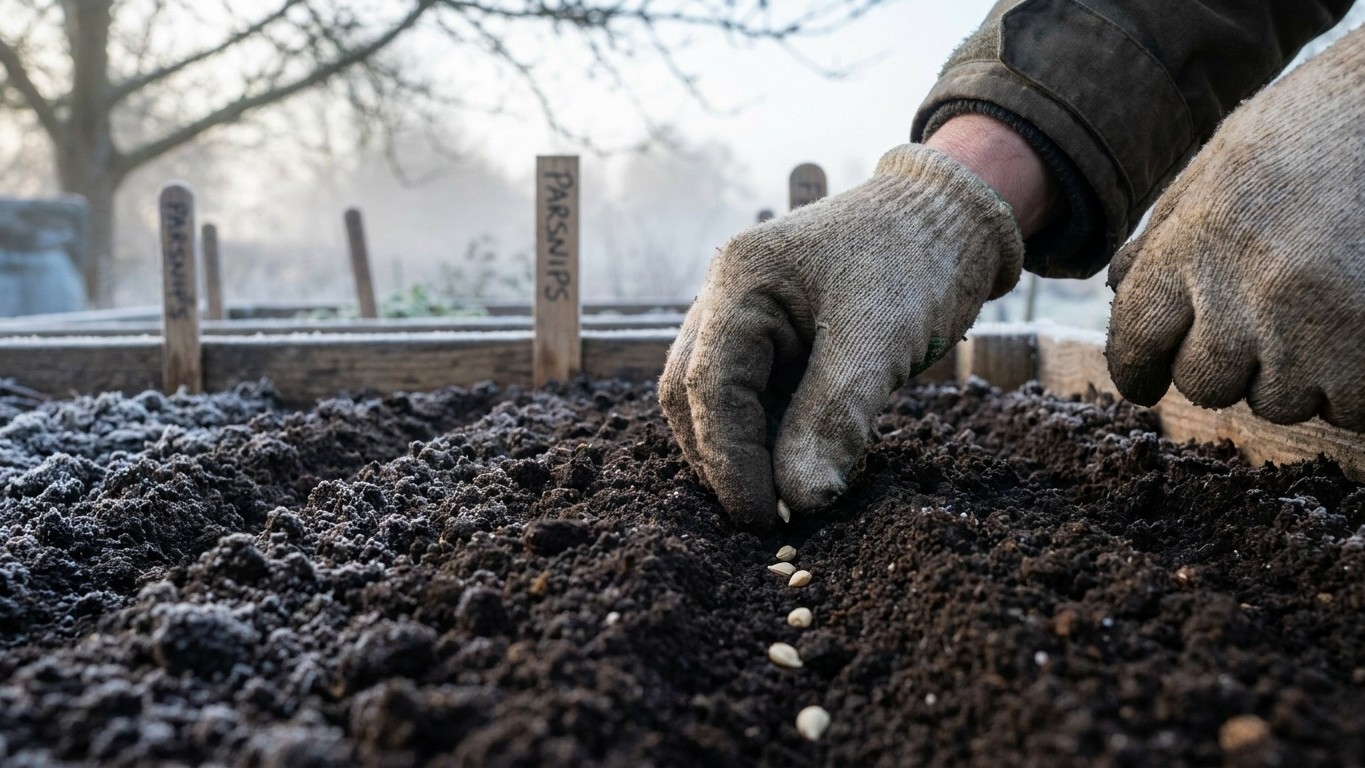

Western Washington gets its answer from soil and light more than from the calendar. The mild, maritime last-frost window here runs from late February into mid-March, but cold, wet ground keeps most gardeners waiting until soil is workable, typically mid-March through April, before parsnip seed goes in the ground.
The short answer
Start with the number that actually matters for a root crop grown for sweetness: the mean minimum temperature of the coldest month at the Seattle reference station is 37.1°F. That is not a hardiness zone rating and it is not the record low anyone remembers from a hard winter. It is the average of the lowest daily temperatures across the coldest stretch of the year, and in western Washington that average sits just above freezing.
What 37.1°F tells you
A mean minimum that close to 32°F means the coldest month brings frost on plenty of nights, but rarely a deep, sustained freeze. That distinction matters because parsnip sweetness comes from frost exposure converting stored starch into sugar, not from surviving a winter in general. A territory can sit in a comfortable hardiness zone and still fail to sweeten a parsnip if the cold never actually arrives at the root. Western Washington does not have that problem in reverse: the frost shows up, repeatedly, through the coldest weeks. It just does not show up as a hard, prolonged freeze the way it would east of the Cascades.
Grow versus sweeten
So does a parsnip here sweeten or merely grow? Both, but the sweetening is moderate rather than dramatic. The region delivers enough frosty nights across the coldest month for the starch-to-sugar conversion to happen, and a root left in the ground through several of those nights will taste noticeably better than one pulled early. It will not have the intense sweetness that a colder, harder winter produces further inland, but it will be a real improvement over a summer-harvested root. The practical takeaway: plan to leave parsnips in the ground into the cold months rather than harvesting on a fixed date, because the flavor payoff depends on that exposure, not on the calendar alone.
Does the season fit?
Parsnips need 100 to 120 days from seeding, sown directly in place two to three weeks before the last frost, according to Utah State University Extension. Here is how that math plays out against western Washington’s frost window.
- The last spring frost in this territory falls somewhere between February 27 and March 18. A strict two-to-three-week-before rule would point to early or mid-February for sowing.
- In practice, cold, wet soil and low late-winter light in the maritime Northwest hold germination back regardless of what the frost date suggests. Parsnip seed simply will not germinate reliably in cold, saturated ground, so most gardeners wait until the soil has warmed and dried enough to work, commonly mid-March into April.
- Once sown, parsnip seed takes 14 to 21 days just to germinate. That is a slow start compared to many garden vegetables, and it needs to be counted separately from the 100-to-120-day maturity clock, since the clock starts at seeding, not at emergence.
- Counting forward 100 to 120 days from a mid-March sowing lands the earliest harvest window somewhere around late June through early August, depending on exactly when the soil allowed planting.
- The first fall frost here arrives between November 13 and November 30. That leaves a wide gap, roughly three to four months, between the earliest possible harvest maturity and the first frost of autumn.
- Stretching the count the other direction, from the earliest possible last-frost date in late February to the first fall frost in late November spans close to nine months, far more than double the 100 to 120 days parsnips require.
The season fits comfortably, with room to spare. That surplus matters for parsnips specifically, because it means gardeners are not racing a shrinking window. There is enough slack to wait for workable soil in spring, and enough time in the ground before winter for roots to sit through the frosty weeks that build flavor.
What goes wrong here
- Forked or split roots in heavy ground. Western Washington’s clay-heavy soils in many yards resist the deep, loose profile parsnips need to grow a single straight taproot. Utah State University Extension recommends deep, sandy soil, and where the native ground is heavy, double digging the bed to at least a foot or more before sowing lets the root push down without hitting resistance and branching.
- Forked roots from overwatering. This is a separate cause from heavy soil, and the two get blamed on each other too often. Consistently soggy ground, common in a wet regional spring, encourages the root to split as it seeks the path of least resistance. The remedy is even, moderate moisture rather than heavy watering, especially once the seedlings are established.
- A late start eating into the season. Waiting on cold, wet soil is the right call, but waiting too long into spring can push the maturity date closer to the first fall frost than a gardener wants, especially in a cooler-than-average year. Sowing as soon as the bed is workable, rather than by a fixed date on the calendar, keeps the buffer intact.
- A mild winter that grows a fine root but never truly sweetens it. With a coldest-month mean minimum of only 37.1°F, some winters bring fewer hard frosty nights than others. The fix is to resist harvesting on schedule and instead pull roots after the ground has been through several distinct frosty spells, checking a root or two along the way rather than committing the whole bed on one date.
Common questions
Can parsnip seed be started indoors and transplanted in western Washington? No. Parsnips are sown directly in place because the taproot does not tolerate transplanting well; disturbing it tends to cause forking or stunted growth. The 100-to-120-day count runs from direct seeding in the garden bed.
How long does parsnip seed take to sprout here? Germination takes 14 to 21 days according to Utah State University Extension. In cool, damp spring soil that stretch can run toward the longer end, so patience before assuming a failed sowing matters.
Should parsnips be left in the ground over winter in western Washington? Leaving roots in place through several frosty weeks is exactly how the starch-to-sugar conversion happens. Given the region’s mild but genuinely frosty coldest month, roots left through November and into the following cold weeks will taste better than those pulled at first maturity.
Does eastern Washington follow the same sowing window? Eastern Washington sits beyond the Cascades in a high-desert climate with a much shorter, harder-edged season, and the frost dates and soil behavior described here for the Seattle reference station do not apply there.
If you follow the almanac, here is when to plant parsnips by the moon. It is a tradition, not a proven method.