
West Virginia gardeners get two narrow windows for spinach: a spring sowing roughly three weeks before the last frost (April 9 to April 23 in the Charleston area), and an autumn sowing in mid-to-late August, timed 50 to 75 days ahead of a harvest that beats the first fall frost (October 18 to November 1). Higher elevations push both windows earlier.
The short answer
On the longest day of the year, the Charleston area gets 14 hours and 41 minutes of daylight. That number matters more than most gardeners realize, because spinach doesn’t respond to heat alone. Long days push the plant toward flowering, a process called bolting, independent of how hot or cool the air happens to be. Once daylight stretches past a certain point, a spinach plant starts diverting energy into a seed stalk instead of leaves, and no amount of shade cloth or mulch reverses that internal clock.
This is the opposite of what happens with onions on the other side of the garden. Long-day onions wait for those same 14-plus-hour days to trigger bulb formation, which is why northern states with more summer daylight grow the long-day types successfully. Spinach runs the mechanism backward: the long days that build an onion bulb are the same long days that ruin a spinach leaf crop by forcing it to bolt.
So a cool West Virginia summer buys nothing. Even in a year with mild temperatures, once daylight climbs into that mid-14-hour range in late spring, spinach left in the ground will bolt on schedule. That rules out summer sowing entirely, regardless of shade or irrigation.
Heat compounds the problem rather than replacing it. Spinach grows best where temperatures stay under 75 degrees Fahrenheit, and that ceiling does double duty: above it, growth slows and leaves turn bitter, sometimes both happening in the same week. Charleston averages 16 days a year at 90 degrees or hotter, which isn’t extreme by regional standards, but it’s more than enough to push soil and air well past that 75-degree comfort zone for weeks at a stretch through summer.
The limit here is both day length and heat, working together rather than one canceling the other. Day length ends the spring crop no matter what the thermometer says. Heat then keeps the door shut through most of summer, both by stressing the plant directly and by keeping soil too warm for seed to germinate well. That combination is why West Virginia spinach lives in two short shoulder seasons instead of one long summer run.
How long the spring window really is
- Start with the last-frost data for the reference station near Charleston: freezing temperatures have a 30 to 70 percent chance of occurring somewhere between April 9 and April 23. That’s the anchor point for every spring sowing decision in the lower valleys.
- Work backward 2 to 3 weeks from that range. Three weeks before April 9 lands on March 19. Two weeks before April 23 lands on April 9. That gives a sowing window of roughly March 19 through April 9, about three weeks wide.
- Remember that this window shifts earlier at elevation. Mountain gardens that freeze later into spring and often stay cooler longer should nudge sowing dates later than the valley figures above, since a river-valley station like Charleston runs warmer than higher ground across the state.
- Once seedlings are up, count the usable growing weeks before the 75-degree ceiling and lengthening days start working against the crop. Spring in West Virginia warms quickly after the last frost, so the stretch of good spinach weather is short, typically just a handful of weeks before rising daylight and climbing temperatures push plants toward bolting and bitterness.
- Treat the spring crop as a fast, early harvest rather than a season-long supply. Sow as soon as the frost risk allows, and plan to pull most of the crop before daylight and heat combine against it.
The autumn crop, and when the soil lets you sow
Fall spinach avoids the bolting problem almost entirely, since daylight is shrinking rather than growing through late summer and fall. The obstacles here are different: soil that’s still too warm to germinate seed well, and a frost line that eventually ends the season outright.
Waiting for Soil to Cool Below 80 F
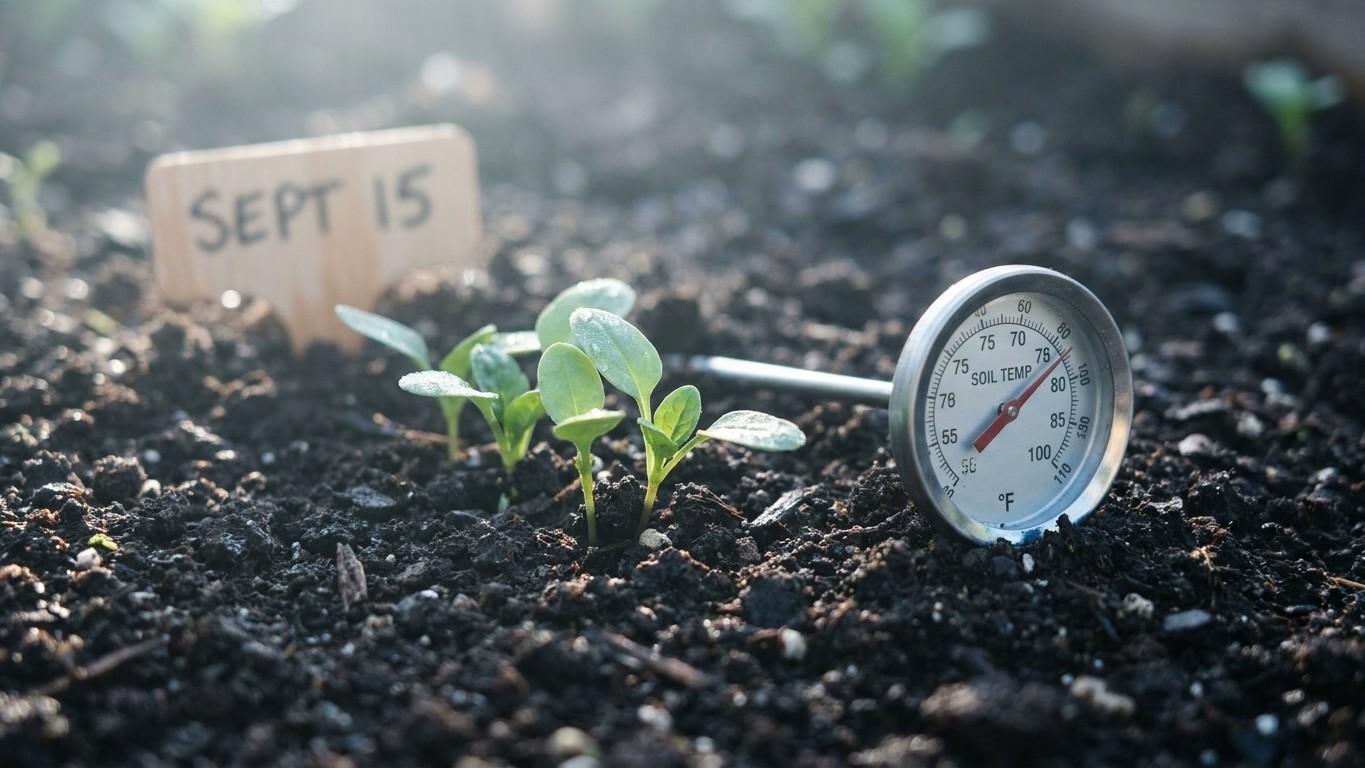
Spinach seed germinates poorly once soil temperature climbs above 80 degrees Fahrenheit, according to Utah State University Extension. West Virginia soil in early and mid-August is routinely warmer than that after a summer averaging 16 days at 90 degrees or better. Sowing too early into hot ground usually means spotty germination or none at all, no matter how good the seed is. The practical fix is patience: wait until soil has started cooling with shorter days and milder nights before putting seed in the ground, rather than sowing by calendar date alone.
Counting Back From First Frost
The first fall frost across the reference area falls between October 18 and November 1. Utah State University Extension’s guidance for fall spinach is to sow 50 to 75 days before the date you want to harvest, not before the frost date itself. Counting back 75 days from October 18 lands on August 4. Counting back 50 days from November 1 lands on September 12. That puts the workable sowing range for an autumn crop somewhere between early August and mid-September, with the earlier end of that range often blocked by soil still running too warm for good germination.
In practice, that leaves mid-to-late August as the sweet spot for most West Virginia gardens in the valleys: late enough for soil to have cooled from peak summer heat, early enough to leave 50-plus days of growth before frost shuts things down. Higher-elevation gardens, which freeze earlier in fall, should sow toward the earlier end of that window rather than the later one.
Four spinach varieties commonly come up in extension guidance for cool-season plantings: Bloomsdale, Melody, Teton, and Olympia. Utah State University Extension names these but publishes no days-to-maturity figures or descriptive data for any of them, so no comparison or recommendation among them can be made from that source. Check seed packet information directly for maturity timing specific to the variety you’re planting.
Common questions
Can I sow spinach in West Virginia during summer?
No. Long daylight hours through summer trigger bolting regardless of temperature, and soil above 80 degrees also blocks good germination. Both spring and fall sowings need to happen outside the long-day, high-heat stretch of the calendar.
Does mountain elevation change these dates?
Yes. The frost dates cited here come from a river-valley station near Charleston. Higher elevations across the state freeze noticeably earlier in fall and often later in spring, so mountain gardeners should sow spring crops a bit later and fall crops a bit earlier than the valley windows.
Why does spinach bolt even in a mild summer?
Bolting is triggered by day length as well as heat. Once daylight stretches into the range that pushes spinach toward flowering, a cool summer doesn’t cancel that signal. Temperature adds stress on top of it, but daylight alone is enough to start the process.
Is 75 degrees a hard cutoff date for harvesting?
No, it’s a temperature threshold, not a calendar date. It marks where growth slows and where leaves start turning bitter. Depending on the year, the garden may cross that threshold earlier or later than in past seasons, so watch conditions rather than counting on a fixed date.