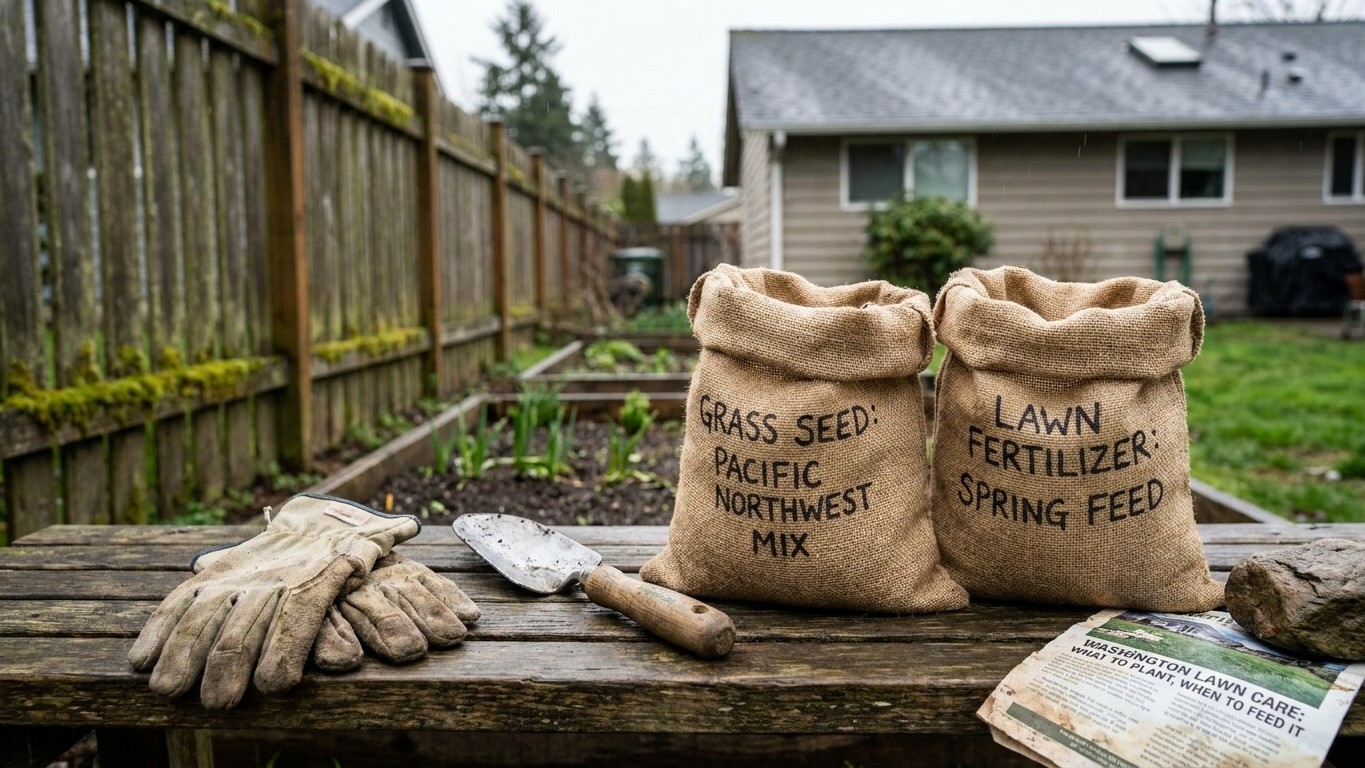

Three days a year. That’s how often Seattle-area lawns see 90°F, which is why the warm-season grasses that thrive elsewhere never really take hold here. But the winters don’t get cold enough either, so the usual rule other regions follow, pick the grass built for your heat or your freeze, doesn’t apply. Washington sits in that in-between zone where cool-season and warm-season grasses both survive, neither one wins outright, and the choice comes down to trade-offs, not a verdict.
Which grass belongs in Washington

The two numbers that matter come from NOAA’s National Centers for Environmental Information, measured at the Seattle reference station over the 1991-2020 period. Just 3.0 days a year reach 90°F or hotter, too few to keep a warm-season grass thriving through summer. At the other end, the coldest month averages a minimum of 35.6°F, mild enough that it rarely delivers the hard, repeated freeze that would kill a warm-season lawn outright over winter.
That combination is exactly what puts Washington’s lowland lawns, at least around Seattle, into the transition zone described by Clemson Cooperative Extension’s HGIC 1214 guide to selecting a lawn grass, a starting point covered in more depth in this Washington lawn Best grass breakdown. Clemson lists cool-season species Tall Fescue, Kentucky Bluegrass and Perennial Ryegrass, and warm-season species Zoysiagrass and Bermudagrass, as options grown in this zone. Nobody nearby is growing a single obviously correct lawn. The choice is a trade-off, not a verdict.
The trade-off, not a winner
Plant a cool-season lawn, tall fescue, Kentucky bluegrass or perennial ryegrass, and it stays green through winter but can thin during the handful of 90°F days Seattle does get. Plant a warm-season lawn, zoysiagrass or Bermudagrass, and July heat is a non-issue since there’s so little of it here, but the lawn goes brown for the stretch from fall through spring rather than staying green in winter. Neither choice is a mistake. It’s a decision about which season you’d rather look at bare or thin turf.
Contrast that against a solidly cool-season territory. Alberta Lawn Care: What to Plant and When to Feed It covers a province where winter cold rules out any warm-season option entirely, so the choice Washington homeowners face doesn’t exist there at all. Washington’s mild coldest-month minimum is what keeps the warm-season door open here, for better or worse.
When to seed or sod here
Clemson Cooperative Extension’s HGIC 1203 planting guide gives the seeding and sodding windows, timing laid out in full in this Washington lawn Calendar, gives the standard windows for each grass type: warm-season grasses go in around May, once soil has warmed, and cool-season grasses go in mid to late September, while soil is still warm but air temperatures are dropping. Which window applies depends entirely on which grass you settled on above.
Anchor the date to your own frost window
For a cool-season lawn, tall fescue, Kentucky bluegrass or perennial ryegrass, seed in the mid-to-late-September window Clemson recommends. Around Seattle, NOAA’s 1991-2020 climate normals put the first fall freeze, the date carrying a 30 to 70 percent chance of a 32°F reading, at November 13 to November 30. Seeding in mid-to-late September gives roughly six to ten weeks of mild, wet fall weather before that freeze risk climbs, enough time for germination and enough root growth to carry the grass through winter. Seed later and you’re racing a shortening window. Seed earlier and summer heat and dry soil can still stall germination.
For a warm-season lawn, zoysiagrass or Bermudagrass, sod or plugs go in around May per HGIC 1203, once soil has warmed enough for active growth. Seattle’s own numbers work against speed here: with NOAA recording only 3.0 days a year at or above 90°F, warm-season turf that would fill in within a season in the Deep South can take noticeably longer to knit together in a Puget Sound yard, because the heat that drives its fastest growth simply doesn’t show up as often.
That November frost window is specific to western Washington and the Seattle reference station. East of the Cascades the climate turns to high desert with a shorter, harsher season, so a reader gardening in Spokane or the Yakima Valley should treat this range as irrelevant to their own planting and check with Washington State University’s extension service for numbers closer to home.
The feeding calendar that fits this climate
Nitrogen feeds growth, and growth follows the grass’s own season, not the calendar on the wall. A cool-season lawn does its major root and shoot growth in fall and again in spring, so the heaviest feeding goes down in September, while a warm-season lawn grows hardest from late spring into summer and is fed on that schedule instead.
Cool-season: tall fescue, Kentucky bluegrass, perennial ryegrass
Clemson Cooperative Extension’s HGIC 1219 Tall Fescue Maintenance Calendar sets fall as the main feeding season, with nitrogen split across two or three applications from September into November rather than applied all at once. A typical program lands around 3 to 4 pounds of actual nitrogen per 1,000 square feet across the whole year, weighted toward those fall dates and tapering off by early winter as growth slows. Kentucky bluegrass and perennial ryegrass follow the same fall-weighted pattern. The full month-by-month breakdown is on Clemson’s Tall Fescue Maintenance Calendar, the one to follow if this is the grass in your yard.
Warm-season: Zoysiagrass, Bermudagrass
For the warm-season half of Washington’s transition-zone lawns, Clemson’s HGIC 1216 Bermudagrass Maintenance Calendar and HGIC 1217 Zoysiagrass Maintenance Calendar both put nitrogen down from late spring through summer, while the grass is actively growing, and taper it off well before the fall dormancy that browns these lawns here. Bermudagrass generally runs toward the higher end of the nitrogen range across a full growing season, zoysiagrass toward the lower end, since it grows more slowly. Both calendars are built around a longer, hotter growing season than Seattle actually gets, so treat the number of feedings as a maximum, not a target, and watch the grass rather than the date. Full schedules are on the Bermudagrass Maintenance Calendar and the Zoysiagrass Maintenance Calendar.
Mowing height and watering here
Mowing height and watering both follow the species, not the zip code, but a couple of local conditions push the numbers around.
Mowing height by species
| Grass | Season type | Typical mowing height |
|---|---|---|
| Tall Fescue | Cool-season | 3 to 4 in |
| Kentucky Bluegrass | Cool-season | 2.5 to 3.5 in |
| Perennial Ryegrass | Cool-season | 2 to 3 in |
| Zoysiagrass | Warm-season | 1 to 2 in |
| Bermudagrass | Warm-season | 1 to 1.5 in |
Whatever height you settle on, follow the one-third rule: never cut off more than a third of the blade in a single pass. Mow a cool-season lawn kept at 3 inches when it reaches about 4 inches, not when it hits 5 or 6, or you’ll scalp it and expose the crown to whatever heat or cold comes next.
Watering
An inch of water a week, from rain or the sprinkler, is the standard figure most extension programs work from, and it’s a reasonable default here too. What moves that number locally is Seattle’s dry, mild summer: little rain falls in July and August, so almost that full inch has to come from irrigation during those months, split into two or three sessions a week rather than one long soak, to keep it from running off compacted lawns or draining straight through the sandy, glacial-till soils common around Puget Sound.
What goes wrong on lawns in Washington

The problems that show up on a Washington lawn follow directly from the same two numbers that set the zone: not much heat, and rarely a hard freeze.
Weeds that never stop
With a coldest-month minimum of only 35.6°F at the Seattle reference station, most winters never deliver the kind of hard, sustained freeze that knocks back weed growth the way a harder winter does elsewhere. These keep creeping through a Puget Sound lawn most of the winter, getting a head start on spring competition that a cool-season lawn in a colder state doesn’t have to fight:
- Dandelion, seeding continuously in mild stretches between fall and spring
- Moss, spreading fastest into thin, shaded, wet turf during the wet season
- Buttercup, rooting into damp low spots that rarely freeze solid
Moss in particular takes over thin, shaded, wet turf faster here than in most of the country, because its growing season barely pauses.
Brown that isn’t dead
A warm-season lawn, zoysiagrass or Bermudagrass, goes brown here from fall through spring, and it is dormant, not dead. The same species stays green far longer in a true warm-season climate: Texas Lawn Care: What to Plant and When to Feed It covers a state where summer heat is reliable enough that Bermudagrass holds its color for most of the year instead of the shortened window it gets around Seattle. Pulling out a browned warm-season lawn in November here, assuming it’s failed, is one of the more common and avoidable mistakes.
A cool-season lawn can also brown, not from frost but from the handful of hot, dry days NOAA records at 90°F or above. Even three days a year is enough heat stress to thin an under-watered fescue lawn temporarily. It typically recovers with the next rain or irrigation cycle rather than needing to be reseeded.
Local help
A soil test settles more arguments about a struggling lawn than any calendar can, since pH and nutrient levels vary block to block even within one city. Washington State University Extension, the state’s land-grant service, runs county offices that handle soil testing and can speak to conditions specific to your county. Start at the WSU Extension website and look up the office for your county before making a major change to feeding or grass type.
Common questions
Can I plant a cool-season and warm-season grass together in one lawn?
Not successfully as a blend. The two types green up and go dormant on opposite schedules, so a mixed lawn ends up patchy, half-green and half-brown depending on the month, rather than uniform. Choose one type for the main lawn and treat any winter ryegrass overseed as a temporary color fix, not a permanent second species.
Should I overseed my Bermudagrass or zoysiagrass with ryegrass for winter color?
You can, and some warm-season lawns in milder climates are overseeded this way to stay green through the brown months. It adds a fall seeding and a spring transition to your maintenance load, and around Seattle’s mild, wet winters that ryegrass can hang on and compete with the warm-season grass longer than expected come spring, so weigh the extra work against how much you actually mind the brown.
I missed the September seeding window. Is it too late this year?
Seeding a cool-season lawn much past that window risks the new grass not rooting deeply enough before the first fall freeze, which NOAA’s normals for the Seattle station place at November 13 to November 30. A light overseed can still be worth doing for thin spots, but a full renovation is safer held until the next fall window rather than pushed into winter or attempted in spring, when cold wet soil and low light slow germination anyway.
Does this whole page apply if I live in Spokane instead of Seattle?
No. Every figure here, the freeze date, the days above 90°F, the coldest-month minimum, comes from the Seattle reference station and describes western Washington’s mild, maritime climate. Eastern Washington beyond the Cascades is high desert with a shorter growing season and a colder winter, so check with Washington State University Extension’s office for your county before applying any date.
How do I tell if my brown grass is dormant instead of dead?
Tug on a patch of the brown grass. Dormant turf holds together and resists pulling because the crown and roots are alive below the brown blades, while dead turf lifts away in loose clumps with little resistance. If you’re still unsure, wait for the grass’s normal green-up window for its type before digging anything up.